
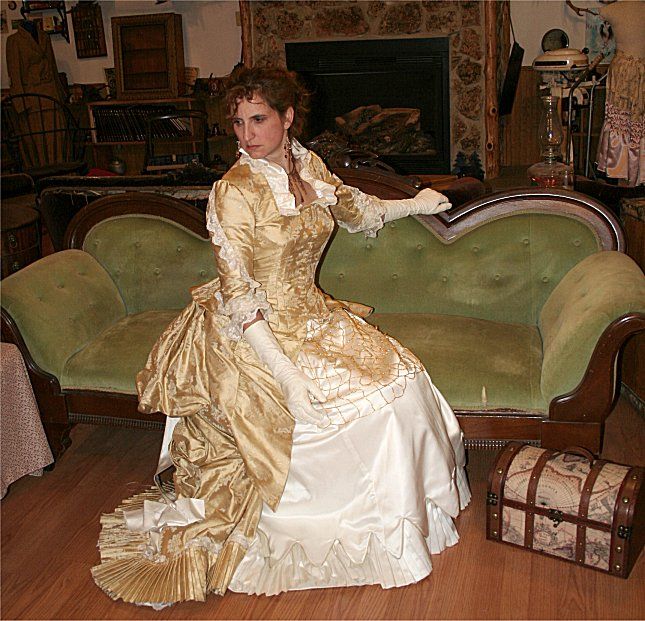
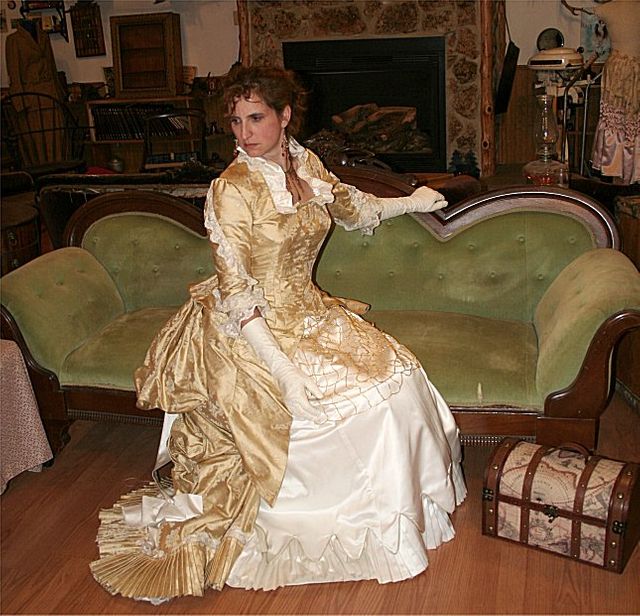
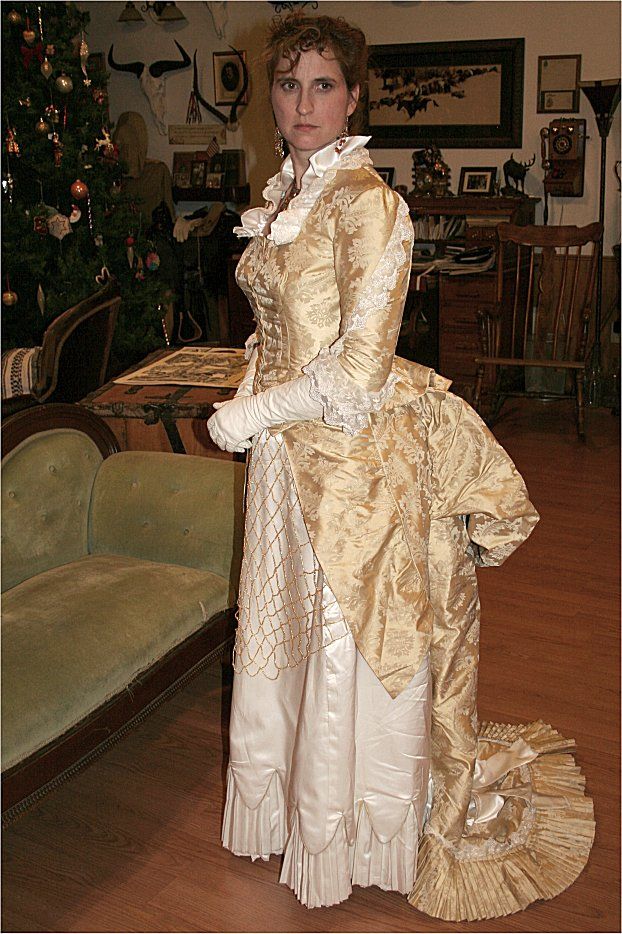
The finished gown- all silk- gold silk jacquard and soft white silk/cotton satin, hand beaded overskirt, embroidered net lace
1882 ballgown for the Cowboy Christmas Ball at the National Cowboy and Western Heritage Center in OKC. Historically correct from the lining up. The design was one of my own and borrowed ideas from exant dress on antiquedress.com as well as period fashion magazines from my collection.
I had purchased the silk brocade/jacqard some time ago on a sale table, and when I knew I had to create a gown from what was already in my stash, this called out to me.The gold is a light- taffeta weight silk. While the soft white satin is a heavier/drapier piece.
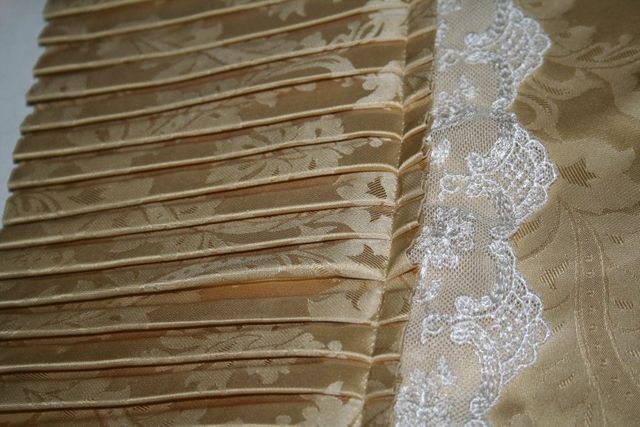
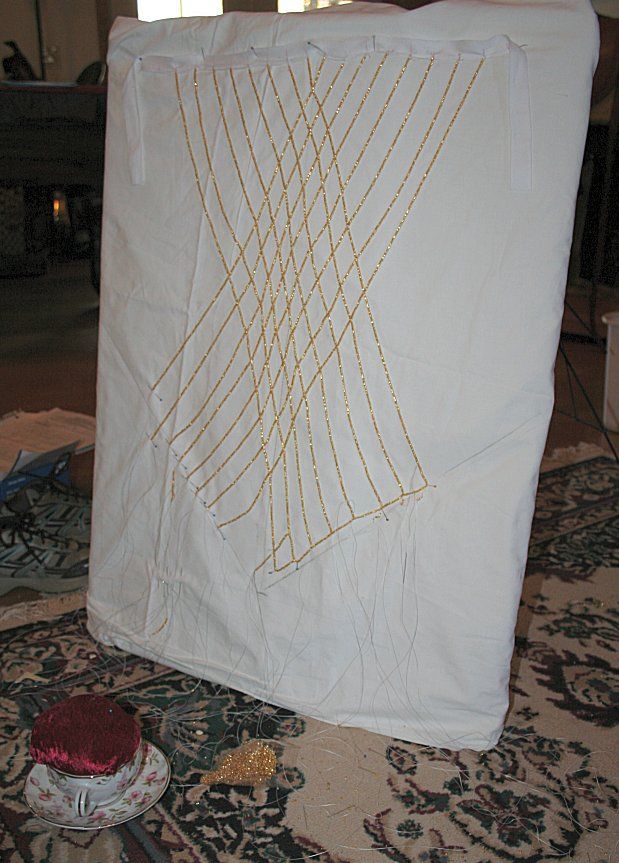
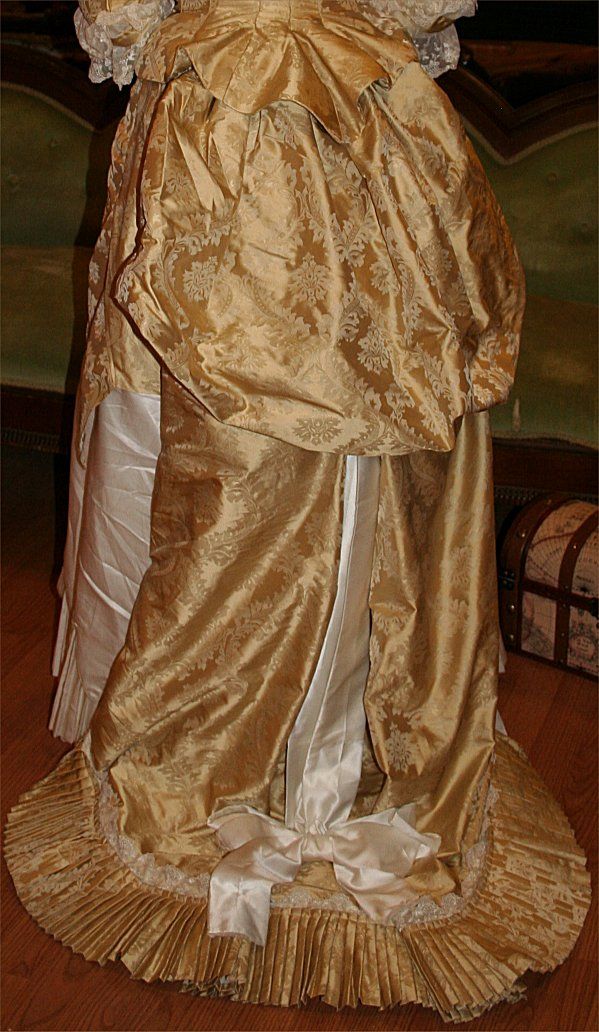
The skirt is built on a foundation utilizing multi- layers that only exend on the cotton base as far as will show on the finished garment- thus, reducing bulk at the corseted waistline. False hems of drill are used on all parts of the gown to provide weight, flow and strength. Undermost front, faced satin bottom is edged first with embroidered net lace, and then with a 10 inch wide book lined knife pleated ruffle. This is covered by a dagged and piped front overskirt. This in turn is topped by a beaded front apron that was hand beaded onto a twill tape waistline, and tacked in place along the sides to hold it center front. A draped side skirt piece was then added to the sides. The back of the skirt was faced with satin and then trimmed on the top with the embroidered net lace. The back drapery of the skirt was cut wider and longer than the foundation skirt. it was then self lined, and book lined pleating was added to the hem of this drapery. When the arrangement was final the draping was hand sewed along the sides and around the base of the the pleating to hold it in place during the dancing. It was finished out by a satin bow, tacked in place to keep it looking neat.
The bodice is cut in true 1880’s style and is completely flat lined and boned. It features hand covered buttons spaced an inch apart, and a low square neckline- when set off by the hand stitched ruffle gives it a Queen Anne look. The sleeves have a pleated insert down the side at an angle. This seam is set off by embroidered net lace. Embroidered net lace ruffles at the elbow and a hand stitched pleated trim over the top of that.
What sets this gown apart is detail- from using a period correct drafting system, to copying extant garmet construction techniques.








What a beautiful master piece. It's lovely!
Wow, this is amazing!
I agree, this is amazing, and gorgeous, thank you so much for sharing it with us. Keep sewing!!
What talent you have! You must have been a big hit - it looks lovely!
This is the most beautiful gown I have ever seen. The details - the work - the time - it must have taken you. I'd put it in a glass case and show it as a museum piece!
Thank you so much for your kind words!, It did cost me a few late nights to finish it in time. I also made both of my daughters gowns for the same events of the same time period. What pleased me was how well it held up to the abuse of the crowded dance floor- the photos were taken AFTER the night of dancing, and it had been stepped on no less than 10 times. I can't emphasize enough how important details like the false hem and taking time to line the pleating help a piece like this hold up to actual wear. AND actually- we have a museum in our home and I just put it on one of my mannequins today- I usually have a mix of my antique pieces and the ones I have designed myself on display.
Stunning...a true work of art!
WOW, WOW, WOW! How many hours did it take to create this stunning gown?
I "THINK" I have around 70-80 hours in it- the beading was done while watching tv in the evenings, and mostly because I HAD to get it done that fast- the motherboard in my sewing machine went out and was on backorder for a month, so it really cut me short on time. I keep a sloper on hand that I have already drafted in my size for that time period, so drafting a pattern doesn't take "excessively long" if I have to start from scratch(new sizing) it can add to the time. The perfect pleater REALLY helps on the pleating time too. I actually have some 1880's pleating aids- but the years have made them a bit rusty and I am wary of trying them out on silk.
This is Exquisite! What a beautiful project.
And ~ thank you for coming back to answer questions. Here's another one ~
I don't recognize the term "book lined pleating" - How does one do that? TIA
This gown is simply incredible!! It has always been my dream to make one as lovely as this!! Do you have suggestions on the best way to alter a size on such a dress? The patterns in stores don't allow for my size. Thank you for sharing!! :)
My mouth dropped open when I saw all the unbelieveable workmanship in your creation...Just the prettiest gown I've ever seen. Thank you for sharing it with all of us!!
Book lined pleating is a corruption of a victorian term for a type of stiff muslin basically you cut two lengths of the ruffle/pleating one of muslin the exact width you want the finished pleating to be, and the fashion fabric must be wider by 2 inches. The ruffle strips are sewn together along one long edge right sides together, and then the fashion fabric is basically "wrapped" back around the muslin. I will try to post some pics in my folder when I get back home with a better explanation- at the kid's house for the holidays!
The reason I learned to draft patterns is simply because I was hard to fit- narrow shoulders, large bust and small waist- Personally I would try my hand at drafting my own rather than trying to grade up- again when I get back to my sewing room I will look up a link or two that may help.
This dress is really stunning. Ths time and effort were well worth it and waiting for the "time and piece" for the fabric were right. You helpful comments to others are great as well. You dress stand on its own in this group. Thanks for sharing with us all. I hope you enjoyed wearing you creation as much as you will enjoy it as a display piece.AS others have said..... a masterpiece!
I have made a separate posting for a "how to" on the book lined ruffles, but I am having problems uploading photos at the moment- it keeps telling me they are too big despite having re sized them to the correct dimensions. It accepted the first one- so I will continue to try to figure out how to get them up.
unwrittenmelody:
http://trulyvictorian.netfirms.com/ carries larger size patterns
There are several books Kristina Harris has a few- try 59 Turn of the Century Fashion Patterns. I had at one time figured out the "scale" that one needed to multiply the given numbers by to come up with the correct measurements in that particular book, but seem to have mislaid my "Cheat Sheet"
Thank you so much for answering my questions. Lol, unfortunately I am incredibly small. As well as big busted. These dresses normally are at least a 4. I don't really see any that are smaller in stores. I'd love to be able to make one of these dresses! I love a challenging project! :) Thank you for all of your help! I love your work!
What craftmanship and artistry! How kind of you to share not only your photo but also your knowledge. The details you have shared are sure to help others.
unwrittenmelody: Pre-baby- I was very small waisted as well as big busted- Learning to draft my own patterns was such a blessing! I actually usually draft from direct measurements. Big busted, means starting from your bust measurement and learning to adjust the darts in the right place to round it out-otherwise the armscye comes out way too big. Draft to measure first- don't worry about the front armscye size, and then slash open bottom darts and in from armscye to close it up- its just a matter of rotating that piece around.
Just to stitch something like your creation would be an awesome achievement, but to have actually designed and drafted the garment....well, it's just amazing! If I had another lifetime, I'd do more in textiles.
I agree with everyone...fabulous materials and workmanship...wonderful
Fantastic and such a priceless gown!! Congratulations on making such a beautiful period gown.
I love the style of dresses from the 1800s to 1900s and your creation is what I long dreamed of wearing as a wedding gown...
I shall have to look up your previous posts!
Keep up the fantastic work!!