Close Up with Charles Kleibacker

comments (1) January 5th, 2010 in design, online extras

Pin It

SusanKhalje Susan Khalje, contributor
Love it! 11 users recommend
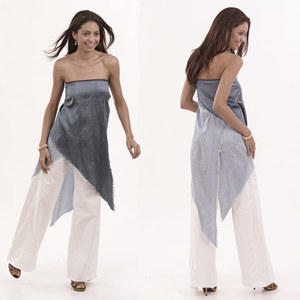
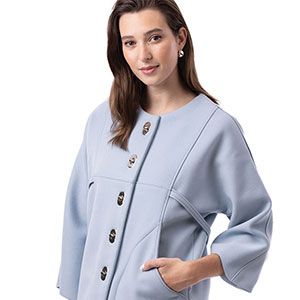
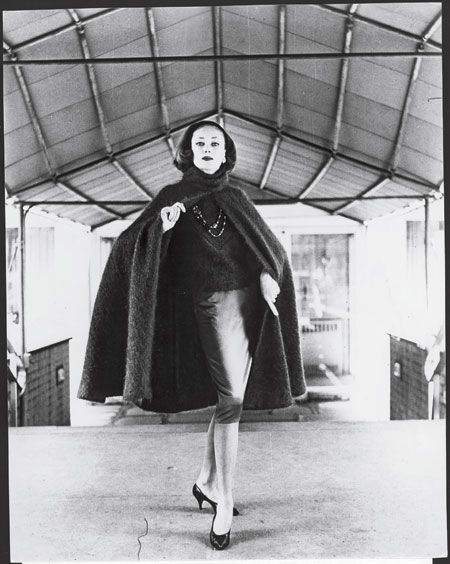
This mottled blue mohair cape and overblous is paired with a brilliant blue silk satin skirt (1957).
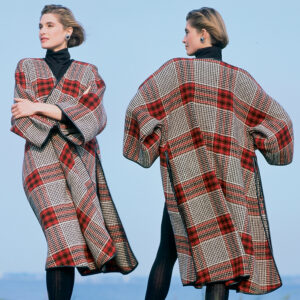
This 1957 swing coat with bias sleeve and wide sleeve cuff was constructed in a bold plaid wool.
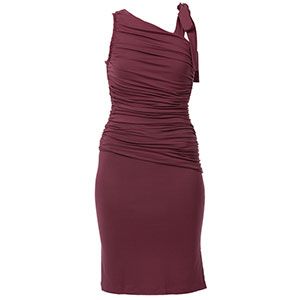
Mid-1970s bias-cut chiffron dress.
This mottled blue mohair cape and overblous is paired with a brilliant blue silk satin skirt (1957).

This mottled blue mohair cape and overblous is paired with a brilliant blue silk satin skirt (1957).

Photo: courtesy of Charles Kleibacker's own personal collection

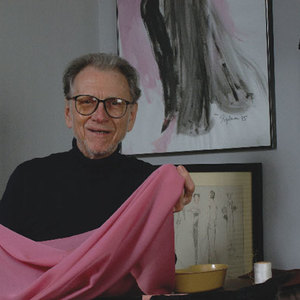
In honor of the late Charles Kleibacker, here is an interview with him that originally appeared in Threads issue 135.

When I think of the best of American couture, I think of Charles Kleibacker. I first heard him talk at a fashion symposium years ago, and he (and his bias-cut garments) were treated with a respect bordering on the reverential. Recently, while researching vintage clothing in Columbus, Ohio, I met up with him, and we spent a fascinating day poring over a number of vintage couture garments in his incredible collection.

A Little Background...

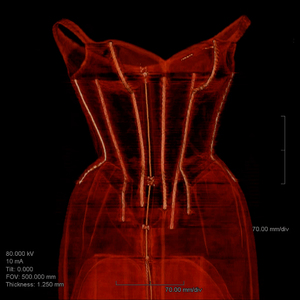
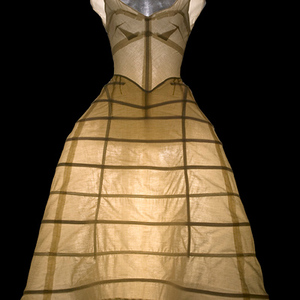
Born in 1921, Charles Kleibacker was known as the “Master of the Bias.” His elegant garments remain a testament to the delicate balance he achieved between brilliantly calculated bias designs, fluid fabrics, and the female form. Before he dedicated his life to fashion, Kleibacker received a degree in journalism from the University of Notre Dame. Starting out in the couture business, Kleibacker employed the Paris-trained Madame Burg, and under her expert guidance, he learned the techniques of working with fabric on the bias.

Kleibacker then moved to Paris where he served as an assistant in the House of Lanvin in Paris under the great Spanish couturier Castillo. In 1958, it was back to New York where he designed for the house of Nettie Rosenstein.

In 1960, Kleibacker opened his own studio in Manhattan. His clients included the country’s finest department stores, and his private customers included Pat Nixon (when she was First Lady), Happy Rockefeller, Diahann Carroll, Gertrude Lawrence, and Ellin Berlin.

In 1983, Kleibacker began a collaboration with Ohio State University, which grew to include a position as Designer-in-Residence, as well as Director and Curator of the world-class Historic Costume and Textiles Collection at the College of Human Ecology. He is currently Adjunct Curator of Design at the Columbus Museum of Art in Columbus, Ohio and adjunct professor at Kent State University.


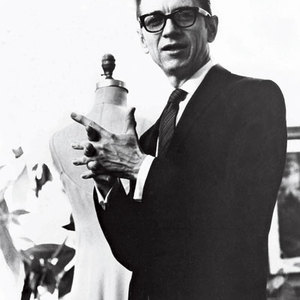
Charles Kleibacker in his New York studio circa 1965.

The Interview

How did you start?
It began for me in Cullman, Alabama, where my family owned a department store. I liked the men’s and women’s clothes, and ultimately, I spoke with the buyer. So that was really where it started. But not knowing how to express myself, I went to the University of Notre Dame, got a degree in journalism, and then went to work as a newspaper reporter in Birmingham, Alabama.

From there, I enrolled at New York University to study retailing. I wasn’t loaded with money, so I studied at night and wound up getting a job in the advertising department of Gimbels for $25 a week. We advertised in almost all of the New York papers, and it was my job to take the proofs around to the buyers. So the next thing was a move up to the production area—and then to an advertising copywriter job. And it so happened that I landed in the fashion department.

At one point, four of us—all good friends—decided to take a trip to Mexico. After that, in the late 1940s, I decided to go to California, where I got a job as a copywriter in San Francisco. Appearing there at the Mark Hopkins Hotel was the great cabaret singer Hildegarde. After reading about the success of her show, I wrote her a letter. Somehow, the letter got through to her manager, and in it, I asked if there might be an opening in her entourage. At the time, I was driving a station wagon. I think, in the long run, that’s why she hired me—so I would help move all of the clothes. With a twelve-piece orchestra, a maid, and a chauffeur, we toured the country.

Eventually, we ended up in New York and, after another tour, in Europe. This was 1949. Hildegarde was to do three concerts at the Théatre des la Champs-Elysée, and she was buying clothes from Dior, Balmain, and Bruyère. At that time, in the couture houses, a collection was shown every day at three o’clock in the afternoon.


This 1957 swing coat with bias sleeve and wide sleeve cuff was constructed in a bold plaid wool.


This mottled blue mohair cape and overblous is paired with a brilliant blue silk satin skirt (1957).


Did you get to meet any couturiers?
Yes, I met Dior briefly. Hildegarde was buying there, so I was very welcome. I sat in that Paris salon, watching the beauty of it all, the way the mannequins walked and turned, the gray background for the beautiful clothes — and I thought, “What in the hell am I doing? This is what I want to do.” Having no idea how, I decided to go to New York and to somehow get into the fashion business.


How did you get your foot in the door?
After an initial effort with a cousin and another designer failed, I offered to pay Madame Burg—the woman who had run our small workroom — what she had been earning to guide me technically in my designs. She had been trained in Paris, and she really knew what she was doing.

It was a small setup; I rented a one-room loft, and I would say, “This is the idea I have. How are we going to go about doing this?” I had enough money for decent fabric, so we would get a few garments together, and I would try to peddle them. We got orders — and reorders — and hired another person. Madame Burg was marvelous. After two and a half years, I had a good portfolio and sailed to Paris in 1954 with $400 in my pocket.


So, you return to Paris, where the atmosphere must have been amazing...
It was sensational—sheer magic! I loved the city and was very much — in a strange kind of way — at home. I was accustomed to draping so I went to see Castillo, the head designer at Lanvin. He looked at my portfolio and said that some of my ideas might work with his.

And under Castillo, Lanvin had wonderful ateliers — a big one for evening gowns, another for suits, and a small one for evening coats alone. I had a little office, plenty of muslin, and dress forms, and I would drape. I would ask Castillo, who had already explained his ideas for the line, to come in
and have a look. And he would say, “Continue on this one … forget that one ...” and so on. The models came in on a magnificent stage, and everything was completely sewn in muslin. Castillo would then tell me to bring out fabric that I thought would be right for each dress.

While Castillo was out for lunch, I’d go into the workrooms. The designer is always thought of as the creative person, but the wonderful people in the workroom bring ideas to life with their own creativity. I was learning techniques from them. Castillo would say, “Charles, you are in the studio; you don’t have to go into the workrooms.” So I asked him, “Are you saying I shouldn’t?” And he said, “No, but you are of the studio.” He was an aristocratic Spaniard, and he didn’t understand my interest in learning more of these techniques. But that is where I really acquired a world of knowledge.


Why did you leave?
Ultimately, I wanted to go into business on my own. Once I had some background, I returned to New York. I hoped a job with a good house might lead into my own situation.

In 1958, I worked at Nettie Rosenstein—a very good house. Then, in the early sixties, I took one of the head drapers with me and opened my own studio. I went to the West Side of New York City, which was not the chic side at that time. We made some clothes and then came the creative job — and I stress “creative” — of selling them, which was up to me. I called Bergdorf Goodman and got “Who? Never heard of you. Dress? Last thing we need.”

At Nettie Rosenstein, I’d tried to design clothes on the bias. I’d been reading about Madame Vionnet and liked the idea of soft clothes. The people in the workrooms had never worked on the bias, and everything I tried on bias got thrown off the line. In my own studio, I realized that this is really engineering and began perfecting this difficult cut. I called Bergdorf again, and this time, they looked at what I had and began to order some garments. In the sixties, nobody else was doing bias.


Describe your signature look.
It’s very definitely biasy — in a neutral color, not prints. And when I say neutral, I mean black, navy, brown, and champagne tones. I also wanted timeless designs that wouldn’t date. I never understood having something for one season and then discarding it.

We got windows at Bendel and Bergdorf. Women’s Wear Daily was wonderful to us. We weren’t the big guns, but we got attention because we were different. My big problem was outside contractors: they had no idea about bias. So I was in my workroom day and night making patterns on the dress form.

By then, Vogue and Harper’s Bazaar were interested. Harper’s had a full page with two of our dresses and a wonderful title: “The superb crepes of Charles Kleibacker.” We had twelve people in the workroom until 1976, when things began to change to trunk shows. I began opening collections in beautiful locations: in 1972, I took a suite at the Ritz Towers, and we got the front page of WWD: “Still on the bias — but with a different presentation.”


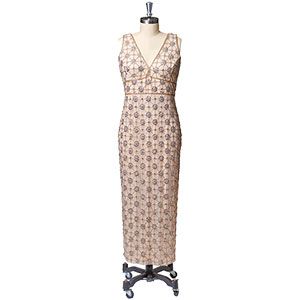
This long peach wool crepe evening gown features a bias back panel and long train (1973).


This mottled blue mohair cape and overblous is paired with a brilliant blue silk satin skirt (1957).

Certainly, with your fascination with the bias, you loved drapey fabrics...
Yes, and in the late sixties, a woman from Du-Pont came and said that they were researching a new fiber. It was very secretive, and they needed some clothes made by someone who knew what he was doing. The fabric was Qiana. DuPont hired me to do cross-country tours in which I explained working with the bias to people who sewed for themselves with clothes made of Qiana and a live model.


So when did you start teaching?
The beginning was with Milwaukee’s Mount Mary College in 1968. Then I needed to know about the history of clothing. That’s when I started to collect historical garments. In the early eighties, I was Designer-in-Residence at Stephens College in Columbia, Missouri; then I went to Ohio State.

In 1984, the dean thought that we might be able to build a historic costume and textile collection for the University. Eventually, she offered a full professorship, but I said, “Forget that; we’re going to get somewhere if you call me Designer-in-Residence.” The city was wonderful to me. I built the collection until 1995. Then I began to freelance at the Columbus Museum of Art. I’ve just started my sixth year there as Adjunct Curator of Design.


So what are you most proud of?
When I think of the sixties and seventies, it really was about the quality of the fabric and the workmanship — and whether you had something that made your garment a little bit different. I’m most proud that I kept going in New York for twenty-six years. It was scary at times. It was up to me to keep it going, and I did.


This long bias-cut dress is pale gray at the top, meaders into a row of yellow daisies, and ends in black (1964).


Mid-1970's bias-cut chiffron dress.


“A great individualist among the American fashion designers is certainly Charles Kleibacker, whose ultra-simple, bias-cut black crepes and the marvelous flowing blond cape over a long powder-blue crepe dinner dress, stood out with the same distinction as a Madame Grés collection in Paris.”       

-Eugenia Sheppard, fashion writer for the New York Post, 1972

excerpted from Threads issue 135, p.55


posted in: design, online extras

Comments (1)

SusanBeck SusanBeck writes: What a fantastic article!!!
Posted: 12:36 am on November 3rd

You must be logged in to post comments. Click here to login.