

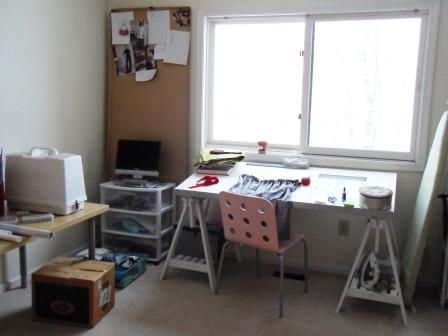
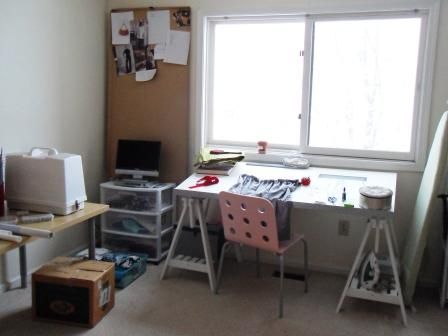
A sewing room has to start somewhere, but the space and the light are good. To come: a sewing table and adustable chair, a cutting counter, a dress form, and more.
For many years, I’ve worked on sewing projects without having a designated place to sew. I think that may be a common circumstance for Threads readers. Sewing is a vital creative outlet for us, but because of families, careers, community obligations–plus homes full of all the stuff required for daily life–it’s a rarity to have a sewing room.
I’m just starting to plan mine, and I’d appreciate your thoughts and tips on organization and equipment. My goal is to have a space that’s not just efficient, but cheerful and inviting.
Five sewing room criteria
- Space: I think that no amount of organization, planning or great equipment is going to fully make up for a real lack of space. I’ve worked around that before, and I despaired of the time I had to put into squirreling things away and getting them out again.
- Light: A source of natural light not only is the best way to discern colors, it’s a natural mood lifter. For evenings and cloudy days, I know I need to put in excellent task lighting to reduce eye fatigue.
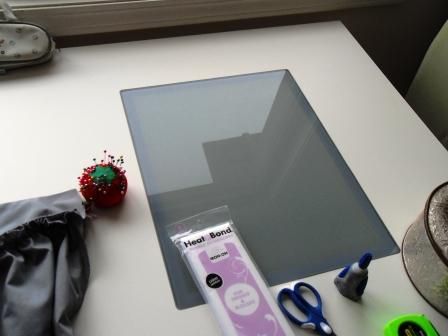
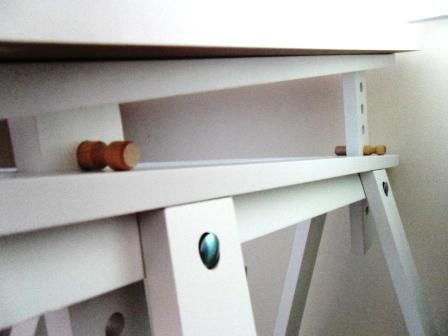
- Comfort: Adjustable furniture is a must-have. My first purchase was an IKEA table I plan to use for pattern drafting and general purpose. It has trestle legs and a peg-and-socket system to raise, lower or angle the table top. It also has a glass lightbox section, flush with the table top. It will be handy when there is any tracing to do. Next, I’m looking for a sewing table with a sunken bed for my machine, and a comfortable, supportive and fully adjustable sewing chair.
- Organization: No more hunting around for notions, thread, tools or measuring tape. Everything is going to have its place. To keep costs down, I’m looking at simple, stackable plastic cabinetry.
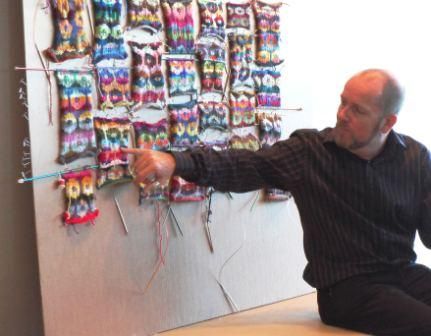
- Cost: I want to keep expenses down (that will mean more to spend on materials!). I’m looking for what works–not necessarily what’s top of the line. One trick I know I’m going to use is to keep some of the large sheets of cardboard from my moving boxes as backdrops for planning projects. Last fall, I attended a color knitting workshop led by Brandon Mably of the Kaffe Fassett Studio. Brandon pinned the classes’ samples to a giant sheet of cardboard. He said that brown cardboard was a great neutral and they used it at the studio to step back and get a good perspective on color combinations. I like that it is free, too!
When I made my recent move to Connecticut to begin working at Threads, I vowed I wouldn’t look around in three years and see any unpacked boxes. Unpacking is a process, though, because it doesn’t work to open one of those moving boxes if you don’t have a place in mind for the contents!
I’d appreciate your thoughts and suggestions as I work on making a creative space. In the future I plan to share updates and the best tips I’ve received from the Threads community. Thanks for reading!















Lucky you! I too sew beneath a window and I love it esp. in the summer when the hummingbirds eat at the feeder hung outside! As for lighting I have a twin flourescent tube fixture for the room but also have a single one above my sewing table and an inexpensive goose neck lamp with an Ott bulb in it. The Ott bulb made a big difference in how my eyes felt at the end of a full day of sewing. More birthdays have also required more light bulbs in various work spaces! My serger is on a typing table w/drawer that I pull up to my sewing space when needed and the ironing board is set up behind my sewing chair so I can swivel around to use it. I have a sewing table with the lift system so that I have a smooth surface to sew on but it had no drawer space. I had a man build a 14" wide section of 5 drawers 4" deep to hold s.machine accessories & notions so they are all in easy reach. I removed the 2 legs on the left end of my 48" table and set the table on that stack of drawers. I have peg board all around the table & use pegs to hold scissors, etc. Serger thread is stored on a rack above the peg board & I replaced the short dowels to longer ones to hold 2 spools. You'd be surprised how you can compact everything! Have fun.
Two inexpensive suggestions: 1) I made a design wall using the pink sheets of 4 x 8 insulating foamboard (around $5 per sheet). Covered it with a flannel blanket. If you'll paint the foamboard white, you can just use a flannel sheet. You can stick most fabric to it, or use pins. 2) I had 8-foot high output, low-wattage "daylight" fluorescent fixtures installed. You can just run the wires down the walls if you don't want to pay for installation. Good light is a must, especially for aging eyes. Enjoy! I love my sewing room.
Sarah, I'm so glad you've started this topic! I've been puzzling over how to make my basement sewing space more efficient, so I'll be following this discussion closely. I've been meaning to look over the sewing tools and supplies I'm storing in plastic stackable drawers to see how many I could hang on pegboard instead. I have a lot of wall space that could be put to good use. I've seen garage wall storage systems that look both functional and attractive, but haven't yet determined whether they'd work for my needs.
I'm always on the lookout for items that can be repurposed to solve sewing space problems. Here are some examples:
For cutting and construction surfaces I have gotten great use from my banquet tables, which can be positioned end to end or side by side as needs dictate and then folded between projects.
I sew vintage patterns, and trace the fragile tissue pieces onto paper too heavy to fold. I store the traced-off pattern pieces--and delicate instruction sheets, which I encase in plastic sheets--in giant corrugated cardboard folders originally intended for storing posters. The folders fit into a box with a hinged lid. Highsmith, the school and library supplies company, sells the folder and box sets, which are called "Corruboard Bulletin Board/Poster Storage Systems."
Back when I worked in commercial bakeries I used rolling bakers' racks to store and move baked goods. Now I have a baker's rack of my own, with about a dozen full-size sheet pans perfect for pulling together supplies for projects. Bakers' racks and full- and half-size sheet pans can be found at any restaurant supply.
The only place that I have to sew is my bedroom.I am trying to get all this stuff in a tiny area. I have a nice start but now I am stuck. I am trying to make things look nice in my bedroom but yet be able to do my sewing.Help!!1
I use several of the plastic small drawer units intended for nuts, bolts, screws etc. They are ideal for storing needles, buttons, elastic, and all sorts of accessories. They come with various drawer sizes and can be stacked. With the clear plastic fronts you can quickly find what you need. I find the hot wheels storage containers from the toy section are perfect for storing thread.
Light is critical--I use daylight fluorescents and love love love my ott light.
I like the plastic wheeled drawer units to store projects in progress.
I sew lots of costumes for our high school, so I use historical patterns and wide fabrics for much of what I sew. I needed a BIG cutting table. I bought three inexpensive laminate covered cabinets 30 inches high. Putting two back to back and one on the end, I screwed those onto a piece of plywood, and put casters on the bottom. On top of the whole assembly I put a piece of plywood cut 54" wide, using the 48" dimension for the length. Then I cut two more pieces 30"x54" and used heavy duty hinges that can hold those two ends up or be let down. I covered it all with heavy vinyl for a smooth cutting surface. This gave me a cutting table that is 9 feet long and 54" wide so that I can use large pieces of fabric, but the flexibility to make it smaller when I need to. The casters help me roll it out of the way if I need the floor space for something.
The other tip I would give is to only by clear storage containers so that you can see what is in everything without having to open any containers.
An organized space makes every job easier and more enjoyable. Good luck!
Hi, I bought a peg board and painted it purple to give it color. Then I went to the local Payless shoe store and got a bunch of differnt size shoe boxes which I labeled until I have time to decorate them with what is in the box. Now when my husband wants a needle or safety pin he can find it by himself. Oh the boxes are on some inexpensive shelves from Lowes. Patterns are in see thru shoe boxes that are divided by toddler, craft, etc. This is how I did my sewing room. I do other crafts which I am in the process of setting up in the sewing room.
I cut slots into an old set of bed rails and hung on the wall so when I buy large pieces of fabric on rolls I slide a piece of pvc water line ($1.10 at Lowes) through the cardboard tube and hang it. Then as I need it, I roll it out over my table and cut. Table is on wheels to roll into place or out of the way, made of MDF at $20 a sheet.
Ohhhh I like the foamboard reminder. 2 sheets would fit the flannel I've got, yet I can fold it in half when not in use & the back side showing could act as a sort of bulletin board to post my next project ideas! Thanks so much for making me think!
After Katrina I had to completelly re-do my sewing studio. Everything had to come out. This help to go through to sort, organize and plan space needs. New lighting, outlets dedicated just for steam generator iron, sewing machine and computer. Always looking for more ideas and and storage suggestions. Great suggestions.
For SandyDandy: I started out sewing in the bedroom then had a nice big spare bedroom that was only a sewing room. Now we live in a two bedroom condo and the largest is the master bedroom. I use one wall to line up the sewing machines and dressers that I use for storage. On another wall is a counter height cutting table that can be opened out to be about 36" by 60 inches. It has drawers and shelves which help. My sorted boxes of fabric can be stored under the bed. I manage to keep the ironing board up all of the time also.
It's not ideal, but I've made it work and my husband is understanding.
I had a bookcase made to hold 3 ring binders. I keep all my different subjects in seperate labeled binders which certainly cuts down on hunting. I also wet a paper towel and place it in a plastic bowl before I begin sewing or crafting. All my snippetts get caught on the moisture and at the end of my session I just throw the towel away. No lint to get caught on my clothes to be ironed!
I used the same insulating foamboard as Sue Metz, except I used mine to create a custom sewing/quilting table. I wrote it up here: http://www.squidoo.com/sewingtable
I am very particular about having things at the right height and avoiding shoulder, arm and neck strain. My need to have a very large, flat surface for sewing and quilting led me to create this system and I absolutely love it. It's nothing more than a large piece of vinyl over layers of custom-cut foamboard but it beats every sewing table I've ever used.
I like the IKEA Trofast storage system. It's not a low budget solution, but it has made organizing my sewing projects and supplies and breeze, and it makes my sewing room look professional. It's actually marketed in the IKEA children's section, but is perfect for a sewing room. It is a wooden frame with plastic buckets that slide in and out to serve as drawers. There are 3 different size buckets you can choose in a number of colors, and a few different size frames. I find it useful because you can choose your storage size depending on what you want to store in each bucket. Additionally, I find it sturdier than the plastic sliding drawer sets from Rubbermaid.
Years ago I bought an IKEA desk for my sewing room... adjustable height table, large working surface. I am not sure if the model is still around, but IKEA offers great desks ideal for a sewing room.
I use a bulletin board for organizing small items that I use regularly. The board is fun and creative, and I make fun push-pins by gluing some favorite buttons onto the push-pin. I now call these "push-buttons", tee heehee. The larger buttons work great because now I have a place to drape long hanks of piping, bias tape, zippers, ribbon and other trim I regularly use.
I have made "pockets" sewn onto a separate fabric backing and attached to the board with a sturdy t-pin pushed all the way down at a severe angle for stability. In these little pockets, I have small 2" strips of fusible interfacing that I have lots of uses for. Another little pocket has my care labels and my name labels. I have a larger pocket that I made for my important notes, and some extra blank papers for notes. You can even make sturdy felt pockets for scissors. There are many things you can make a pocket for, and hang them on a bulletin board or wall right next to the machine. This is the ultimate storage solution for me--I don't like digging in boxes for items I use quite often, and this takes far less valuable real estate in your sewing area. Think of it as the tool wall in the garage, except everything is in pockets instead of hanging free and getting dusty.
If you want photos, go to my website http://www.sewjoe.com and send me an email and I will send you a photo.
An adjustable chair has really helped to keep me sewing comfortably. I received several gift cards to Office Depot so I only had to pay a small amount...The chair was $200 and I got to choose the fabric...My machine is Bernina and my tables and shelves are IKEA. I know the chair was expensive but maybe you can hint at gift cards (for birthday, christmas, hanukah, kwanzaa...) from a favorite chair store?
Thank you Neasha for the tips for my bedroom.I have the wall where one of my bedroom window is lined up with my machines and plastic drawers. In the corner is my yaffa storeage with my books and sewing hams and stuff.In my closet on the lower rod I have plastic bags with the prodjects I am going to do.Under the bed is under the bed boxes with fabric. There is a chimney in the wall where the closet is. There is a nook on the other side of the chimney with electric outlets. I am thinking of moving my bed and using that little nook as a sewing thing. Maybe put up a spring tension rod and make a curtain to put across there and pull it when I am not working in there.The dhort wall as you come in my room has the dresser and vanity and chest of drawers. I hsve lots of fabric.Too much for my room. So I hav been going through it and seprating it and putting it in Storeage containers and taking it up and neatly stacking it in my attic. The containers are marked as what is in it. I have been putting my thread on a thread rack and organzing my things. I have developed alove of vintage sewing machines. I have them set up and sew diffrent things on the different machines. I am still a work in progress with that room. I'll get there yet. My freind says that with all I am doing in there I don't have time to sew. No I don't. I have been a widow for 21 years and life hasn't been easy. I am partially retired now and want to get this in some kind of order so I can sew.
SandyDandy
You've forgotten one plan-changing element: power. Sewing machines (especially computerized ones) and sergers and most especially irons really require dedicated power sources and power strips with a surge protector. Can your machines go where your light sources are? or are you going to have to get power to your machines in a less-than-optimum way?
Also, where it comes to light, you really can't have too many light sources. Better to not turn some on than to not have enough!
Another thing that's worth considering: buying those translucent or see-through plastic drawers is great and I highly recommend them, but does mean two things: your initial outlay will be fairly large, so start saving up so you can buy them all at once...because...whenever possible buy all the same height units. I like the stacking ones, myself, as you can stack them as tall or as short as you like, and dependent on whether you need storage on top of them running across several units, or wall space above them for display, etc.
I found the hard way that if you buy units at different times (on sale, for instance), they're almost never the same height. Buy the drawers in a deeper size rather than a shallow one -- better to have too much room in a drawer than not enough.
Also: take out the carpet. Threads in carpet = mess.
My, let's see, 10 cents. :)
For the first time in my life, I have a dedicated sewing room. We live in a restored 1890 Victorian home, and although I use the most modern equipment in the sewing room, the room is a half-open space at the top of the stairs, about 12 x 12 feet, and I didn't want for it to detract from the ambience of the home. My sewing machine (a relatively new Janome) sits on top of an antique Singer sewing machine table--the original Singer is below in its compartment, and the treadle is useful in keeping me relaxed while sewing. The drawers are perfect for storing scissors, needles, pins, buttons and other fasteners. There are two comfortable upholstered chairs on one side-wall that are perfect for hand-sewing tasks. Between them is an antique oak bench with a back that pulls up over the bench to create a cutting table (when covered with a piece of formica that can stand up behind the bench when not in use. The bench has a large compartment below the seat for storing fabrics (not all my fabrics; I still have other stashes, of course--I've been sewing for 60 years). There is an antique oak washstand on the opposite wall, with mirror and several drawers for storing thread, bobbins, zippers and other essentials. It also has a doored cabinet for patterns.
The most important feature to me is having the sewing machine in front of a large east window, through which I can watch birds in the large hemlock behind the house and other wildlife in the five acres beyond. My relatively new Janome sits on the table of an antique Singer machine (the old machine is still below in its compartment, and the treadle is helpful in keeping me relaxed while I sew. But I also have an Ottlite beside the sewing machine on the Singer top, as well as another on the bench top to use when hand-sewing or pressing. (The cutting table is a good base for a legless ironing board.)
Because I had serious spinal injuries in an auto accident three years ago, I am unable to get around very easily, but I use a comfortable adjustable office chair at my sewing machine, and it allows me to get around to the other convenient spaces on the same floor and to adjust the height when I am cutting or pressing. Fortunately all our floors are hardwood, and that means that all the thread and clippings can be easily vacuumed with my little "alien" hand-vac while I am sitting in the chair. (The vacuum is actually a Dyson Animal, but it is the only item in the otherwise Victorian room that looks alien.)
I hope these ideas are useful. They have certainly added greatly to the quality of my life--which without being able to sew would be depressing.
It looks like you're off to a great start--I also use the same IKEA table legs and keep them at the top height so I can stand when working or use a hydraulic adjustable coved bar stool, $50 at Target and worth every penny. You can get it to exactly the right height & its comfortable.
To supplement daylight I suggest 48" double silvery florescent fixtures from Home Depot. They're sharp, professional and modern looking and will hang from chains (included), from hooks screwed into the ceiling or beams. They come with plugs and pull-chains, or you can wire them in if you're so inclined. Mine are wired into track light strips that were previously installed on the ceiling. I've put into them HD true-daylight Blue-ray tubes ordered on the web. I have *5* of these in my dedicated bedroom-sewing room and it is wonderful to have enuf light to be able to work anytime *and* be able to match fabrics perfectly.
I have a lot of fabric and store it in another storeroom in clear plastic boxes (all the same), by number. A sample of each fabric cut to the same size (6" wide by 18" long) hangs doubled over an individual kid size hanger (good plastic ones at Target) in the closet in the sewing room. I use a tagger for fine fabrics (from ULine on the web), to put on a tag with the fabric number, and also to tag across the fold of the hanger to keep the fabric from falling off. The saample is big enuf to match fabrics and play with, and the number tells me where the fabric is in the storage space. You can organize and reorganize the hangers any way you want--by color, by prospective projects, etc. It's flexible! New fabrics just get the next number available, irrespective of color so you don't have to stuff the next, say, pink one in an already overflowing "pink" box.
Enjoy planning your space! A terraced planter in the window well is my view, and the large north facing window floods my basement sewing room with light during the day. At night I use Ott lights, and an antique floor lamp that amps up the light!
If you are buying plastic storage drawer units, I would suggest that you only buy the IRIS brand. The Iris brand is more expensive, but the drawers will not stick like other brands do. I've had my Iris storage for years, and they are in great shape, have survived two moves, one out of state - and loaded with supplies. I used a label maker and labeled the plastic drawer contents. Also, it is quicker to find things if you organize alphabetically.
I use a sewing machine foot organizer bag. I scanned the info from the catalog and put the images and info about the feet in the pockets. I can find and return them and keep organized. Presentation binders and sheet protectors, organize lots of info. I like the Artbin brand handled boxes which are archival, for storing projects in progress or to be transported, and they are available in lots of colors! and are stack-able. They are really for scrap booking papers. I used a scrapbooking 6 drawer plastic cart, removed the original drawers, and put my embroidery thread totes in it instead.
I found 3 commercial legal size file cabinets on Craig's List, they are wide enough to keep stabilizer rolls and patterns in. A laminated top bridges them. The closet is customized for sewing storage = lots of shelves.
The fabric stash is in an unfinished part of the basement with daylight fluorescent fixtures. On metal shelving. I used archival foam-core board, available at art supply stores or online, on top of the metal wire shelves and also encased the end of the shelving with wood. It looks better! I attached a curtain rod and hung pretty vintage tablecloths to help protect my stash. Finally, my fabric is out of plastic totes. My ironing board is next to one of the shelving units, which means I get to stretch my legs and move when I sew. It's only a few steps away. I have two drop leaf cutting tables (JoAnn's) that each take up a very narrow 16" x 36" footprint. We put a locking device - one that is for dining room table leaves-- so that I can lock the two tables together to be 36" X 120" if I want. I pull them out into a room at the base of the stairs, and my husband doesn't mind the mess. I inherited my mom's Koala Outback cabinet. I love it! I use a lot of the 3M Command hooks to hang embroidery hoops on the side of a bookcase and on the back of the doors and wall. I use old sewing machine needles to hang specialty rulers, etc. Best of all, I have my favorite artwork hanging on my walls. It is amazing how we can find ways to organize. Just think outside the box, see potential, find ways to re-purpose things.
For years I used plastic drawers and bins. I find them very frustrating. When I set up my "space" --finally after I retired, I decided to purchase some drawers from my local home improvement store. I found them in the closet area in the store. They are in boxes and you put them together yourself. It is not difficult. They come in various configurations but are 24" wide. I started with four and bought two more, so I have a cutting/work table that is 72" long. I placed them back to back for a nice, wide, 48" work space that has storage access from each side. I thought of just putting them along one wall, but like the extra wide cutting space. I purchased a large cutting mat and it works out perfectly.
Shallow drawers are used for trays with shears, and various other equipment items. I also have bias tape, lace, zippers, etc. all sorted and filed in shallow drawers. Deeper drawers are used to file patterns. Cupboards with doors hold my iron, pressing equipment, bins of various projects, fabrics, etc. I find the drawers units most useful, however.
Later, I purchased inexpensive book cases (also from the same area in the home improvement store) and set the adjustable shelves so I could stand fabric and interfacing or stabilizer on bolts. or stack plastic boxes with quilting or other projects on the shelves. I have the boxes large enough to hold quilt blocks, or pieces cut and ready to sew.I bought 8 boxes, and don't start another project until I get one done and an empty box is available for it. Keeps me from collecting too many UFOs. I can also stack projects for emboidery on the shelves, folded and visible to remind me what needs to be done when I have a moment or get a notion to sew.
My talented brother made a thread rack for me the way I specified. It holds 100 spools of embroidery thread and hangs like a colorful picture on the wall above my machine.I have actually requested another one just like it. I need more room for threads.
My sewing room is in a daylight basement, and on the south side so I have good light from the window even in the winter. However, I have a "sun lamp" bulb in one of the lamps in the room for use on gray winter days when extra "sunlight" is needed.
I think every dollar I spent on the storage units has been worth it--both for storage and for counter-top work space. They are also an attractive addition to my room and don't look like stacked "junk" in the corner.
Older style Babies Cots have Peg Board bottoms; nicely enclosd in wood, and just the right set back to allow the special hooks to be inserted when the board is screwed to the wall.
Various places sell sets of drawers that are shallow; and a handy person can route or saw a 'kerf' from the sides of the right sized wood or plywood cube during construction then put pre-made drawers such as those sold at IKEA for holding Kitchen cutlery and tools.
Jam Jars are a pretty way to store Buttons, Hooks and Eyes, Press Studs, and so on. And a standard bookshelf can be sawn in half so the shelves are only 5 1/2" deep, Then it will fit nicely in behind a door because of the door frame!
My scissors live 'tips down' in an old Cutlery Basket; complete with pillows to cushion their tips.
I also make full use of the Label making functions of my computer and printer to label everything; saves opening the container with White Press Studs when you want Black.
A large Kitty Litter Bucket holds a variety of diameters and heights of cardboard tube; yardsticks and such items are stored vertically in there.
Instead of a broom I use a Dollar Store Handle and Bar intended to be covered with dampened static cloths, instead I use 'cut-to-size' pieces of Fleece to catch and hold threads; when it gets too dirty I can wash it or throw it, and it is easier to swoosh across my wood parquet floor.
My biggest regret is that my sewing room does not have enough space for all my machines! So I have 15 or so elsewhere in the house.
Liz
My husband built me a lovely sewing room. I have my serger centered between my computerized machine and my power Singer. I can slide between all three depending on the project I'm working on.
Two of my machines are on "lifts". When the machines are down for storage, I cover the holes with stiff mylar plastic sheeting. I have also attached a portable "swing away" task light under my sewing surface. I swing it into place in one of the lift openings and have have an instant light box without the need for a separate box to store.
Also, it's helpful to have electrical plugs installed at counter height for using craft tools. Extremely handy if you plan on using your sewing surface for any crafting projects...no need to bend over or hunt behind sewing tables looking for an outlet. Of course, power strips mounted on your work surface work as well!!
When I married almost 40 years ago, my husband always made sure I had a designated sewing area. It may not have been a fancy room all to itself but I always had a space in which to sew. When we moved here, I had no room. We had downsized 15 years ago and I knew I could eventually work something out. At the time I only had my mechanical machine and a serger. Then came the Designer I by Husqvarna and everything that goes with a computerized embroidery/sewing machine. I had to have a computer close by; I needed storage; I wanted a larger place to cut out projects. Well, after 5 1/2 years in the house, we were coming home and when we opened the garage door it hit me. We had a pull-down staircase in the garage that led to an attic where we could walk around. I asked my husband if the garage was large enough to put in a permanent staircase--it was. I then mentioned that maybe we could build a sewing room in the attic. He said nothing---poor man--another project for him. Well, on New Years Day of 2001 he started clearing the attic. We hired a professional to put in a 5' horizontal awning window on the east side of the attic and to build a permanent staircase on the west end of the room. In his spare time, my husband built me a wonderful sewing room. It is 10'x 24'. This house has an A-symetrical roof line. He had to build a vertical wall, which created a void between the sewing room and the storage area of the attic, where a person cannot stand erect. In that void he built 12 four foot long shelves and 4 two foot long shelves PLUS under the shelving are 7 12" deep drawers and 7 4" deep drawers!!! Above the shelving is 2'x20' corkboard for me to pin up whatever.
My husband is a master electrician (now a consultant) so I have (are you ready for this?) 30 electrical receptacles! I am wired for cable TV and broadband Internet service. My lighting consists of four 4' long fluorescent fixtures with four tubes in each. I have two different light switches so my lights either go on with 8 tubes burning or 16!! At night it is as bright as daylight. On the south side of the area is actual attic storage where I can stand up in some part of it. There I have some free-standing shelving that I can move if I so choose. On the north side is a knee wall and beyond that more storage. In that area I have to bend down but I have three sets of shelving for supplies I rarely use. I have my two sewing machines, a serger, a blocking board (which sets on top of a set of shevles which gives me fabric storage,) and my wonderful gateleg cutting table with drawers. There is room for my large loom but if I am weaving, I don't have too much room to walk around but I can at least weave up here if I choose and when I am not weaving, I can fold up the loom and push it to one side. It blocks some drawers but it is easy to move, if I have to.
The ceiling is pretty cool. The roof slants to the north so there isn't too much room to stand. That is where the sewing machine tables and computer desk are located. I sit so I don't need room for standing. Since I didn't want to have to sand the dry wall of the ceiling, we covered it with canvas! It's pretty neat. We stapled the canvas to the dry wall and left a little slack. We then covered the staples with covered buttons so the ceiling looks like a big tufted area. It's really nice.
I painted the room, laid the vinyl flooring, and put up the cork board. My husband did everything else and on October 8, 2001 I moved everything up here with the help of 2 men from a local moving company. I had everything in the lower level of the house, most of it in the laundry room. Whatever closet area wasn't being used, I had supplies in it; under beds; in boxes; wherever. Now it is all in one place. I can move from the computer to the sewing machines. I can plug in anything and not worry about overloading electrical circuits as my husband put a circuit breaker box in the sewing room and it has it's own designated power.
I love this room. I come up here and can stay all day. I have TV, radio, stereo or just the solitude of the cukoo clock ticking. I have a view of the lake outside. There are two windows I can open and hear the birds. There is a crab apple tree in our side yard and the top branches are visible from the window. It's wonderful and I thank my husband all the time for building this room for me. I am so fortunate. Now, if only I didn't have to cook, clean, laundry, iron, errands, take care of the yard----if I only had more time to sew!!!
I have recently promoted my sewing room to My Studio.
My suggestions for organization follow:
1. Consider a metal pattern case of drawers, like they store patterns in in stores. They cost less than I imagined, and they store a lot of patterns. I ordered one, maybe from one of the pattern companies, and it only cost $160. It will probably need to be drop shipped, which will add to the cost, but for me it was completely worth it! You can use metal paint to match your sewing room colors. If you choose the same color as the walls, it will disappear into them, and decrease its visual space.
2. Perhaps a door blank would be a better choice than a sewing cabinet or table. I am continually frustrated at my machine cabinet, because there is only space to machine sew there. After stitching a machine seam etc,I want to slide sideways to an open flat area to pin the next step, trim the seam, baste by hand or whatever. Not having the underneath drawers so close would solve this problem. The door blank is large, can have the sewing machine hole cut out, and a shelf inserted underneath. Have a plexiglass shape cut out to surround your machine as it sits on the lower shelf. If you need to use the free arm, remove the plexiglass. The door blank can be supported by simple metal or wood legs, or stacking drawer units. Best are table legs at far ends, with rolling drawer units underneath. This offers the best flexibility. Then you can slide over to a flat table to do non machine work, and slide back to work at the machine.
3. I used two plain bookcase with shelves to organize my notions. I bolted them together in back for stability. I used plastic sliding drawer boxes in them. They come in different colors and sizes. I labeled them with their contents: Closures, Cutting Tools, etc.
4. I was lucky to find a used vintage thread cabinet with drawers. It's made of wood with clear drawer fronts, and labeled with the thread manufacturer's name on it. I put it on top of the pattern cabinet, and it holds a lot of thread!
5. Any large table can be used for cutting out and other work. Look at garage sales, or use a door blank as noted above. Best to use bed risers to elevate it to save your back. More rolling cats with drawers can be used underneath. Or plastic storage bins with lids can be stacked underneath, for storage of larger items.
Happy sewing!
I am fortunate to have a great cutting table that is actually a drop leaf dining room table. However, it was not a good height for long cutting sessions. I bought a set of bed-risers, placed them under the legs of the table and, presto, my table is now waist-height. No more aching back! I use the space under the table to store boxes of out of season fabric.
Through trial and error I have found that industrial-type shelving units work great for all types of storage. They come in different heights (I prefer 6ft height), shelves are adjustable, and you can get them in various depths. I use a narrow depth unit for my books & wider depth units for storing boxes of fabric. That way you don't have wasted shelf space. This type of shelving is available in a wide range of prices.
Invest in a hand-held label maker and label everything. It will save a lot of time later on.
Every yard of fabric I own (and I own a lot, as do most people who sew) is catalogued. I made up a sheet that includes info on the fabric (yardage, width, fabric content, care instructions, date and place of purchase, and most importantly, what I plan to make from the fabric). A large swatch of the fabric is attached to the sheet and then it goes into the appropriate 3-ring binder. I have one for home-dec, one for crafts, and four for garment fabrics (woolens, silks, knits, wovens. I also number each box containing fabric, and the number of the box goes on the info sheet. I printed the sheets on index wt. paper so that they are sturdy.
I found some wonderful plastic boxes that come in a huge variety of sizes from very small (great for my bobbins) to very large (I keep large amounts of batting in the largest). The brand is Really Useful Box (I found mine at Office Depot) and they have latches on each handle. They have a couple of sizes that are great for projects I am working on. I put each project and its components (patterns, pieces, thread, etc.) in the box. That way when I have some time to sew, everything is together. It also helps me keep my "works in progress" from getting out of hand.
When you get ready to set up your work area, try to move everything out if at all possible. I rented a "pod"-style storage unit that was brought to my home. I was able to move everything into it and lock it up. Next I gave the walls a quick coat of paint in a bright cheery color. It was easier to set up the room as I wanted because I had the space to do it.
The best advice I have came from a co-worker of mine who is a draftsman. He advised me to measure my work area and draw it out on graph paper. Then I measured each piece of furniture that I wanted to use in the work area and drew that out on another piece of graph paper. With the furniture pieces cut out, I could move them around to my heart's content until I found a plan I liked.
I love my kids dearly, but am so excited that another is off to college as I have plans to convert his room into my sewing haven. I have had my eye on a table by Horn and have been saving my pennies for this time. Horn is on the web if you want to purchase a table. I know there are websites that sell the mechanical parts to make a table too, but I feel this is the way to go for me. I am planning the layout, but always come back to the cork on the wall for projects. I have my eye on two tall, thin cabinets at the hardware store that I will use for storage and place a rod in between to hang fabric or projects. I have a closet, and am in the process of planning an efficient way to store the fabric, but am keeping my notebook with swatches and fabric info. Patterns are a pain for me to store, but have gone with a narrow container that allows the pattern envelopes to stand upright. I may put them in larger clear plastic bags, fold to fit so they won't be so bulky, and store in a notebook. I figure if I put in a dorm fridge, I won't have to come out for days!
Lots of useful information in the comments so far! I'm starting to plan a sewing room, too. For the first step, my brother will build a Murphy bed on one wall with drawers and shelves on either side (drawers below, shelves above) so the room can double as a guest room.
For storage, I like drawers for fabric to keep the dust out, but I like to put notions and tools into clear plastic boxes so I can see them. The Container Store is my favorite for storage boxes. I looked at labelers after seeing Martha Stewart raving about them, but honestly, I think that the Post-it removable labels are cheaper and more attractive.
Then, on the window wall, I plan to build a fold-up table from a piece of plywood that I salvaged, with 45-degree supports. I love the table that Sarah bought, especially the light box, but I want something that I won't stub my toes on. (My graduated bifocals leave a blind spot right where I plant my feet, so leaving the floor clear is preferable.) For cutting out, I'll get two folding tables from Home Depot to put side by side. And one more thing, a ladder-like rack (made from dowels and 2x4's, probably), to hang fabric as inspiration for upcoming projects.
Excuse me, but why are you maintaining a motel room in your home?
It took me a long time to figure out that I own this house. It is mine. I am not in the motel business. My car is not painted yellow. I am not in the taxi business, either. Why am I trying to accomodate people who are employed and have plenty of resources to stay in a motel? If, they come!
I sold the double bed. I have told people that I do not have overnight accomodations. If they want to visit, fine, but I cannnot put them up, unless they want to sleep in the middle of the living room with the cat.
Finito. I have been in the motel business too long. Too long the room has been vacant and non-functional. Why am I doing that? Who am I trying to please? Certaintly not myself!
For me the answer was, it was a waste of valuable space. Ever looked at what a house costs? They figure the price per square foot. If you have a room that is say, 10x10, or 100 square feet, and your house cost say, $200,000 and is 1800 square feet in size, then you are wasting more than $1,100 a year.
You probably share a bedroom, share a bathroom, while the spouse runs amok in the garage (lattery known as the Man Cave), the kids have their own rooms, and woe betide anyone who trespasses. What are we thinking about? So, you need a new budget item: Money set aside to purchase motel room for mother-in-law's visit. Sound ridiculous? Well, what are you, if not allowing yourself to be taken ridiculous advantage of by family and friends?
And you are going to use this space to make your own clothes (savings) and furnishings (savings) and for hobbies (savings)?
America, wake up! Guest bedrooms are a luxury no one can afford in this day and age.
Except for very early on I've always had a designated space - altho I sewed my sexiest silk dress on the kitchen table, but that'a for another site.
I agree w/VMiles - - don't hold back - go for it.
I'm a garment sewer & embellisher - - do some quilting.
I moved into a home in Sun City located in Georgetown, TX five years ago & my sewing room was planned WAY before the moving van arrived. It's not a large space, but organized in a messy way - - I need to see stuff - -
1. I took the closet doors off, had my husband build extra shelves high inside the closet. Brought plastic stacked drawers & put them at each end of the closet facing each other with a stacked wire system between them facing out. The stacked wire system can move from side to side so that I can get into the plastic drawers. Full of fabric.
2. My husband built a cutting table using packaged kitchen cabinets from Lowe's, but he added height at the bottom using casters & a base board - I'm tall.
3. I had a white laminated table for the sewing machine.
4. I set the machine table in the center of the room & the cutting table against the wall behind it.
5. For the opposite & side wall I purchased a mission-style computer desk & hutch, file cabinet, and low TV cabinet from Target for show because this is what people see when they enter my home. But I put them to good sewing & computer use - - I bought black leather & wicker accessories (also at Target) to use for storing my vintage laces, machine accessories & part of my button collection.
6. I painted the walls sage green & put in a wood floor. I hung a quilt & other art work so that my guests can enter my home, look to their left & see a wonderfully appointed room - - never knowing that I'm hiding wonderful sewing items right before their very eyes.
7. On the sewing side I have framed pages from a vintage Vogue Pattern book w/a sign underneath that reads 'live your passion'
8. I also have a white wicker rocker with cushions that I made using vintage bark cloth with a black background.
9. I have fabric & vintage laces & linens stored everywhere in my house in, what I think, are clever & creative ways.
But nowhere do I feel more warm, cozy & creative than in my sewing studio.
I need to see stuff - - some of you who are neat & tidy might not like my studio, but I would like to have y'all over & I'll bet you will appreciate my space.
:)
I too am planning a sewing room and have read with interest your many comments. I already have a hobby table 36"X36"x59" that folds down to 13"x 36" or I can use half of it. I got mine on sale years ago @ Hancock Fabrics but I saw them @ Joann Fabric also. I have a wonderful 36'X59"cutting mat that fits the table. The height is great for cutting out and working on projects. (I have also used it for a buffet table since it is on rollers)
I am a visual person and like to see and enjoy my fabrics. I have them in boxes but to compare color combinations etc. is not always easy.
I came across some shelving units (Billy Bookcase) on Ikea.com that come with combinations of glass and wood doors. I am thinking about these units because I could see my fabrics and hide accessories. In the future as I could add more units and also move them.
What do you think
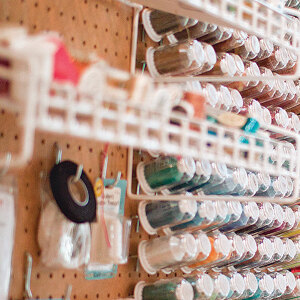
Get a peg board! I have one, together with the metal brackets. It holds serger thread, regular thread, larger spools of embroidery thread, home made patterns, notes, scissors (out of harm's way), rotary cutters and anything you wish to hang. The list is endless.
It's on the wall, so takes up no floor space, it can be as big or small as you wish and can be hanged wherever you wish, even on the 'dead' space behind the door!
The best part is it is relatively in-expensive. It looks good too, most professional and organised. No more clutter means more time to sew!
VMiles, how wonderful! It took me a long time too, to realize that I/we live here. My sewing room/studio was a "guest room" alternate, with trundle beds and a cutting table i could dismantle (with a lot of time)for the once every 2 years guests. The new, never-used trundle bed went to Salvation Army on my husband's prompting and I now spend every day in my completely dedicated sewing room, next to my DH's completely dedicated writing room, that also used to be a bedroom.
What I'm learning from these wonderful posts are 2 things. First, it pays to invest in organization for sewing. Investing in organization is always hard, as it's expensive and time consuming up front. Sewing focuses the issue because it takes so many little and big things to do it. Think of how many notions one has! But the payoff is incredible although later. In my room, I actually for the first time know where everything is and i'm comfortable and love being in there. Organization means that you can focus on creativity and productivity and not on hunting. Hunting is stressful and detracts from life.
Second is that having an avocation like sewing forces us to focus on what is truly important in our lives. We have to make choices: a once in a while guest room, or a room to live in and truly enjoy every day.
OneBroad: I have 2 of the IKEA tall Billy bookcases in my sewing room, but i don't use them for fabric (originally thought I could). I use & love them for books and some equipment/supplies, like paints, stamps, etc. For fabrics, be careful that you are aware how narrow the shelves are: about 11". Many plastic boxes are wider than this. Although U can get extra shelves for the Billy's, fabric visibilty IMHO with them isn't great.
I suggest thinking about how you can get usable-sized fabric samples of all your fabrics within easy "eye-sight," so U can see them all at once. I decided this was a huge priority for me as using them together matters a lot for my work. I also decided that samples of everything all 2gether needed to be in my room but the fabrics themselves could be stored elsewhere, as long as they were easily findable and accessible (described in my previous post below). I use kid sized hangers to individually hold samples of each of my 50o+ fabrics, and this is the single most important thing in my sewing room. If I had no closet I'd make hanging rods out of dowels and chains suspended from the ceiling to hold the hangers. In the (leftover guestroom) closet in my sewing room I took out all the original fittings and put in ClosetMaid from Home Depot, so that I can have multiple hanger rods spaced close together vertically to hold the samples, plus a few wire shelves to hold boxes with pattern pieces and fabric parts in progress.
I have a great way to organize and store patterns. I have been saving and collecting patterns for many years, even inherited a few from my mother from the 40's and 50's. I never liked the boxes I had them in and the pattern envelopes on the older ones were beginning to fall apart. So now my file cabinet is my new pattern filing system. I tape up the sides of a file folder. Write a brief description of the pattern on the file folder tab. Then I cut the pattern envelope open flat and tape or glue it to the front of the file folder. And of course the pattern pieces go inside the folder. The larger size is so nice and then I can file all the patterns in the file cabinet. No more digging through several stacked boxes!
After many years of sewing in a room shared with a guest bed I now have a whole room to myself. At the urging of my husband, son and daughter-in-law I turned our never used formal living room into my sewing room/office. It faces south and there is a large widow so I can see the comings and goings in our flower gardens during the changing seasons. My sewing cabinet, cutting table, and craft table now stand ready to use. I used Ott lights at my sewing cabinet and craft table. Plastic bins hold everything I need for my beading projects, memory books and card making. My patterns are in labeled pattern boxes. My serger stands next to my sewing machine. My threads are in see thru plastic bin made for thread. My notions, etc are in my sewing cabinet.
Happy sewing.
Go to the hardware store and purchase one or two of the small multi-drawer cabinets used for storing nuts and bolts. They are great for storing buttons, snaps, hooks & eyes, etc. I love mine!
I have a wonderful sewing room and a tip for storing carded buttons. I took those wooden thread racks the sewing stores sell and cut off every other row of pegs, then drilled holes in the top of the rack so that the racks could be hung on the wall. The result is a great place to store your buttons, you can see them and it makes a nice decorative accent in your sewing room as well. BTW, I also hang all of my thread racks on the wall, they take less space, don't get knocked over, you know exactly what you have at a glance, and they look great on the wall. I can send pics if you are interested.
Have fun!
Obviously this is a topic near and dear to alot of our hearts! such a shame that so many of us wait till everything else is done to make our dream a reality. Congrats on taking it in hand now.
I am on a redo at present having out grown the area that I had. My new area isn't any larger in wall space but has a bit more floor area. It is however unfinished so now have that to deal with.
Here are a few ideas that have made it to the new room;
I love my peg board. Have used one for 25 years. Thanks for the painting suggestion. That will perk it up. I have everthing from ribbon to needles hanging from it.
I decreased the size of the cutting table to fit but have a basket to halod fabric on the end.
My thread is also on the wall. Only way to go!
Am working on new tables for the machines but like you have planned a trip to IKEA. If they don't advertise in THREADS they are missing out on a big market!
I will anxiously watch this blog. Thanks to all for the hints.
Wow! I love all of these ideas and printed the whole article off to save since I am planning a new sewing space. It won't really be new, but we are switching bedrooms with our tween daughter who is in the smallest of 3 bedrooms in a very small house.
I have shared my sewing space with our office space since I took up sewing about 1 1/2 yrs ago. So, I'll have to share again in the smaller bedroom. It does help to know how to do mechanical drawing and space planning, which is my background in interior design, but it doesn't take the place of gathering great ideas from others who have been there; done that and are much wiser for it.
I have been using an old kitchen table as my sewing table which is deeper than your typical sewing table/cabinet. I just purchased a very inexpensive sewing cabinet to replace it, from a well-known discount store. It got awesome reviews from hundred's of people. I knew the depth would be better for the smaller space I am moving into. I found the matching mobile cabinet at another well-known discount store's website. Why either store didn't carry both items--I don't understand. I really don't need a fancy $1300 sewing cabinet that I see advertised at almost any sewing store you may go into.
Someone here mentioned it before, but I'll say it again--ORGANIZATION PAYS OFF. Yes, the initial time you put in can take a lot of time, unless you started organizing from the beginning of planning your space. But the ease of finding what you need rather than wasting time is such a benefit.
I put my fabric stash in clear bins in my large, but narrow closet. And I totally agree with the person about getting all the same storage items--saving your money to get them all at once, for example. I bought about 3-4 at a time and rather often so that the place where I got them from would pretty much keep them in stock for a while--a well-known discount store; not a speciality store. I like that they all match and are visually pleasing. I have to admit that I am not really pleased with having to go into my closet to actually get the fabrics I want to use. I would like to change this............I'm thinking, I'm thinking........
I have a large binder with organizational sheets that lists each fabric with the following info:
-the 'name' or description of the fabric, including color
-fabric content
-source (where I bought it)
-width
-price per yard
-notes (including washing/care instructions and the date I bought it)
I found this organization form for all that information at patternreview.com. It is a great way to organize. I also marked each bin with a letter on the lid and the front (depending on how they might get stacked) to correspond to the letter I wrote next to the fabric samples in the binder. And I change the yardage I have in stock if I don't use all the fabric for a project. So, I just go 'shopping' in my binder.
I keep a lot of my 'stock' info. on different spreadsheets I made on my computer. I have a list of patterns that have lots of info. about them (mfg, what size, the reviews about it, etc.) and know exactly where I can find it in pattern file boxes I found online.
I keep a lot of loose items in clear bins and label them. I want to see everything. I also have stacked clear plastic drawers. I have an 'open' bin with all my various measuring tools. I use ArtBin storage for my construction and some embroidery thread. My serger thread is kept in another clear storage bin. I keep all the brands of thread separate from one another, as I have a spreadsheet of my 'stock' so I don't keep buying duplicate thread. I know it sounds anal, but I can't help it.
I bought a kid's plastic stretch-out coat hanger (the kind that looks like diamond shapes when you expand it) in different colors at a dollar store. I attached that to the wall above my sewing table to hang scissors, embroidery hoops, tape rolls, and whatever else.
After my grandmother's death, I found an old shadow type box (you can get these at craft stores) you hang on the wall to put little trinkets on in the compartment shelves within it. I thought I would eventually find a use for it and did. I'm not a trinket collector. I attached it to the wall and put thread, pins, etc. on it.
My task lighting comes from a light I have saved from years ago when I was in college and had a drafting table at home. This is a table-mounted light with a clamp. It has springs on the arm of it and extends out over your worksurface. The actual part that provides light is a round fluorescent bulb (that I have never had to replace!) with a magnifying glass in the middle of that light. So, I can stretch out the arm to the lamp right over or to the spot needed for doing any intricate sewing or just needing that extra pow of light. It sometimes pays off to save stuff from another lifetime ago.
There are definitely some things I want to improve upon when moving into the other bedroom that I see now. I really appreciate everyone's comments to give other's much needed ideas and ones that can save some money!
I hope you have a closet in your sewing room, as most rooms do. I find it is best for fabric to hang over the bottom rod of a hanger for storage. I simply select the fabric I want as I would clothes in my bedroom closet. The closet also adds extra protection keeping the fabric out of the rooms bright lights and possible fading on the folds if left folded on an open shelve. On the closet shelves, I have my bags of batting and pillow forms on the top shelve, and clear plastic shoeboxes of trim, ribbon, buttons and patterns on the lower shelve. On the floor, sits my sewing machine case, if needed for travel, and wooden hoop stand. All very funtional and accessible when I open the door to my sewing closet.
I'm hoping to get a response from JoaninGA who mentioned cutting slots in an old bed rail and hanging rolls of fabric on it. Plus the table...I'm wondering about that. Is there a way for you to post a picture of this?
To JoaninGA... could you post a picture of the items you mentioned in your post? The bedrails and the table?
Thanks so much.
Great ideas from everybody on redoing a room. I have always had an outside building for my sewing room but with the new computer machines I found the heat and cold weather changes effected them. So, I finally took over a spare bedroom and started on my Design Studio. I took the doors off the closet and put my metal pattern cabinet on one side.
I bought this years ago when a fabric store went out of business. It has been the best. I keep patterns in the top drawers. These are labeled by style such as suits, dresses, tops, childrens, mens etc.. I keep baby items & material m etc.. in the others. I have lots of shelving, plastic bins, plastic rolling drawers, cork on the wall if front of my sewing machine, and thread racks hung where they are easy to reach. My main space is an L-shape so my machine & serger are a twist away from each other in my swivel chair. I purchased a hobby and cutting table for the middle of the room and everything is around it. On another wall I have an old cabinet with my PR620 embroidery machine. I hung thread racks on the side of the cabinet and above it on the wall so all my embroidery thread is handy. Hoops are stored under the machine and next to it is another plastic drawer bin for supplies. When I made the move I have been trying to catalog my material on three by five cards. These are stapled together by content of the box they are stored in. My ironing board sits behind me while sewing and is easy access for quick pressing. I love my studio and sometimes just go there to hang out. I sit and flick through all my magazines (that are stored in a magazine rack (that hangs behind the door) from an antiques store)gaining inspiration for my next project. Seemingly my husband has blessed me with all the latest equipment but I still long for the extra time to use it all.
Here is a great tip for storing fabric so it does not wrinkle or crease. Start with 2 lengths of rope. Knot them together at one end. Take 36" pieces of about 1" PVC pipe. Making somewhat of a ladder, thread the rope through one piece of PVC in opposite directions Leave a space about 6-8" and thread another piece of PVC pipe the same way. Keep doing this until desired length and number of pipes is used.
(I am not giving specific amounts because this is easily adaptable to make any length. When it is finished secure the bottom ends so they do not slip through the pipe. Making large knots will work. When finished it will look like a ladder you use on a boat. Then you can hang your material over each rung. This could be hung on a wall, hung on a door,
or secured over a hanger and put in the closet. You could also vary the length of PVC for a specific place. I found this idea in a magazine years ago. Great for fine fabrics.
I also save wrapping paper rolls to store material on. These can be stood up in a bin like in the stores.
Last year I finally moved out of the basement and into the spare bedroom. My room continues to evolve and must serve many purposes other than just sewing.
Suggestion for an inexpensive decent chair.....Office Depot....the Alvy chair. With coupons and special pricing, you probably could get it for less than $50. I sat in this chair extensively at a sewing class and was very satisfied. I thought the value was tremendous.
Well it looks like you have had lots of replies!! I am kind of in the same boat of starting my own sewing room. IKEA or thrift stores are the way to go for the price. I thought about buying that light table but so I could have a small L shaped I bought the cheap white table desk with gray legs in the shortest ($20 total) and 2nd to longest ($56 total) and bought the thing that goes around the leg that swivels, i put my essentials (scissors, magnet with pins, seam ripper, chalk, ruler, etc). I have enough room to have my sew machine and a small serger with a table top ironing board and still have extra room. I am buying 4 of the expedit bookcases (2X2) with locking casters to put them all together and add a cutting board on top to make my cutting table (perfect height for me). It gives me room to cut and when I'm done i just roll flush against the wall. since it is a book case i am going to add baskets/boxes to the squares for organization (possibly my thread) and extra room. Fortunately I do have a walk in closet in this room and that is where my fabric is going to be(out of light). I still have to buy a shelving or bookcases of some sort to put in there to organize. Since I also craft I want to find something with lots of drawers (not to expensive) to put in the closet to hold my craft stuff. I did buy a file cabinet from walmart with castiers (I like things mobile) so i can put my recepits, inspirations, patterns, etc in it and it also serves as a side table I can put a lamp on top for extra lighting. As for thread....not quite 100% what I'm going to do. Right now I have them in a clear plastic locking container. For extra lighting besides my window I am going to buy the pink ottlite. For my chair I have a plastic rolling chair with the small ikea sheep skin rug and ooooh is it comfy. I am going to replace my carpet with some kind of flat surface (cork, laminate, wood laminate, tile, ?). there is a blog on http://www.burdastyle.com/blog/my-sewing-room , there are alot of replies on there. I always hear that peg board it awesome and dowels on the bottom of a cork board work. Another idea I was thinking about if buy sheets of cork (painted white maybe) and kind of wallpapering a part on my wall with it. Well good luck and can't wait to see what you come up with.
Oh forgot to say I am adding a full length mirror somewhere probably on the back/front of a door. Shoe hanger on the back of a door work really well for space saving ideas to put things into. Have fun!!!
We're building out our basement now and I've really enjoyed reading all of your posts. There are some great ideas here.
From IKEA I am purchasing 3-36" 3-drawer kitchen cabinets http://www.ikea.com/us/en/catalog/products/S59814162 with a butcher block countertop and 2 tall glass door cabinets http://www.ikea.com/us/en/catalog/products/S29811867 to go along the back wall of my room. I plan to use the drawers to store my stash instead of the plastic boxes I've been using and books and other fabric will go on the shelves in the tall cabinets. I have a great bookcase, from IKEA, Expedit http://www.ikea.com/us/en/catalog/products/60071358 that houses all of my books that will be placed on the other end of the room.
I want to buy a new table http://www.ikea.com/us/en/catalog/products/S19836095 for my sewing machines and sergers but may wait a bit and use my old tabletops on file drawers for a while.
I have a wonderful old metal music library cabinet that has 30 narrow drawers where I keep all of my sewing supplies. On top I have my cutting board/work table that my Mom and I made out of sheet of plywood covered with an old wool blanket and canvas. I've replaced the top several times over the years and now have a top, with 1" square measurements on top, from a man at the Sewing Expo.
The floors will be walnut laminate and I want to put my Dad's oriental rug in the seating area of the room where I will have some comfy chairs and a table.
Lighting....now that's something we're still working out. I think I might want some cans in the soffits of the tray ceiling. My husband is insisting on 3 recessed fluorescent fixtures up the middle of the room. I want 2 and to hang a family antique chandelier in the middle. Still working on that issue! I also purchased several 3-halogen light adjustable fixtures that I want to put in several places in the room. http://www.ikea.com/us/en/catalog/products/20088681
I am really enjoying the process. I will post pictures on my blog soon. http://thelifeofnancyh.blogspot.com/
I made a cutting table using a hollow core door and saw horses. The 2x4 studs can be cut to a suitable length and the door offers plenty of room for laying out.
I have moved frequently and never had a good set up for me to sew. When I was growing up the old singer sat in a cabinet in the hall, you had to drag it into the kitchen to sew. When I first moved to Arizona, I had an Ikea table with my sewing machine and serger on it. I am short and the table with the machine on top was not working out well. A few years ago I found an older Koala outback plus cabinet (minus the serger insert) at a yard sale for $20. It is open all of the time along a long wall in my sewing room. My Bernina 350 is in the lift portion, my bernina serger sits to the right, at the ends are an older Simplicity embroidery machine that was gifted to me and an newer Janome coverstitch machine. I have a small horn cabinet on wheels in which I store my thread and some notions and a closet full of plastic bins. When I retire I will sort it all out.
You know you've got an amazing thread when people are literally writing pages to contribute ideas to storage and setting up a sewing room hey? Haha I'm getting a lot of ideas for doing up ours just by reading the comments and I hope the wife is happy with her surprise!
I think about how to work around the five windows and five doorways in my family room, soon to be sewing room. There's not a lot of wall space. Most of the wall space is only the bottom half part, maybe 3 1/2' tall. It is also not heated or cooled. The windows face all compass points: 2 west, 1 south, 1 north and 1 east into the kitchen. Lots of good natural light and some good cross breeze, if it's not too hot or cold.
I have three tables, three deep cabinets and three hutches I could use to organize. My ironing board is in that space. Plenty of clear plastic bins. I just need to protect my fabrics from fading.
I think I have al the right ingredients, I just need to place therm for good access to my stuff and good flow through the room.
We will see...
So many great tips!
Mine is I have a fantastic Palmer/Pletsch book from the 90's called "Dream Sewing Spaces" that has hands down the best practical information I've seen about planning sewing space setups but also talking in depth about sewing ergonomics. I haven't seen any other books quite like it -- and though it admittedly looks a bit dated the setup suggestions and ergonomics are still absolutely applicable. I should really pull that book back out and redo my own space!