

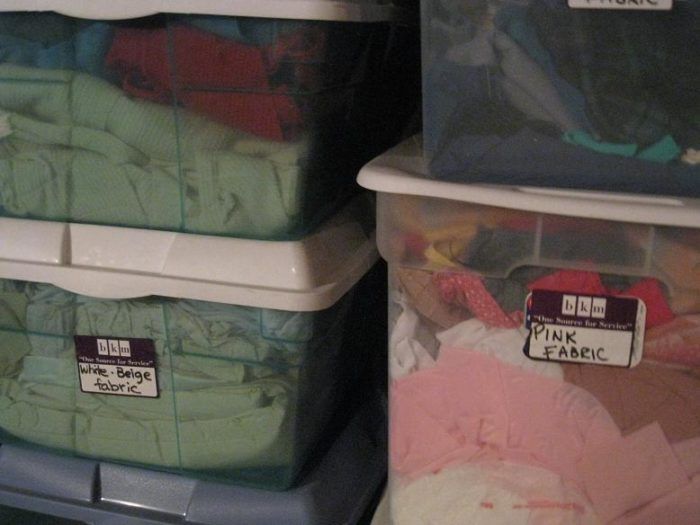
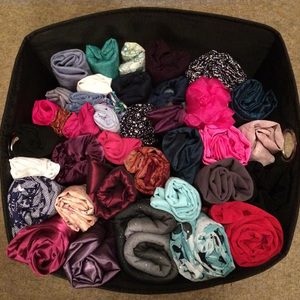
My stash is stored in plastic bins sorted by color.
My Out-of-Control Fabric Stash
Although it wasn’t a total surprise, I recently discovered that my stash had gotten totally out of control. I had fabric stored in our bedroom, in our basement as well as in two guest rooms and an office–a little here; a little there. I decided to consolidate all of it into color-coded plastic storage bins, and I was dumbfounded by how much fabric I actually had. Some I had purchased for specific projects that never came to pass; some of it had been given to me by sewing friends. Some had been in my mother’s stash. I don’t even remember the origin of many wonderful fabric pieces. I could probably sew for the rest of my life without buying a single piece of fabric–but I know I won’t be able to resist adding at least a few new colors or fabric types to my collection.
The color-coded bins are stored in my basement, and although the bins work really well, in order to get to the bottom bin, I have to remove all of the bins above it. This can be daunting at times. I’ve thought about logging all of my fabric in a journal or other paper file and include small swatches, but I actually enjoy rummaging through the bins to select my next project. I know there are undoubtedly better ways to store huge amounts of fabric in a logical fashion, but so far this seems to work best for me.
Other Stash Solutions
Our Threads seamstress uses 5 or 6 metal lateral file cabinets to store her fabrics, lace and many notions. This method is ideal because the file cabinets fit in with our office environment.
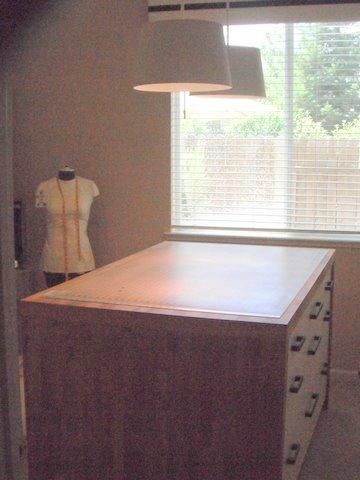
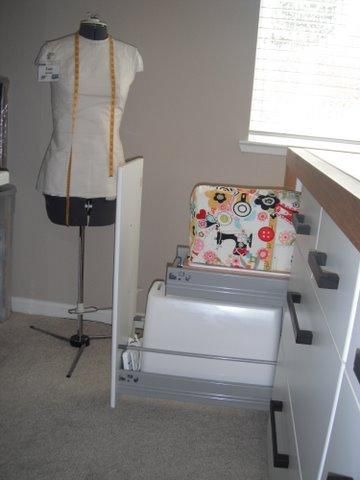
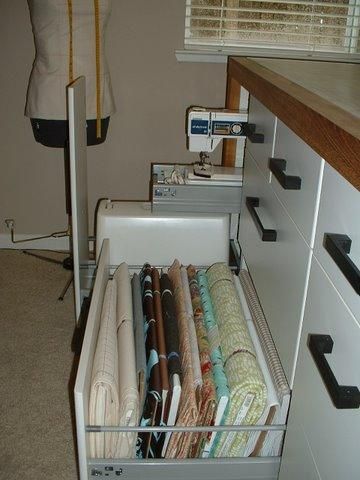
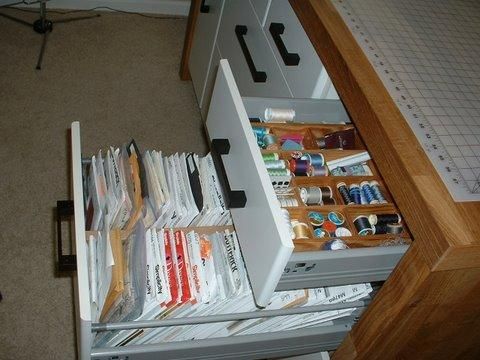
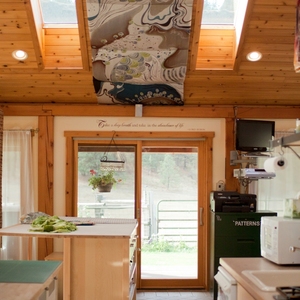
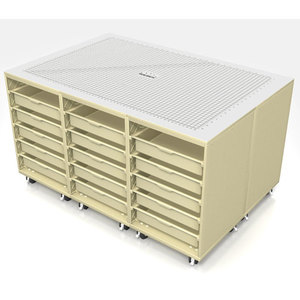
One Threads reader, Judy Gordon, wrote to me explaining how she totally revamped her sewing room. She purchased kitchen cabinets from Ikea to organize her sewing life, and she’s overjoyed with the way the room turned out. She especially loves the kitchen island cabinet that sits in the middle of her sewing room–complete with large cutting board on top. She’s tall, and the island is just the right height to make cutting comfortable. In addition, the cabinet has lots of storage. She was able to choose the drawer sizes and shapes for all of her cabinets, and she picked them out with her notions, fabric and machine storage in mind. She has everything she could ever want close at hand and easy to find.
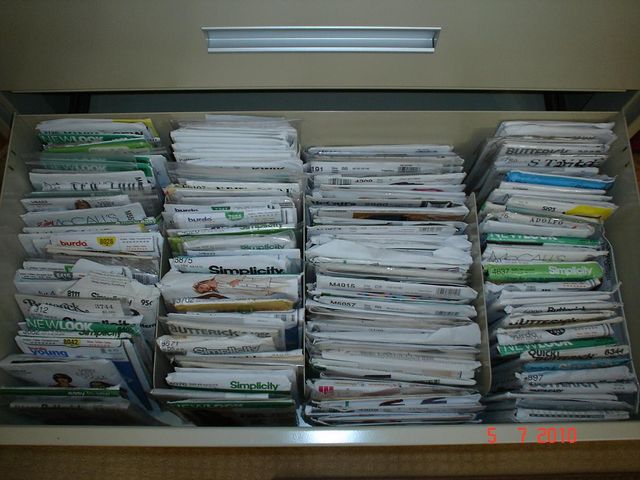
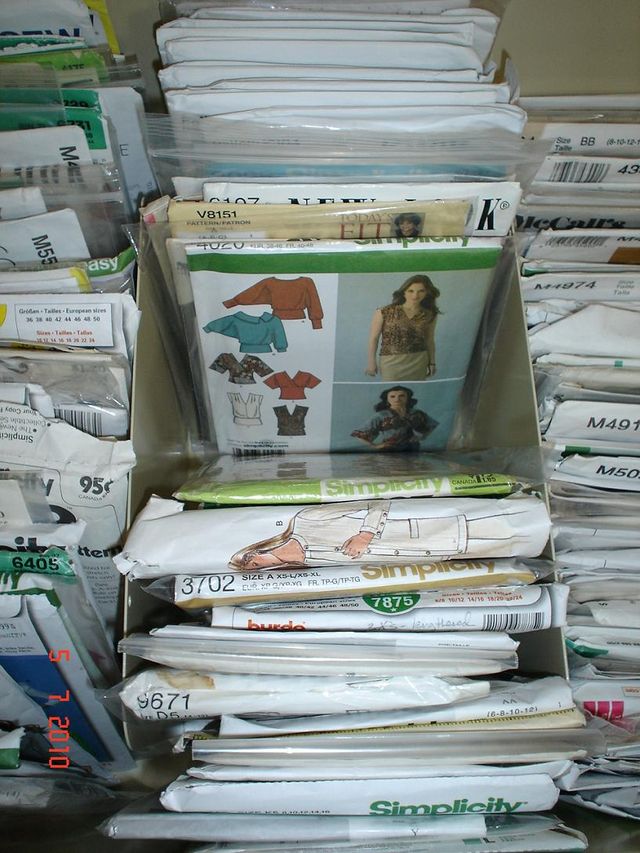
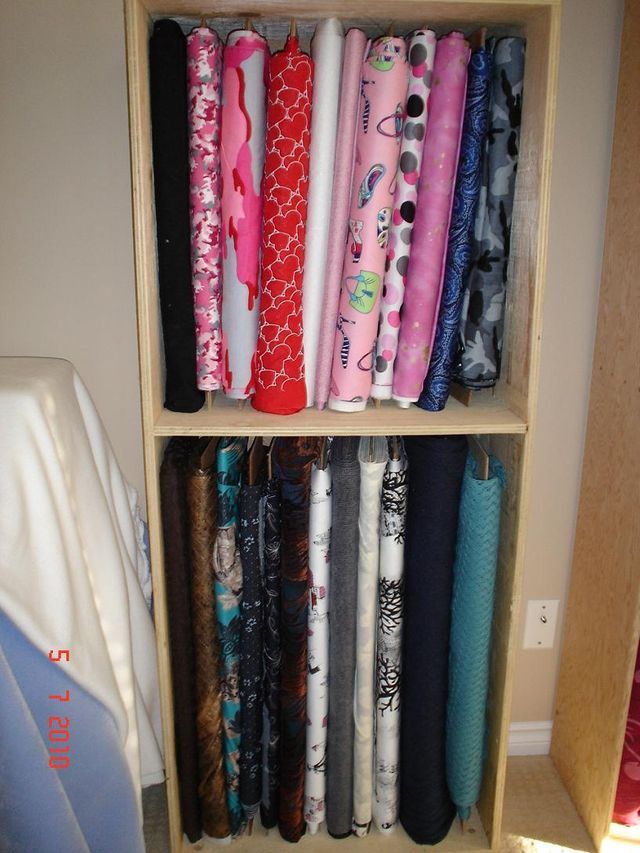
Another reader, Kirsten Ireland, sent me a photo of her pattern storage. She uses a 4-drawer lateral file cabinet, but she found one with moveable dividers. She adjusted them so that her patterns fit perfectly into each section. Now her patterns are as easy to access as they are in most fabric stores, and she no longer has to trip over plastic totes! Her husband also built her custom shelves to house her 170 bolts of fashion fabric. Her organization puts me to shame!
What great storage methods have you discovered? Have you tried ideas that ultimately failed? Have you used methods that turned out to be better than anticipated? Hopefully, we can all learn from each other’s successes and mistakes.
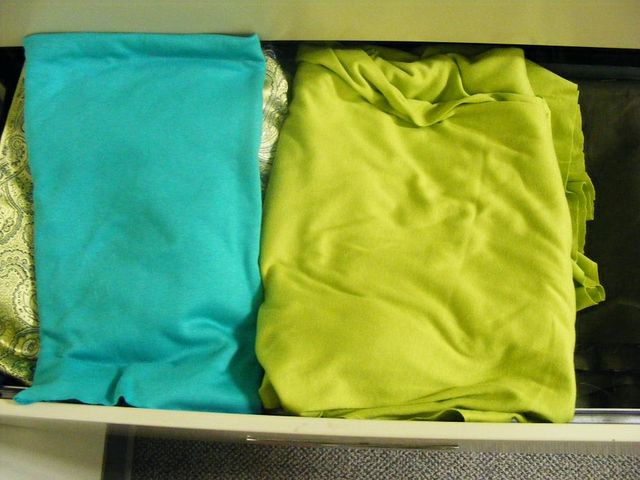











You've shown some very interesting and timely ideas. I'm in the early planning stages for my out of control sewing studio and I have been thinking of premade cabinets so to see a working studio incorporating them confirms that's the way I want to go. Like many others, I have the walls of my room covered with ideas, family pictures, and boards with lots of stuff pinned to them. It all looks very messy. Not to mention the stacks of boxes, bins and bags of fabric stashed everywhere. To organize all my stuff behind neat & tidy doors and drawers will be heaven. I made an effort two years ago to sew up my stash before I bought any new fabric; I did, but I've been shopping for fabric every since and now I have more than ever; sigh! It feels good, though!
A few years ago I bought some inexpensive garage cabinets at a hardware store. They have three equal-sized drawers that are the perfect size for laying bolts of fabric on their sides and they're even deep enough to hold pattern envelopes. They have hard-finished particle board tops so I didn't have to buy a separate countertop. I kind of like the "industrial" feel they bring to my sewing room. The drawers are too deep to organize notions well, but I'm working on getting all the small stuff into magnetic spice tins from IKEA which will hopefully end up on a piece of metal on my wall.
What I really don't know how to deal with is all the leftover pieces from my projects. What will I ever do with 1/4 yard of t-shirt knit, or 1/2 yard of chiffon from my daughter's prom dress? Probably nothing, but I can't bear to throw it out just in case. I also don't know what to do with all my unfinished projects. I sure wish my sewing room had a closet.
As soon as I purchase fabric, I serge it and throw it in the laundry for pre-washing if it needs pre-shrinking. That way I know it's always ready for me to work on when I want it. I have many large Rubbermaid bins (about 45), labelled and numbered according to type of fabric (ie: Bottom Weights, Top Weights, Laces, Linings, etc.). I choose which bin it is to go in, cut a swatch and glue it on the page in my folder for that bin. I write the length and width as well as any other comments that I may need to know later such as fibre content, flaws, border print, etc. Then the bins get piled in the basement out of the way. My fabrics are easy to find when I need them. My silks are rolled onto several tubes in layers according to colour so they aren't folded. My laces, ribbons, and trims are in small bins and arranged and labelled according to width, colour, and style. I don't have them catalogued but keep them on shelves above my cutting table so they're handy. I purchased a pattern cabinet from a store going out of business and am in the process of putting the patterns in plastic zip lock bags and arranging them by number. I will punch the envelopes and put them in a binder. The pattern cabinet is also in the basement out of the way and it saves space in my small sewing room. I can relax with a cup of tea and shop my stash without going anywhere or making a big mess!
As soon as I purchase fabric, I serge it and throw it in the laundry for pre-washing if it needs pre-shrinking. That way I know it's always ready for me to work on when I want it. I have many large Rubbermaid bins (about 45), labelled and numbered according to type of fabric (ie: Bottom Weights, Top Weights, Laces, Linings, etc.). I choose which bin it is to go in, cut a swatch and glue it on the page in my folder for that bin. I write the length and width as well as any other comments that I may need to know later such as fibre content, flaws, border print, etc. Then the bins get piled in the basement out of the way. My fabrics are easy to find when I need them. My silks are rolled onto several tubes in layers according to colour so they aren't folded. My laces, ribbons, and trims are in small bins and arranged and labelled according to width, colour, and style. I don't have them catalogued but keep them on shelves above my cutting table so they're handy. I purchased a pattern cabinet from a store going out of business and am in the process of putting the patterns in plastic zip lock bags and arranging them by number. I will punch the envelopes and put them in a binder. The pattern cabinet is also in the basement out of the way and it saves space in my small sewing room. I can relax with a cup of tea and shop my stash without going anywhere or making a big mess!
I know my stash is out of hand........ cupboard and boxes overflowing, binbags! etc etc Sometimes buy fabric because I can't find stuff I already own, But too busy sewing to organise!!!!
This is a temporary solution that I am using. I bought lots of bankers boxes, labeled them and stacked alphabetically.
So "Black- Box A; Box B; then "Blue- Box A", etc.
I include "Novelty" and "Stripes" or whatever makes sense for the work you do. Also there's boxes labeled "Special Projects- Box A" etc.
Big plastic bins are better but I can't afford them right now. The boxes are vulnerable to moisture.
I keep a spreadsheet of patterns after I accidentally purchased a duplicate pattern (it was on sale). Guess I really liked it. (It's on the smart phone.)
I'm tempted to do something similar for fabrics, too.
I find I am stimulated by the sight of the fabric, so I have a shelving system in a closet with stacks of fabrics organized to blouse, slacks/skirts, whole projects, silk, upholstery. I copy the front of my patterns as I purchase new ones and put the copies into a 3- ring binder. They are subdivided to pattern house and tops, skirts/slacks, etc. My patterns are in pattern boxes and large shoe boxes according to House. When I select a pattern, I go to the box to pull it out and check my stash. I also love to shop for fabric. I never have enough space for it all!
I'd love to know how long ago Judy Gordon purchased that wonderful island from Ikea. It is certainly something I am interested in! The storage is perfect - do we ever have enough? No. I have a very large sewing table with the original intent of more home dec sewing but w/economic downturn & that not as much in demand, it's time to make a revised plan! So, I'd like to dismantle the big table & replace it with something more manageable.
Fabric Storage: I purchased cardboard fold-out storage bins, 15"x12"x8". As each piece of fabric is placed in a box, a swatch is pasted to a small card with the length, width anad box number notated on the card. The card is placed on an adhesive photo page according to color, and the pages placed in a loose-leaf binder. The boxes are stored in three metal shelf racks against a wall in a basemeant bedroom. The racks are covered by curtains whose rods are mounted to the racks. I am able to peruse the fabric swatch catalog to search for the desired fabric, go directly to its box and extract it. At present there are 48 boxes in this system, all full. Back to the drawing board to devise more storage, as I suffer from a serious ailment known as "Fabricholic". I am no longer allowed in a fabric store unless I am on a leash.
Over the years I have amassed about 25 square metal cookie tins from the Charleston Cookie Company that still makes those wonderful benne cookies that I wear on my hips. I use the tins to store my buttons with color labels to match. They make cute multicolored gingham stacks in my bookshelf in my studio and make buttons EZ to find when I have to coordinate with fabrics at the end of my projects. I also have drawers of threads separated by shoe boxtops which are just the right depth to remove a selection of one hue for trying out in the light. Keeping them in a dark and dust-free environment keep them from fading and deteriorating.
I like being able to see my fabric at a glance so it is folded neatly and organized by color on metal shelves in my "craft closet". A room that at one time (before I owned my house) was a bathroom. Patterns are in a two drawer plastic organizer (I don't have that many patterns), ribbons, trims, lace, etc are in plastic tubs of varying sizes on other shelves in my craft closet.
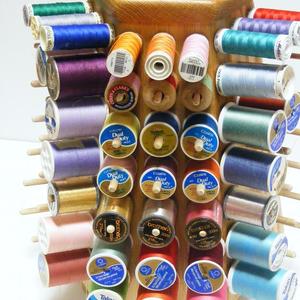
Thread lives in two old thread boxes I found at garage sales. One is harvest gold, the other avocado green lol
Projects in progress live in a heavy weight, cardboard apple box by my sewing machine. Under the small laundry basket of "repair asap" items.
I know it sounds kind of insane, but my system actually works for me!
Then there are all the OTHER crafting supplies....
I have to see my fabric to be inspired so bins don't work for me. I have a 3x12 foot well lit closet that opens on the sewing room with double doors. In it are wire shelves to hold my fabrics. I don't as big a stash as many. The fabrics have all been folded around a 5 inch acrylic ruler so are all the exact same size and stack beautifully. I sort them by type. My patterns are in those black and white boxes you get from the chains. When recently building my space, I made sure that to the left and right of my machine are large shallow drawers that I can reach into while sewing. They have in them numerous cutlery trays and in those I separate zippers, scissors, needles, etc. I like being organized and find if I am I am much more productive. I don't do well with mess and disorder. It totally sucks out my inspiration.
Hi:
I am totally new to this forum (having just discovered it today) but I loved reading all of the great storage ideas. Like many others, my fabric stash inspires me so I keep things in clear plastic containers stacked under my cutting table. My fabrics are stored according to 'quilters' uses so I have six containers labeled as follows: a fat quarter, strips, strays (left over blocks) charms (5x5 inch squares) and itsy bitsy pieces. I haven't been quilting long so my fabric stash isn't too large....yet. I'm also returning to sewing after years of raising a family and working so I am just in the process of organzing a sewing room (on a limited budget). I appreciate all of the clever ideas. Thanks!
Welcome, DeniceC., to the Threads website. I hope you find lots of information and inspiration here.
If you're returning to garment sewing after a while being away, you will enjoy reading our SewStylish fashion issues. They're only available online or on the newsstand. Threads, of course, is available as a subscription publication as well, and comes out 6 times a year. It's also available online and on the newsstand. They're both packed with lots of wonderful sewing techniques, design ideas, and inspiration to advance your sewing skills whether you're a beginner, intermediate or advanced sewer.
Please be sure to post photos of the work you've done (quilts are OK to post, too) on Readers' Closet. Look for it on the right side of our home page. I look forward to seeing it.
April Mohr
Threads, SewStylish and CraftStylish.com Editorial Department
I had no idea how much fabric I had accumulated over the years until I moved 2 years ago and there were boxes labeled 'whole pieces' vs. 'small scraps';not to mention all of the notions that went along with it.
I kept my thread stash in 2 X-large butter cookie tins. One was for the dark colors and the other for the brights and whites.
Once I got motivated and started to unpack, I transferred all the notions to a 32 qt. plastic bin w/locking lid with a list to the contents. That goes for the unfinished projects; mending bins which is up to 2 and they are different color bins, same size so they fit in the bottom section of my closet.
The fabrics are all folded in 32 qt plastic bins w/locking lids and in the bottom of my closet for now. Most of them are in categorized by type of print (Oriental, Hawaiian, Fishes, etc)but there are others that needs to be re-organized which will be done on a rainy day. My stash is up to 8 bins, plus 2 dresser drawers! LOL!
Last year we totally remodeled our house. The remodel was so extensive that we had to move out for eight months. Everything we didn't need immediately went into storage. To store my fabric stash I sorted the fabrics by fiber, putting all the cottons together, all the silks together, etc. We've been back in our beautiful house for eight months, and I've found it very helpful to leave fabrics sorted this way. They're in clear tubs, so I can see which colors I have, and I've pinned to each piece of fabric its size (length and width).
Right now these tubs are stacked against the far wall of my new sewing room. Eventually my husband is going to build shelving floor-to-ceiling along that wall, and I'll be able to take my stash out of the plastic tubs. But for right now the tub method is working.
This article plus the many comments make me feel so much better! I've had a gradually increasing stash for years and I'm now in the process of really organizing it! (Naturally I felt I had a photographic memory for everything that I had!!!)I've had most of it in a large walk-in closet plus numerous plastic bins. Last week I emptied out the closet, cleaned and painted. Full lengths of fabric was rehung but grouped according to type. I bought a large sturdy shelving unit for middle of the closet for smaller lengths of fabric and upholstery fabric. The plastic bins will hold craft fabrics, scraps from projects that are still in my wardrobe (in case I want to remodel them. I've always had two plastic bins for lining scraps.One light and one dark because once in a while you need just a little bit! As for the small scraps too small to make anything out of, if they're sturdy I know of a charity that sews bags to attach to walkers and wheelchairs in hospitals and that's where they will go. I'm about 60% of the way through my plan...wish me luck!!!
Hi! Just joined today, and am excited to be part of this creative community. I was delighted to stumble upon this article since today was the very day I began taking a digital photo inventory of my stash (more on this in a minute).
I'm passionate about the etsy credo — "reuse, recycle and repurpose," so:
* My stash is made up of irregularly sized items — they're mostly rescued clothing from thrift stores and friends. I save them for the embroidery, appliqué and fabric collage potential. With the wide variation in sizes, I can't make neat stacks that sit like well-behaved grade schoolers. I pack them tightly in the clear plastic bags that my comforters came in. I've also bought a box of extra-large Space Bags — the kind that flatten out when you vacuum out the air. I plan to clear out a TV armoire in the family room that my husband assembled for me years ago, and that's where they'll go. Our children are grown, and we only need the TV in the living room now.
* I try to stay on top of the deluge of ideas I have by keeping at least five clean paper bags on standby for grouping pieces that will eventually come together. That way I'm not constantly digging through my stash. I pose the pieces on my dining table first and snap a pic to jog my inspiration when I get the time.
* I'm mulling over options for building a quick and easy thread holder, and will likely post to my blog when I've completed it. I was inspired by an online article about using particleboard and dowels. Mine might use pot rack hooks snuggled into the grooves of wooden shutters. Either that, or the same hooks on an expanding garden trellis. No drilling, no gluing, and I can repurpose the items when another idea strikes.
* Mental organization is more important to me than physical neat freakiness. That digital inventory I mentioned earlier? After I finish taking the pictures, I'll group them by color, then begin collaging storyboards of possible projects on picnik.com or PowerPoint (so that I won't have too many paper bags sitting around).
You're all invited to check in and see if I've brought these good intentions to fruition! I anticipate being able to post about it in late September, if not earlier.
http://www.scrollwork.blogspot.com
I bought IKEA wardrobes and fitted them with a closet pole for hanging fabric that I will be using soon. Below that are two of those wire drawers, lined with thick clear vinyl and filled with neatly folded linings. Another wardrobe has shelves for fabric sorted in bins and more clear vinyl lined wire drawers.
I have a large bulletin board next to the machine with many pockets and small hooks for notions and regular stuff I use while sewing (such as hooks for cording and piping, zippers etc--things I use a lot) The pockets are pinned up on the board to hold labels, scissors, tube-turner, notes and other small items.
I definitely get more done when everything's organized.
My sewing room is relatively organized--I have lots of pegboard for notions & thread and my stash is in clear plastic bins, but there is some that is stacked on top. and I still have a counter full of "stuff". (I find if I put a project away it WILL become a UFO) The one thing that is well organized however, is my pattern collection. I need more boxes for that--again. This was not my original idea and in fact, the first time I heard about this I laughed thinking it was way to anal of a project for me. Then I spent two hours looking for a pattern because I couldn't remember how it was categorized it when I filed it into the labeled boxes. I created a spread sheet-pattern name, number, the box number & a brief description of the pattern. I put the pattern guts into quart size freezer bags (they have a white space for writing pattern number & box number on them)and put the envelopes in plastic pages which are stored in a 3" binder (there are 3 binders) Now I have a "pattern catalog" and I just flip through the catalog to find my patterns. Saves time and I reuse patterns more!!!
I had a stash for years and found that by the time I got around to using my stored fabric, I often didn't like it anymore or it was out of fashion. I eventually gave my stash to charity, got rid of my storage box and now I only buy what I am going to use. I'm still tempted when I go into my favorite fabric store and I sometimes will buy for one project ahead but no further. My sewing space looks much neater and I love what I make with new fabric.
Hello ladies-I just found this site on just the right day. After having a brain spasm that caused me to think I needed to paint my workroom (delayed somewhat by back surgery) I have just this week put everything back in place with the exception of stuff I've dumped. Some of the dumpees are older than my children who have children. I had my soon to-do projects in bags stacked on a bookcase. If I couldn't remember what the combination was going to be, the fabric went back to my stash to live again in a new project. The Stash is divided according to color into large Rubbermaid boxes. I also have a box of fancy fabrics, a box of knitting stuff, a box of upholstery, a box or linings/interlinings. The boxes fit under my cutting table and the table at right angle to my sewing machine. The tables are banquet tables bought at an office supply store. Use plastic pipe to raise the cutting table to the right height. Threads are sorted into gallon zip bags by color and the bags are in smaller Rubbermaid boxes. One bag holds fancy thread and another for polyester. Same for buttons, one box for new buttons, one for old (legacies from previous sewers)sorted and bagged by color. Patterns are in yet another Rubbermaid box which is shallow enough to have the patterns lie sideways and they are sort of divided into kids, home, men's, etc. Quilt patterns are in a file cabinet. Magazines are sorted by title and years into magazine boxes bought at an office supply store. Anything metal used for sewing (scissors, turners, hemostats etc,) are on a magnetic tool strip, bought at a home supply store, on the wall behind my machine. My little bits of fabric are divided into what I can use for strip quilts and what I can put into a bag for dog/cat pillows at the pound. So today before I turn my machine on, everything is neat and clean and I can feel ideas beginning to move around in my head. Even the air feels lighter!
Wow! I just started a massive clean-out & reorganization of the lower level of our home. I decided today that my sewing room organization needs some updating.
Currently fabrics are sorted by type & weight into numbered storage totes & cardboard boxes. There is a master list of fabric & dimensions that I try to keep up-to-date as fabrics move in & out. The stash is getting out of control & need some purging & reorg. I especially need a way to store them so I don't need to unstack boxes to get to fabrics at the bottom.
The one thing I will continue to do is to preshrink & press all fabrics before storing. This way I have an accurate measure of each piece & it is ready to go when needed.
Things I do that work:
I keep all remnants & scraps stowed under my cutting table in a fabric storage tote. Larger pieces go back to inventory (basically more than one yard, more for basic pant/trouser fabrics.) When the tote gets full I pull out 3 boxes labeled "silk remnants & scraps", "scraps - less than fat quarter" and "remnants - fat quarter or larger" and sort everything into them.
I have a lateral file drawer (36"w X 30"d X 14"h) just for linings, another for interfacings, and another for manuals, disks, instructions.
Under my 36" X 80" mat-covered cutting table are wire storage cubes where I keep containers of elastics, trims, stabilizers & goops, fabric paints & dyes, buttons, etc - mostly in recycled containers.
Thread is hung on 5 wall racks.
Tools of all kinds are in an 8-drawer rolling oak tool chest I bought years ago, with a paper cutter & hole punch mounted on top.
Topping all of this is one of my all-time best gifts - halogen track light in zones - aimed at my ironing board, cutting table & machine counter.
Things I need to improve:
Pattern storage - I draft most of my own, on freezer paper, pattern paper, or oak-tag board. Some I roll up in wrapping paper tubes, some I fold in 9x12 envelopes, still others I punch & hang on hooks in the closet, and some I throw away & reprint as needed... I need to pick a method & stick to it.
Fabric sorting - many staples like basic colors of twill or silk, denim, cotton drill cloth, muslin I buy in large quantities (1/2 bolt or more) when I see a good deal. These become obstacles in the closet or sewing room.
Like most of these commenters, I have too much fabric, old patterns, old needlework magazines, etc. I have been organizing the fabric by color and type and donating it to a quilt guild for them to make charity quilts. Some of the fabric has gone to Goodwill also. The quilt guild also wanted the magazines. I will never miss any of it since I know it is being put to good use.
Quilt Fabric sorted by color and occassion. I do my clothing fabric by type. i haven't found a good way to store thread or types of ideas for sewing.
A husband's clear plastic "fishing hook" box (HOME DEPOT OR LOWES) is excellent for threads. I have three: Blue/greens, salmon/corals, and brown/tans/gold boxes since I wear fall colors.
I bought an OLD 1930s art deco ARMOIRE for my four pattern boxes. (My dear son, Dean, inserted shelves which stand on their own.) Fabric is by subject: Skirt, slacks, jackets, dresses, etc. (I keep scraps in a bag,from my projects, in the event that something becomes torn and need mending.)Interfacing has its own box with labels.
My plastic roller chest has buttons, zippers, and bias tapes. A clear bowl in the window holds small tools often used. I feel like an artist when sewing, I do small sections, one or two hours at a time. I love the THREADS magazines and videos! Thank you so much!
My husband and I have a VERY small house and I have carved out a sewing/office area for myself in part of what used to be the attached garage. My sewing machine and desk and printers are at one end. At the other are bookcases, a bachelor chair (folding stepstool, ironing board, chair), and my stash. I use Creative Options #705 and #708 boxes because they are a nice size, stack well, are clear so I can see what's in them, are affordable, and my husband can tolerate looking at them. (Fabric.com is a great source.) I have sorted and labeled by ongoing projects, planned projects, fabrics of a certain type (music, for instance, as I purchased quite a bit for possible choir gifts and the Wizard of Oz just because I like it), and finally true stash bits, pieces, and remainders by color.
I'm sort of a fanatic that way. My thread rack, like my crayons when I was a child and learned the colors of the rainbow, is organized by color starting with red going through orange into yellow, then green to blue into violet. Browns, greys, black and white are at the bottom. My stash fabrics are organized the same way. Prints are placed into boxes depending on which color dominates the print.
Next to my sewing machine, between it and my desk, is a bookcase which stores my patterns, sorted and labeled in boxes by type - costumes, childrens, accessories, dresses, tops, bottoms, etc. I have my zippers, trims, buttons (colored, white), lace, etc. in clear shoe boxes on the shelves. It took time to do this, but it's so nice to know where things are and where to find them. I also do a bit of crafting and have those items - jewelry making tools, etc. - in clear containers
We had a home built 10 years ago and it had a 4 car attached garage. I suggested to my husband that it would make a wonderful sewing room. He told me to go for it. It extends past the front of the house so there are walls on 3 sides of the room all with nice large windows. The carpenters added extra outlets all around the room about 40" off the floor so all I have to do is reach over the tables to plug things in.
I'm not as young as some of you and have had all sorts of arrangements for threads and fabric, from peg boards to plastic boxes and open shelves. (still have some of those) Too much dust accumulated on threads that were on pegboards. They are now stored in the stacks of plastic drawers. Some are for sewing, others for serging and still others for embroidery. Other drawers have misc. small sewing items. The drawers fit neatly under two 8 foot home made tables used for 2 sergers and 2 embroidery machines. They were made to accommadate my short stature. (5'2")Now my elbows rest comfortably on the table. The chairs are low enough so that my feet are flat on the floor. (ergonomically correct)
There is also an 8 X 12 foot design wall covered with fleece. The fleece covers insulation fibre board so I can pin into it as well.
As someone else said about the fabric in boxes you have to keep moving boxes to get to the bottom one. It was a huge expense but I ordered 4 of the big metal storage cabinets from an office supply with 5 shelves and double doors that display everything at a glance. Before loading them up we cut a thick piece of plywood and added wheels for each of the cupboards. One holds quilting, one is for garment sewing, one for home dec and the other holds misc. and extra guides and threads for my long arm quilting machine.
The cutting table is from the sewbrite people and has a huge cutting mat. I've arranged the cubicles so I can sit in a drafting chair to sew if I want to alternate cutting and sewing quilt blocks.
My husband and I share one end of the 20 X 40 foot room for our computers and office supplies. We are both retired and spend a lot of time in this room. People that visit are awed by the size of the workroom until I tell them that to clean the floor it's like cleaning eight 10 X 10 foot rooms.
No matter what size the room we still have problems finding just the right place for everything. I think we could take a lesson from some of you who have condensed everything into smaller quarters.
great suggestions,every once and a while I have to make spaceas our home is not that large,when I get rid of my Threads magazines, I cut out the projects and sewing articles that Ithink I will use and put them in the clear vinyl covers and file them in my Sewing Info note book and this is faster than going through all my magazines.
I sew because I am...There is no better way to achieve an addictive state of FLOW.
Thank you for this! I've gleaned several ideas I plan to employ in my own sewing studio. I hope you do some articles on this soon--especially focusing on special storage challenges like thread, notions, scraps,fabric stash.
Anyway here are some of my storage strategies:
* Most of my fabric is in four 34 by 34 cabinets with 9 cubie holes I got at a big box store. Like others, I get inspired by looking at the colors and these allow me to see everything, yet focus on what I'm looking for. Each cubie is loosely categorized. One is full of cotton prints, organized by color. One has fashion fabrics by hand (silky ones in one cubie, dressy fabrics in another, woolens another). Another has a melange of decor, specialty fabrics, etc. And the final one has basics. For delicate fabrics, I got those canvas drawers that slide into the cubies so they won't be damaged by the sun.
* My old college trunk holds a lot of the fabric I inherited from my mom. Shamed to say the rest is in the garage in large plastic bags.
* My cutting table is a solid wood door sitting on top of two of the cabinets above.
* Regular thread spools are organized by type and color into clear lucite cubies that were originally designed to organize office supplies.
* Notions, cone threads, etc. are organized in six sets of plastic drawers I picked up on sale at a box store. They work very well.
* Craft items, assorted tools and other odds and ends are in plastic boxes from the dollar store that were originally designed to house shoes.
* Buttons are organized by color in clear jars from Ikea. These jars were originally designed for spices.
* All of my books and magazines are in two bookcases from the local box store.
* Fabric still on the rolls is standing on it's end inside an old clothes hamper.
* Scraps are gathered by color into old hat boxes or in clear vacuum "space" bags-- which are kind of cool cause they don't take a lot of space and you can see whats there before you open up the bag.
* Articles I've clipped from other magazines (my Threads are all in tact); are neatly organized by category into those magnetic photo albums that are horrible for photos, but perfect for clippings!
* My cutting board is a 30 X 80 solid wood door covered with cutting mats and resting on top of the cabinets described above.
* Three bulletin boards hold odd notions (like embroidery hoops), inspriation clippings, a floor plan of the room, and swatches from current projects.
Now, why isn't the room neat and tidy?
I sew because I like clothes that fit ME in colors that flatter ME.
I sew because I love clothes that fit and because it is my form of meditation.
psfws1963 writes: you ask why i injoy sewing.I don't know why it's something that i know i should be doing. It's just one of my many passions in life. posted: 9:31 am on September 19th
I have my fabric in 6 plastic draweres stacked on top of each other. Also some fabric in three small bins (mostly cotton fabric in the three bins, one for linen look material that my mother gave me. The other bin drawers are organized by fashion fabric and cotton fabric for quilting. One bin is of interfacing and muslin and the other bin is for fleece. I have my embroidery thread in bins on a two shelf roll table. Inside the shelf roll table is a basket of fat quarters and some show boxes of serger thread and regular thread. I also use a fishing supply box for my smaller thread. It is labeled by color. I have a four plastic drawers with zippers in a plastic shoe box and elastic in another plastic shoe box. I keep my patterns in a large plastic bin. I got an idea from another website for pattern storage and I used it. I made color copies of the front and back of the pattern envelope and put the two pages in page protectors and put them in a 3-ring binder in order of tops, pants, multi-clothes, knits, etc. Now they are in order and I can find them at a glance. They are also in the same order in the plastic bin. I have a small sewing cabinet that my brother made me years ago that I keep my notions, needles and supplies in. In one part of the room is our computer and printer, along the shelf on the computer desk are some of my sewing books and binders.
Wow, you guys put my fabric storage to shame. I have mine stuffed into a suitcase...
Maybe I should fold it and color coordinate it at the least. :/
I have two boxes for jeans to sew green projects; a storage bin for flat fabrics, a work box (all the items I need to complete the current project), a box for felt hats I find at yard sales (I rework them to make special creations), one for beads, one for leather and purse findings, and others for those little odds and ends like ribbons etc., but I need to find a home for special fabrics and clothes that I can't wear but can use the fabric in other ways....... linings, velvets, etc. I am a make-do kind of sewer right now due to a lack of cash for crafting. I found this idea of separate boxes for each category of supplies in a sewing book from the 1940's. Great ideas for re-working damaged clothing were in there.... gotta keep this one! I'm a recessionista LOL!
I'm 63 and have been garment sewing since 13 and in many settings. My husband and I built our house 12 years ago and one bedroom had to be the sewing room!! Storage:
1)2 kitchen "islands" from World Market placed back to back for a cutting table 48" square. There are drawers and shelves underneath for storage. 2)a built-in large custom made desk with drawers and top for my sewing machine and serger 3)an old wooden file cabinet inherited from my mother-in-law butted against the desk and used for pattern storage. The side of the file cabinet has handy reference charts and fashion ideas. The top has a TV-VCR-DVD combo. CDs are stored in a notebook. I am about to donate my old Threads magazines and use the CD for 1985-2010 issues 4)I made a padded bulletin board for the back of the desk with fabric to match the walls (dusty pink) and printed fabric ribbon which I collected from fancy presents, supplemented by plain black grosgrain. The bulletin holds photos of embroidery samples and grandchildren modeling things "Gigi" made for them. 5)an old dress form wrapped in silk with old jewelry attached. This form is about to get an overhaul--will be a working model as featured in Threads magazine on how to create one used in French couture. 6)The closet has shelves across it inside and double doors. It holds fabric wrapped on carboard inserts I collected from a local fabric store and grouped somewhat by color. 7)A white iron daybed is against one wall-underbed storage hidden by a dust ruffle.8)Lighting is an important consideration in a sewing room-desk lamp, 2 large shuttered windows, recessed general lighting and 2 drop-down pendant lights over the sewing desk. 8)There's adequate storage for the normal seamtress, but I still need to cull out occasionally, and of course, there's fabric spillage elsewhere in the house.
I was just talking to a friend recently about how similar these sewing storage counters are similar to garage counters. When it comes to stowing the little things away, it just helps to have a dedicated drawer for different things doesn't it.
I wash all my new fabric in the hottest water the fabric will take, dry the fabric, then fold and hang each piece on its own hanger in a huge closet. When I want to sew, the fabric is ready!
I have built-in bookcases on one wall to store sewing books, flat patterns numerically, and similar items. My machines are by corner windows so I have the best light for sewing. (I had to wait for my son to leave for college to get his room!)