
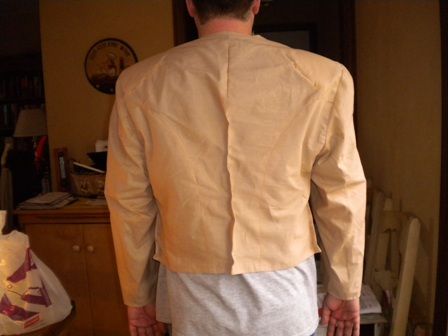
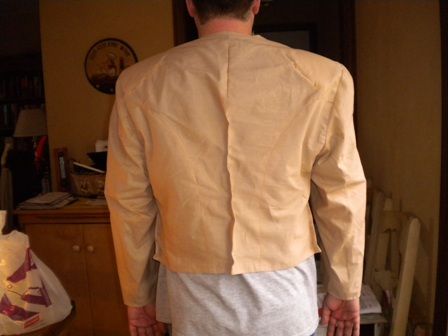
muslin-back view
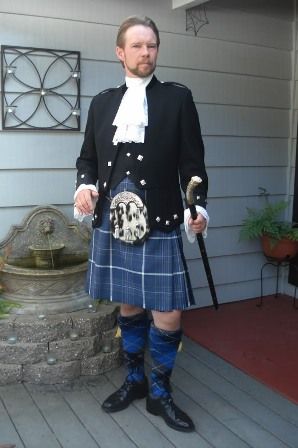
I am in need of some help in fitting a muslin. this is a Sheriffmuir doublet, a formal piece worn with the kilt. I have drafted a pattern and for the most part, it fits my client well. pictures show the back view of the muslin, and what a “store-bought” doublet looks like.
As seen in the back view of the muslin, it bags and sags oddly in the juncture where the back and sleeve come together, and in the back of the sleeve as well. Does anyone have a suggestion as to how I can modify the pattern to make this fit better?
I am in Idaho and my client is in Boston. Were we closer together, we could have this all sorted out in a half hour. As it is, I make up the muslin, mail it to him, he tries it on and takes pix then sends it back for a re-vamping. It’s getting costly to be mailing packages back and forth across the continent, and I am wanting to actually get going on this.
The Sheriffmuir is intended to fit snugly, and is not a relaxed fit as one would find with a sport jacket.
Any comments or help from the pros out there would be greatly appreciated.








I'm far from being a pro, but I recently had precisely the same fitting problem in the back of the muslin for a ladies jacket I was constructing for myself. Maybe my experience might point you in a direction you haven't considered yet for that.
After 2 weeks of trying every possible combination of alterations known to man I gave up in disgust and went on to another project. About 3 weeks later it suddenly dawned on me that most of the alterations I had tried were attempts to reduce the size - everywhere except the bust and waist. That tipped me off that I actually was NOT using the right size pattern. I tried one more time with the next size smaller pattern and made adjustments to increase the bust and waist (pretty easy since I was using a multi-size pattern) and voila - a perfect fit. The entire back and shoulders were just too large in the pattern size I had chosen originally and would not hang correctly no matter what I did.
I agree with Ginnylynn. Try reading some of Kenneth King's alterations series he's published on Threads. He talks about net gain and loss in garments. It appears that the shoulders are quite extended, which can be ok (and thus the need for the shoulder pads to support the extension) but the back is just too wide starting from about the 1" from the top of the sleeve cap. If you had a fitting assistant there you could pin out the excess folds, tapering to nothing at the sleeve cap, the fold amount would be what you would essentially reduce the back by (by "cutting" each the armhole in farther one-half the amount which would reduce the width.
The other problem with the sleeves; you are a brave lady to take on sewing for someone you can't touch. So many things are not going to be apparent to you in pictures like posture and stance that can affect fitting. I have a problem with sleeves that wrinkle; my lower arms curve forward more than the norm and a two-piece sleeve with some extra length eased in starting at just above the elbow and ending just below is a must for me. I use my own pattern I've drafted and use in every garment and throw the pattern piece away. Even when the sleeve cap is wide enough a one-piece sleeve still twists because I need more shaping.
It also appears from the photo that he may have one shoulder that slopes a little lower than the other (not uncommon)(looking at the photo left side) and you may have to build a little thicker pad to even it out.
Good luck. As I said fitting is difficult enough without trying to do it virtually. One of the reasons that people that routinely have custom clothes made for them have a body double that the seamstress can do most prefitting on.
Greetings FabricLover007, 24 November, 12:36MST
Thanks for your feedback. I'll look into those alteration articles you mentioned.
BTW, I am a man, not a lady. ( wink!)
Unless being a Kilted Man classes me with the Scots of yore who came to be called "The Ladies From Hell", by the Germans in WW I.
In that case, I'll take it as a complement!
Regards aye,
Tim
I would try the following to achieve a closer fit at the back of the jacket:
1. Reduce the across shoulder measurement so that the roll of the sleeve is closer to the top of the arm. (-1/2")
2. Reduce the back armhole by slashing pattern horizontally from centre back to armhole.(-1/2")
3. Reduce the upper back sleeve by same amount.(-1/2")
4. Consider adding a back shoulder dart. This helps to fit the curve of the back. the dart could be 3/8" to 1/2" depending on posture.
5. Add a vertical fitting seam/dart at the side back that runs from hem or close to the hem to the armhole. Refer to a classic mens fitted suit jacket for shape and location.
Hope this is helpful.
I wish I knew how to add a drawing to the comment box!
Good luck! I admire your will to do the task long distance.
Hi Tim, I would like to share how I would tackle this dilemma:
Staring at the shoulder seam, place a dot at the desired shoulder seam line (where the seam should be).
Now, measure the distance between the current jacket shoulder seam and the desired seam from your dot. This distance will be the amount to decrease the width of jacket front and back, which will pull in the arm hole to where it should be. (I'm assuming the front is too wide as well),Ex. If the distance between the current top sleeve shoulder point is 3/4", then you will place a dot 3/4" away from the current armhole sleeve seam every 1/4" to 1/2" apart, finishing at the underarm on the jacket side seam.
Using a french curve, draw a line connecting the dots. This is your new cutting line that will decrease the jacket width.
You will now adjust the height of the top sleeve seam by adding the same adjusting measurement, ex. 3/4", to the top sleeve. This will increase the height of the sleeve, allowing it to meet with the desired jacket armhole neatly.
At this point, your sleeve is a little longer. You can make an adjustment by, cutting off the adjusting amount, ex. 3/4" from the sleeve hem line.
*Don't forget to add your seam allowance to the adjustment before you cut from the adjusted pattern.
**If the front jacket isn't wide enough to use the same adjusting measurement as the back, you can still use the same method by, putting a dot at the desired location on the armhole front panel,and measure the distance between the dot and the current point of the jacket front arm hole. Repeat the previous steps.
*** This is my giving to you, for "Thanks Giving". I do hope this will help.
Greetings Manella, 26 November, 05:38MST
Thanks for sharing your thoughts with me. I can't decrease the width across the back, as I have already altered my pattern to widen it across the back. The fit in the front is fine.
It's just that there is that bunched up undersleeve and consequent bunching of the back right where the sleeve join is.
I'm thinking perhaps that I need to decrease the height of the sleeve cap, and make a proportionate change in the armscye.
I'm waiting on my client to get back to me with some measurements purtenant to making that adjustment.
T'would be easier if we weren't separated by the entire continent, or if I had a male body form. Those things aren't cheap........
Best for the Holiday season to you and yours.
Regards aye,
T.
One shoulder is higher.
Armcycle is not correct. Needs shoulder length shortened.
It appears that the arc needs to be closer to body and perhaps not as deep.
Cannot see from picture if client is round shouldered but that could also make a difference. Men get 'dowager's hump" as well and you may need to allow more fabric over the hump.
The disadvantage of distance between the client and the seamstress/taylor is that you cannot tug the muslin to view the fold changes. Can the client send you a similar jacket that does fit him?
Try more measurements.
Hi, I'm far from being a pro as well, but I think that Ginny may be on to something. If at all possible it would be great if you could get someone to measure the person and relay the measurements to you. Look up how to make patterns for all of the measurements and how. Then take those measurements and transfer to your pattern. This along with your adjustments you already know about should get you closer to a better fit. I would search out anything you can find on pattern making and fitting alterations for additional help and tips. Also the doublet should be fitted with the white shirt underneath, not the t-shirt as it appears in the picture. If this is the jacket as seen in the picture they need to try moving in the muslin as well. What kind of pattern did you start with first? A jacket pattern or a shirt pattern? The sleeves and armholes are designed different. Did you check out costume patterns? I would also check online (google)to see if there are any forums or blogs for additional info, helps and tips. Keep us posted on your progress and the final outcome. Good Luck
Hi, A great system for pattern making is the Lutterloh System of making correct fitted patterns. They can be found at: ( http://www.lutterloh-system.com/ ). You can correct the back pattern separate from the front. I agree that the shoulder is the original of the problem and not the middle of the back. By moving the shoulder seam in towards the neck, then readjusting the shoulder seam arc the bunching should improve. It also appears that there is alot of extra room in the sleeve, it may need to be adjusted as well but not by much.
Greetings all, 2 December, 12:20MST
My thanks to all for weighing-in on my sewing dilemma.
What I have done now, is rip out the sleeves, and sent my client just the body. He's to be having more pix taken, and with some measuring help on his end, and my suggestions; to fit up the body in the back.
I will then make the appropriate changes on the body pattern pieces, then probably have to shorten the sleeve-cap accordingly.
Regards aye,
T.
I'm not sure that the client has his back totally square on to the camera, however the shoulder seam looks too long to me and needs to be narrowed. Also I hope you have staystitched the neckline, as this can stretch surprisingly and can throw this area out of kilter. I personally thought that this style of jacket had what is known as a 'yoke back' similar to what is seen on a frock coat or a victorian body coat. I would reccommend that you head on over to http://www.cutterandtailor.com where you will be able to pick up lots of pattern drafts and information from pro tailors. Just be warned that the site is for pro. tailors by pro. tailors working in the here and now; they do not countenance "the fancy dress/steampunk-I'll start with the bodycoat/hardest item there is to tailor- brigade", but you should be ok with highland regalia.
Greetings Posy, Pearl Harbor Day, 5:48pmMST
Thanks for "weighing in" on this. I got some new pix from my client with just the body and no sleeves. Shoulder pads in place.
I do need to take in the shoulder length by 7/8" each and am messing around with the sleeve pattern. It is a two piece sleeve, and I am adjusting the sleeve circumference to match the armhole, plus a couple inches for ease in the sleeve cap.
Thanks for the weblink. I'll take a squint at it.
Merry Christmas to you and yours.
Regards aye,
T.