
Corset Supplies From the Hardware Store
Use zip ties when you can't get boning.
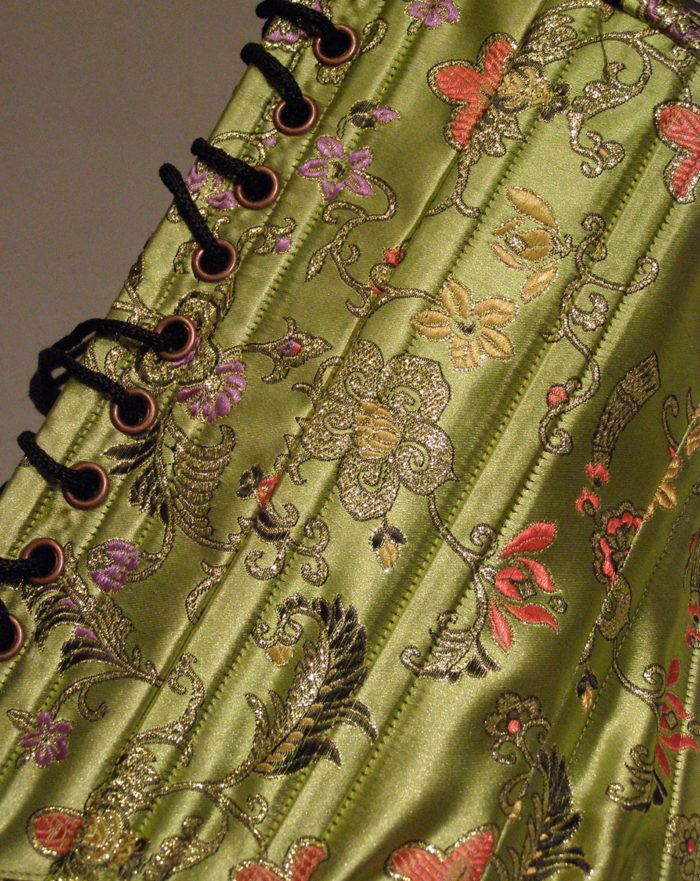
I was talking to a correspondent in Wisconsin recently, and we got on the subject of boning for strapless dresses. It seems she had a tight deadline for a wedding dress and was in a quandary about where to get boning in her small town. I mentioned the tip I was given about using zip ties as boning. She really was enthusiastic. The ties were something she could readily get it at a nearby building supply store, rather than having to order them from a distant or online retailer and wait for their delivery.
The tip: Use zip ties as boning
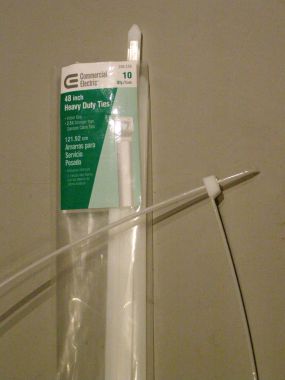
These are also called cable ties, and I heard about using them from some of my students who are into corsetry. They said the zip ties were a suitable substitute for whalebone. The zip ties come in different thicknesses, but I decided to use the heavy-duty ones.
Putting zip ties to the test
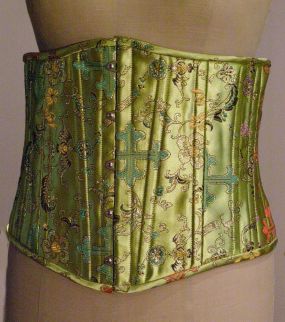
I decided to try this out and made myself a men’s-corset-as-cummerbund.
Aside from the fashion fabric (which I also lined the corset with), there’s a layer of cotton twill as interlining. The lengthwise grain of the twill is parallel to the waist, meaning it runs 90 degrees to the center lines.
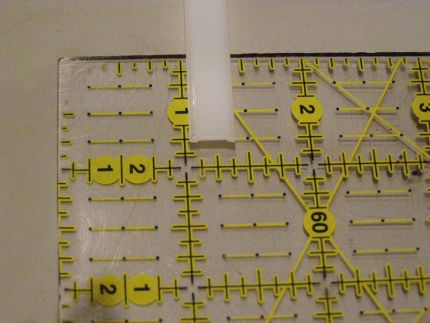
These ties are shy of 3/8 inch wide, so when sewing channels for boning, you can sew true 3/8 inch parallel rows of stitching, to contain the boning.
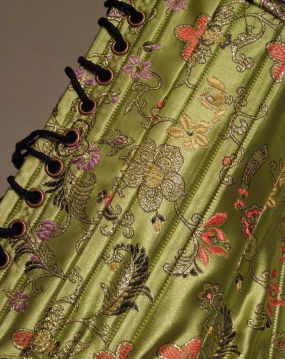
The channels were sewn through all layers after the vertical seams were sewn, and before the binding was applied.
When cutting the ties to make the boning, snip them long enough for the ends to sit next to…
Start your 14-day FREE trial to access this story.
Start your FREE trial today and get instant access to this article plus access to all Threads Insider content.
Start Your Free TrialAlready an Insider? Log in










What a great idea! My hubby always has these things in his garage, so I can steal his and save myelf a small fortune! Mr King, you are a god!
Thanks for the compliment, but I'd say I'm more of a disciple (of fashion)! And besides, it wasn't my idea, I'm just the one passing it along...
Great to see this here, Kenneth! I've been contemplating using electrical ties instead of the more expensive steel bones I'm used to for some planned costume bodices, but I just haven't taken the leap. The thing I find most promising about them, from what I've read on various costumers' blogs, is that body heat won't soften the ties and shape them to the wearer's form (bulges, curves, etc.)--they'll retain their firmness, unlike regular plastic boning.
I have used quick cable ties in costuming as well. They are very handy when time and budget prevents me from using the steel stays. However, be aware that they are 'fatter' and will give the garment a thicker feel than regular corset stays.
I am so going to be looking around the house and garage with an entirely different outlook! LOL!
I have worked with electrical ties on many costume projects. They are inexpensive, readily available, and can be cut without special tools. They are not, however, one standard thickness. The smaller ties are narrow and thin, and the longer ties yield a thicker and heavier bone. Use both for the different areas of your corset that require different support.
Check out the 2009 contest at nationalsewingmonth.org (sponsored by sewing.org). Entry 9 & 10 used these as a recycle/up-cycle alternative along with a lot of other found items.
September is National Sewing Month, get sewing!
You need to be aware that the ties will not do as good a job as spiral steel bones, or better yet, white steel bones. But if you only need light support, they are fine.
Supplies can always be got by mail order from Farthingales -- they sell by mail order. For the US, they are in California, and for everywhere else, try Stratford, Ontario, Canada. Just Google them -- they are very fast! :)
Christine
Maker of Corsets
I have found lots of interesting items that lend themselves to various sewing projects at our local Surplus store: tiny key rings, star washers in copper, brass or aluminum, whole spools of key chain in both stainless steel and brass including assorted fasteners and connectors. At a woolen mill in the Amana colonies, IA, wooden spools and bobbins I used to cap off cafe rods I made of wooden dowels. I have trimmed and saved the selvage register marks of some cottons which are as attractive as the printed fabric. Does anyone have any suggestions for these? The Habitat Restore in Davenport, IA, is loaded with hardware items, dresser pulls, escutcheons, etc. that I can see trimming the pockets of jackets.
Brilliant substitute for those of us who don't have sewing supplies close by. Thanks for passing it along.
What an AWESOME tip! Thank you so much for posting this! Since I do doll sewing (1/4 and 1/6 scale) cable ties would be so much easier to use!
Mr. King, I always marvel at the perfection of your sewing!!! I remember watching you many years ago on PBS in RI, maybe on Sewing with Nancy (?) and just soaking up the tips and methodology you showed us. I bought your book on shirtmaking, and again learned alot! I've been sewing over 40 years, and have to credit you with a lot of my skills!
This cumerbund is just beautiful, and every thread appears in place! I would expect nothing less from you! Great idea with the ties, too. I have the tendency to OVER order things, and when I was making Ren Faire fashions a few years ago, I think I ordered 10 miles of boning, but when I finally DO run out, I'll remember this tip.
Thank you for being so generous with your instructions, and having impeccable teaching as well as sewing skills!
I do love this tip! Zip Ties!! Forget the hardware store, I have these in my electrical bag :D
Thought I'd also add this link for anyone interested in more supplies...
http://www.farthingalescorsetmakingsupplies.com
We recently used these (what we call 'electrical ties') in a variety of weights for Elizabethan costumes for the stage. The slightly angled ends are helpful for distributing the pressure around the waist in tab-bottomed corsets, or in corsets that just come down slightly past the natural waist. All of the ties we used were easy to work with and inexpensive. And they didn't add any weight to the already heavy costumes. As another reader observed, they don't change shape, in our case, even after about five weeks of dress rehearsals and performances under hot stage lights. For dance costumes, with which range of motion and freedom of movement are more important, I would use coiled steel boning. But for anything less active, these are fabulous. And they are cheap enough to play with ... imagine the shaping possibilities!
Oh, my, what a fantastic idea! I've used items from the hardware store for embellishment (and unusual home decor) but would have never thought of using zip ties in constructing a garment. Thank you so much for sharing this, it somehow makes corset-making less daunting.
Additionally, your choice of grommets is really quite yummy with the coloring of your fabric and looks so much better than the usual silvertone one finds on corsets.
I've used zip ties a fair bit, but I'm not really happy with their springback ability. After several wearings, if you do any bending at the waist, the ties tend to develop a permanent crick, which can make the below the waist bit of the corset try to poke outwards.
It's an ok solution for one time wear or a learning piece, but not so much for a real sturdy corset.
I've had luck with using hemp cording - if you use the Elizabethan style of cording the entire piece, really seems to stand up much better if you need stabalizer in a pinch. You can even just cord layers of underbody and then top the whole thing with tacked on fashion fabric if you don't want the look of a gazillion little stitching lines. You can also get that at the hardware store.
I am so excited to try this idea. It came at the perfect time. I am in the process of making several corsets for Halloween. Thank you for sharing!
Luna (costume maker)
What a great idea!!
I'm all for using materials in unexpected ways! I use large grommets from the hardware store on corsets. They are just as heavy-duty as the ones usually used on a corset that is made to hold up to a lot of wear (unlike the tiny grommets), but are faster to get a hold of and less expensive (not that grommets are that expensive, mind you).
The suitability of substitute materials all depends on the the requirements of the garment. If you're making doll clothes or a one time wear Halloween costume, zip-ties may be an excellent choice, but if you want to wear the corset again or have it give you shape, you will find that the "bones" bend in unpleasant and permanent ways. I've had to rebone store bought corsets with 1/4" spring steel bones for people. Of course that was a temporary fix as those corsets are not made with coutil or often even canvas or duck and soon lost their shape anyway.
Farthingales is an awesome resource for all corset making supplies. Their blog has great tips and shows some beautiful corsets in the making.
Rogues of Thread
bythebodkin.wordpress.com
I greatly enjoy reading Mr. King's articles. He is an amazing artist with great techniques. I have previously worked as a seamstress, needleworker, and costumer. A former boss had told me about using zipties for quick, inexpensive, flexible boning (some bend more one way too, so face them so they do bend outward). She also told me that a quick way to cut them off AND give a gently curved end which was less likely to poke through the end of the channel was to use either fingernail or toenail clippers, depending on the thickness of the ziptie!
I have issues with using the zip ties in corsets. First they hold in the heat as it is using polyester in your corset. This is fine if it is a short time use costume, but if you are using it for wear under multiple layers for a period correct look you will have heat issues. I have seen ladies go down in a 70F day with having used zip ties in their Elizabethan corset. It also likes to poke through worse than any steel I have used. I also have had the issue in a formal dress where they bent over and stayed that way the whole time. Even when you let it relax after an event (the formal) it will immediately recrimp to the bent form regardless of what you do in subsequent wears.
In regards to grommets in corsets, yes they work again if a costume, but if you use this for a firming corset (much less CW or Victorian) they will pull out and deform your look. I do however like the stainless steel washers to wrap and use and awl to create the hole for corsets. That is an awesome and strong tie. (Again depends on if it's a few time wear or your undergarment mainstay)
Lisa - 16th century recreationist
I have used the plastic cable of a grass trimmer from my husband's garage!. The cable is very thick and you can melt the ends.
Hadn't thought of zip ties in terms of holding heat in an Elizabethan corset. That's what mine has, and I've been wearing it for seven years. The corset is 100% cotton and linen fabrics, most of them re-purposed, and it does get sweaty, so I (gasp) throw it in the washer. Haven't had the issue of the zip ties cracking at the waist or at all. This corset is perhaps heavily boned enuogh to prevent that type of bending - or I'm able to be a little more careful? When I'm wearing it, it's knees and hips that do the bending, not waist. The zip ties do eventually poke through the top seam, so I reinforced that seam. I wear a D cup, so I added a little support inside the corset, based on pistures of historic corsets. I know that historically, less affluent women used things like reeds as stiffening in corsets. I've experimented with all sorts of things, because I simply can't afford steel boning. The heavy duty electrical ties from the lumber yard work. I've used the wimpy little ones to stiffen a hat, but as corset materials, they're no better than that plastic stuff sold as boning in fabric stores. I have a Victorian riding corset (early experiment) made of denim cut from the good parts of worn out jeans, "boned" with rope clothesline. It works quite well to eliminate soreness from driving or riding around mountain roads in vintage pickups with extremely stiff suspension. Purism is all well and good, but it can come off as snobby and exclusionary. It's not just those of us who sew. My dad is a sculptor who spent years being told that his work wasn't art because it wasn't painting or at least cast metals. There are times and places for both purism and affordable function.
These are also great for threading through a anug casing at the edge of a bell sleeve or hem for a fluted edge on heavier fabrics, especially for the stage. (This is a more dramatic version of serging a narrow hem over fishing line on tulle and such.) Just slide cable ties into the casing end to end. You can close the casing with a tack stitch or a safety pin and remove the ties to clean or store the garment.
typo -- that's a "snug" casing
Hello!
In response to Puterdame, the show was called Sewing Today, and the host was a lovely woman named Nancy Fleming, who was Miss America 1961 (her talent was sewing). Sewing With Nancy is still on-air and is hosted by Nancy Ziehman, another lovely woman.
As for the shirt book, that would be David Coffin, who was an editor for this fine publication for a number of years--he has a book out on Trouser construction now, which is excellent. My book, called Cool Couture, is still selling briskly.
For those comments regarding the drawbacks for the zip ties, indeed there are. They aren't a substitute in all cases for spring steel or spiral steel, but another resource to consider when making a project (especially if you are in a time crunch and don't have the proper materials on hand.
As for the comfort in wearing, the fabrics on this corset are silk and cotton, and there is quite a bit of space between the bones, so the garment is comfortable to wear. But it is a bit thick from the thickness of the zip ties, but I don't have too much aversion to that.
Besides, these corsets I made (I did three of them that weekend) were an experiment, so I really expected nothing more. Having something that I could wear afterward was just a bonus!
Hello!
In response to Puterdame, the show was called Sewing Today, and the host was a lovely woman named Nancy Fleming, who was Miss America 1961 (her talent was sewing). Sewing With Nancy is still on-air and is hosted by Nancy Ziehman, another lovely woman.
As for the shirt book, that would be David Coffin, who was an editor for this fine publication for a number of years--he has a book out on Trouser construction now, which is excellent. My book, called Cool Couture, is still selling briskly.
For those comments regarding the drawbacks for the zip ties, indeed there are. They aren't a substitute in all cases for spring steel or spiral steel, but another resource to consider when making a project (especially if you are in a time crunch and don't have the proper materials on hand.
As for the comfort in wearing, the fabrics on this corset are silk and cotton, and there is quite a bit of space between the bones, so the garment is comfortable to wear. But it is a bit thick from the thickness of the zip ties, but I don't have too much aversion to that.
Besides, these corsets I made (I did three of them that weekend) were an experiment, so I really expected nothing more. Having something that I could wear afterward was just a bonus!
I apologize for the double post--working in-flight can be so distracting!
Heehee! When I first skimmed this article, I though the zip ties were to fasten the corset with. ;-)
I love cable ties and use them often, but they can be a safety hazard. A customer of mine left her corset in progress and came back in the room just in time to find her child had fastened one around his neck and was frantically pulling the on the end trying to get it off, which only tightened it more. Had she been a minute longer, there would have been a tragedy. If you have children in the house, cut the fastener ends off as soon as you purchase them.
Thank you Mr. King for this information. I thought it was a good idea in time of need. How creative!
If you are going to be using a busk, might as well buy the sprial bones too, a 10 yd coil is only about $10 & its easy to cut & tip
WHY on earth would anyone use zip-ties instead of the boning meant for this purpose? Buy it on line, buy it at the fabric store, but boning is made for garments! Zip-ties are not.
I made an Elizabethan corset with plastic canvas bones and it works great! *disclaimer* I am a b-cup and slim to begin with so I do not require much in the way of support or winching in just some smoothing. If you have a larger bust or are making a waist squeezing corset steel is the way to go.
I have been using Zip ties in my corsets for the past year. They are very comfortable and give good support. But mostly they are affordable. Since I make renaissance corsets with as much as 30 rows of boning front and back, this works really well a bag of 500 8 inch is 15.00 or a bag of 200 11 inch, in some cases i used the really thick 24 inch ones. you do not get nearly as many in a bag, but when you need extra support, these are great and i like to use them down the center front for that stiff flat effect.
A woodburning tool from the craft store works great for smoothing nylon boning. With a little practice you can even taper the edge to reduce bulk.
Thanks for another super idea! Reading through the comments, it's clear that there are pros & cons with this material as with all materials.
I have used zip ties in kite making, as well. Several years ago I made some tails called spinners that required a stiff hoop. I removed the locking end as that would have caused a lump. As I recall, I simply used extra long zip ties & overlapped the ends inside the casing. I don't recall what material the directions called for but the zip ties worked great for this purpose.
Also, Margobears warning is worth repeating. CABLE TIES NEED TO BE KEPT AWAY FROM CHILDREN -- STRANGULATION HAZARD. Perhaps a lock on the sewing room door is the best solution since there are so many things in there that are harmful to curious & exhuberant children. You never know what they are going to think of next!
I can see zip ties working very well for an Elizabethan corset. The multitude of bones or other stiffener in a Ren corset creates a garment that is semi-stiff all over, spreading out the stress more evenly.
I adore, and really resonate with the comment on purism versus affordable function. This may be because I come from a retail window display training, not an art background.
In window display (theater costuming and set design are similar disciplines), one doesn't stand on what the "correct" technique or material is. One needs to get a job done in a fixed amount of time with the materials at hand. So there are times I "sewed" draperies with a hand stapler and hemmed them with duct tape, used foam rubber caulking (it comes in different diameters and accepts latex paint well) to make elaborate crown moldings, and made ice cream from semi-set-up plaster scooped out with an ice cream scoop and painted with latex paint.
So, while I can appreciate using the correct materials when doing a particular thing, I'm not averse to substituting when time constraints, or lack of available materials keeps me from delivering something on time. So, I feel fortunate that I got a window display training and not an art training--I've met people in the art world who, like Immc writes, look down at my (and others') work because of some of my materials choices.
But my customers, as well as some museums (like the Victoria and Albert) think otherwise and have my work in their permanent collections. So much for purism.
This is a long way of saying, that the more we know about different materials and techniques, gives us more versatility and flexibility in our work, and enhances creativity--a really desirable outcome. Something I think we all agree on!
I'm still at the very, very, very beginning stages of sewing and creating clothes.
could you help me by answering a very quick questionnaire? Because i would really love to hear the opinions from you experienced artists! it's just so i gather some information for my year 13 school project. you can find the post on readers closet, titled "questionnaire", and its very quick and simple to fill in.
Thank you so much!!
Awesome alternative use of materials! And you won't set off the metal detector at the airport, especially embarrassing when the boning is in an undergarment.
It is an awesome idea and one I have tried. Unfortunately if you have a curvy or full figured body type the ties tend to bend and flare at the bottom making for a very unattractive trumpet look.
Thank you Mr. King. I'm one of those in a pinch, little time, little money, and in a small town. I was searching for a subtitution for spiral steel and actually read this tip on wikipedia first. I kept searching and found your article. I feel confident that this is a viable solution for our production. This has been a God send. Thanks again. P.S. Can I work with you this summer?