

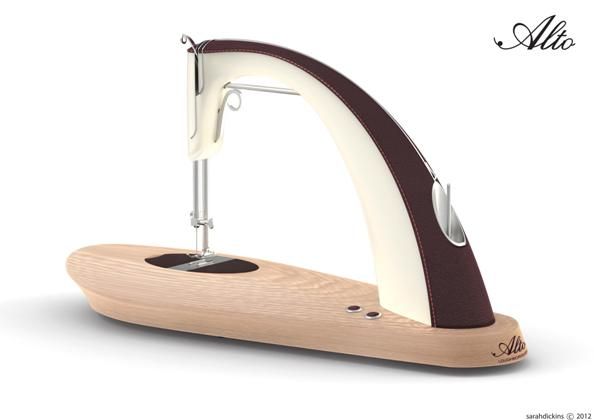
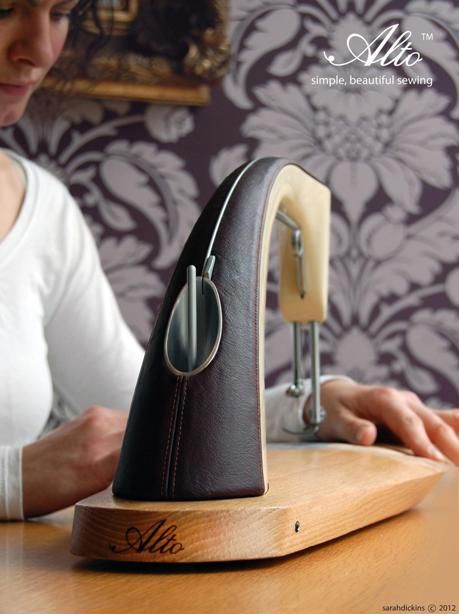
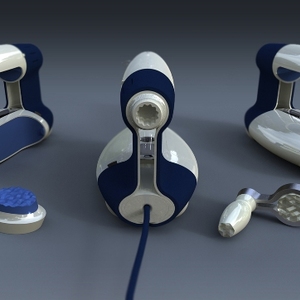
This is Alto--a prototype for a new sewing machine design entered into the 2012 James Dyson award program, created by industrial designer Sarah Dickins.
I love product design almost as much as I love sewing and fashion design-and when those topics dovetail, the love-fest is all the more intense. A few weeks ago we looked at a design concept and prototype for a sewing machine called Sue. Now, there’s another unique and spiffy sewing machine design concept–called Alto–from another industrial designer in the United Kingdom. The Alto has been entered into the 2012 James Dyson Award program (the challenge: design something that solves a problem). It is now among more than 500 other entries from 18 countries that are being reviewed by Dyson engineers.
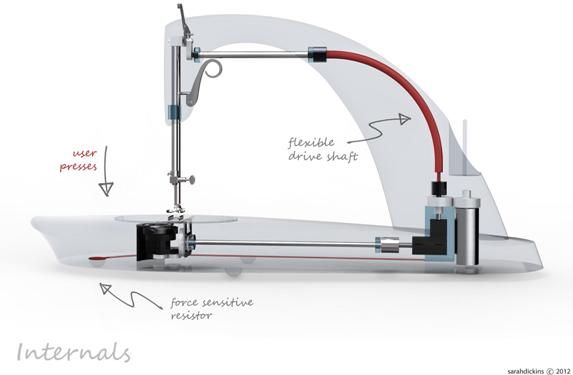
Like Sue, the Alto is designed to make learning how to sew and use a machine easier for beginners, but it approaches this goal in a different way. The designer, Sarah Dickins, set out to simplify sewing machine use for beginners by making operation more intuitive. For example, instead of controlling the needle’s speed through a foot pedal, the user places more or less pressure on the surface around the throat plate; a touch-sensitive sensor speeds up or slows down the needle action accordingly. So the fabric’s movement through the needle and the needle’s speed are controlled in one motion. The Alto’s thread path is also much simplified; the user follows a straight, metal-outlined path from the spool up the machine’s arm and through a loop, then down to the needle. Sarah tested her prototype’s mechanism with inexperienced sewers, and she found that 50 percent of them threaded the machine correctly the first time.
Perhaps designers who do not sew lack a deep understanding of the kind of features and operation a serious sewer needs from a workhorse sewing machine, but I think the Alto is another interesting concept for a sewing machine geared specifically to the barest of beginners who may find lots of stitch options and multitudes of electronic controls overwhelming. And of course, from an aesthetic standpoint, the Alto is simply gorgeous. Its form is sleek and contemporary, but this modern element of its design is balanced by the use of natural materials such as wood (for the base) and a leather (or perhaps faux leather) veneer. New ideas are always interesting-not because they’re new, but because they present different perspectives on solving old problems.
What do you think of the Alto? What do you think of industrial designers’ attempts to redesign and simplify sewing machines for beginning sewers? Do any of these concepts have legs, or do they fall short of the mark?
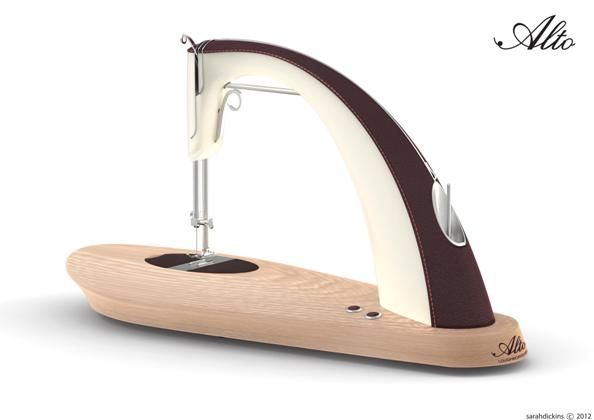
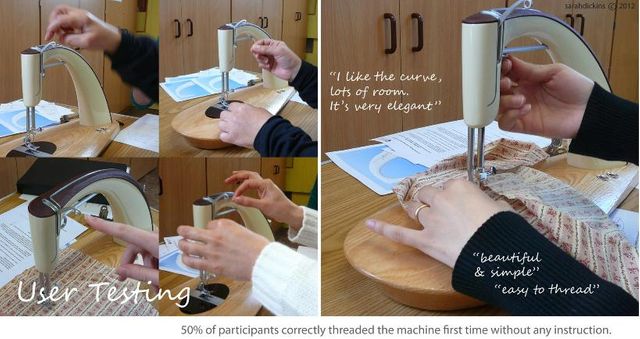








The machine's sculptural appearance is beautiful. The height of the arch solves one of my ongoing complaints about sewing machines - the low profile of the work area that limits light and visibility. Sewing machines are not ergonomically friendly.
The concept of a manual pressure feed is intriguing, but i think would be difficult if manipulating large, bulky projects, such as quilts or drapes - which i guess makes sense if the machine is a beginners product and you are making that first skirt or apron or whatever. It might also be a product for handicapped persons with limited lower limb mobility.
I would love to see the next iteration, " 2.0", so to speak, of this re-invention of the sewing machine.
This machine is facinating. I love the height as I always feel as if I a lowering my head to get a good view. As a beginner machine it looks great and not intimadating.
The archlike design reminds me a lot of the first Husquavarna sewing machine.
Looks nice... beautiful design - for an "object d'art". Unfortunately, it's "supposed" to be a sewing machine!
The speed control sounds hard on the hands.
Plus the person doesn't know the different between a "foot pedal" and a "presser foot"...? You don't use the "presser foot" to control the speed - the presser foot holds the fabric against the presser plate! Perhaps they need to study how sewing machines work a little longer before redesigning something they obviously don't understand.
Plus they don't show it threaded... in one picture, someone is supposedly sewing on it. But I still don't see any thread. Makes you wonder.
As to being good for a beginner, I wouldn't want to spend money on such a basic and simple machine, which appears to do nothing but sew forwards and backwards ( I can do that on my treadle, so where's the progress?). In any case, after a project or two or three, such a rank beginner isn't going to be such a beginner any more, and may appreciate a better sewing machine. I wouldn't pay good money for something that would only suit me for a few weeks or a few months!
As a piece of sculpture - this is lovely. I'm not sure that the throatplate is the best place to have the speed controller. I would think that straight sewing might alright, but sewing a curved seam or attaching a ruffled piece for example might prove more difficult. Interesting beginning idea though. The high arch is terrific. I agree - another iteration would be good to see.
We are so used to bulky and chunky machine design that this concept is stunning in its simplicity, why haven't any of the established sewing machine manufacturers thought outside the box, one wonders, and streamlined the design. My first thought was "that'll fix the problem of sewing garments when you have to scrunch them under the arm to get to a particular spot for a seam.
Love the look, now if they could do this kind of thing for a more advanced machine I'd be happy. Easier threading is always good, although my 8 year old granddaughter seems to manage it with no trouble on her Singer Elite and even on my Husqvarna. The wooden bed is problematic: I'd worry about raising a splinter or a rough edge that catches the fabric. Still, I'm excited about the idea that someone is actually looking at more streamlined designs. Wonder what will come next?!
This machine is really a great step up. I have a very small sewing space and this size machine would be great. Also I take my machine to the theater and do a lot of sewing and this would be a good light weight machine and can be used everywhere in the theater even on the stage.
I love the shape of this machine it is so great for large project.
I would love to see this machine out there.
It's wonderful that someone out there is 'finally' thinking of the sewing machine. I have been sewing for around 20 years and always wondered why nothing has changed with all this new technology out there. The embroidery machine was a great start, so why stop there?! I am really excited to see what's next!
if the amount of pressure controls the speed of the machine, what happens when you're sewing chiffon vs sewing heavy denim? Or making a bag with many thick layers?
It is a lovely machine. However, the throat plate speed control mechanism doesn't strike me as an improvement. If a beginner learned to sew on this very differently controlled machine and then advanced enough to want a fancier machine, she would have to start over to learn speed control with a foot pedal. Also, the throat plate speed control just seems clunky to me. But, maybe that's because I'm so used to controlling speed with my foot in both cars and sewing machines.
I'd like to see how the stitches look and how they hold up, too. I wonder if the simplified threading mechanism provides proper tension.
I started with a knee operated machine and then moved to a foot pedal machine, so I might be willing to try a hand controlled machine - however, I agree with Serral - for bulky stuff it would probably be difficult - I make blue jeans and also do machine quilting - those are the projects I would test this on - but I suspect that freehand machine quilting would be easier since the feed dogs are not driving the fabric
love it! who cares if it doesn't sew chiffon or denim - it's a new concept and it sounds like a MAC sewing machine or the first droid phone. It will develop into something great and new, you'll see. If the price is right it will be a wonderful way to introduce sewing to anyone, any age gender. What may seem odd to someone who is used to first and second generation machines may never feel quite comfortable with something very new but there are those who can learn.
My mother is turning 99 this week and she was a career clothing designer who made her first garment in Europe when she was 5 and had her own boutique at 17. She still makes her own clothes and does free alterations for friends. And now she surprises everyone by using her laptop to send emails, Skype etc. When presented with a computer she said, well, I'm a designer and I can learn to do this. She called cooking "designing food." Everything else is designing life. What better lesson can we learn than from her attitude? I think she would love this machine.
I'd definitely look into getting one of those if I didn't already have a good sewing machine. LOOOOOOOOVE the design.
I'm moving from the U.S. to HK. I will not be taking my U.S. machine not only because of the voltage but because it takes way too much room. Alto' footprint would be perfect for a tiny apartment. I am not familiar with what is available outside the U.S. for 220 voltage. Does anyone have any recommendations? Thank you in advance.
I could have used something like that machine this summer when I was making new covers for my outside furniture covers. I couldn't get close to finish off the final seam. This design would have let me get right in there.
I would love to try this out! It's a sweet style for a small footprint and might be outstanding for freemotion quilting and embroidery!
Beautiful machine. Like the size as well as design and the simplicity could be an advantage for more than beginners. How many stitches and other options on advanced machines do most people use? I agree with Cloff that it seems like an iteration of a treadle, but in a positive way: with a few more options, it might be a good, basic machine. I'd like to see the stitch quality (which isn't so great on my expensive advanced machine) and practice machine embroidery using the throat plate pressure speed control. I'm guessing I'd want a fairly large throat plate to make it work.
Not for me, I bought a top of the line Singer when 16 years old, not a problem for any of the people I have taught to sew since then. All but 80 now and still use that fav. Never knew of a machine that you had to hold a lever down to go backwards, LOL. No cranks for me either, going backwards in another way.