

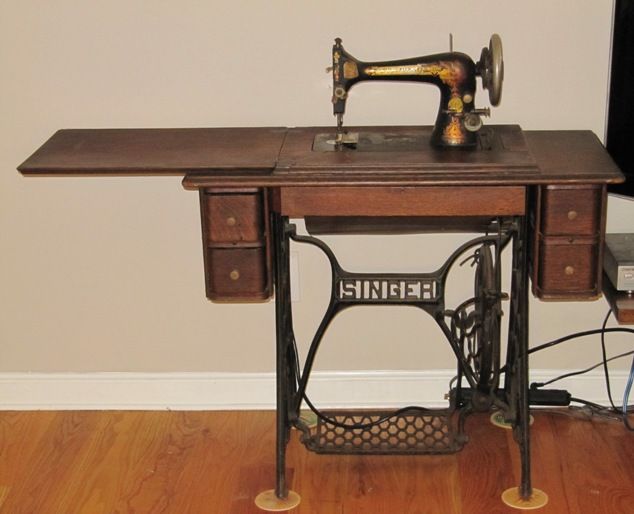
My 1907, treadle-operated Singer sewing machine.
Several years ago, I was given an antique Singer treadle sewing machine that has been passed down through my family for a few generations. I had no idea when it was manufactured or its model number. Several parts are missing, it’s not in great shape, and it’s basically non-functional–but it still is a wonderful piece of family memorabilia, and I love having it in my home. My flat screen TV usually lives on top of the Singer cabinet, so I look at it every day. Perhaps someday I’ll refurbish it, and when that happens, it will be important to know a little more about the machine.
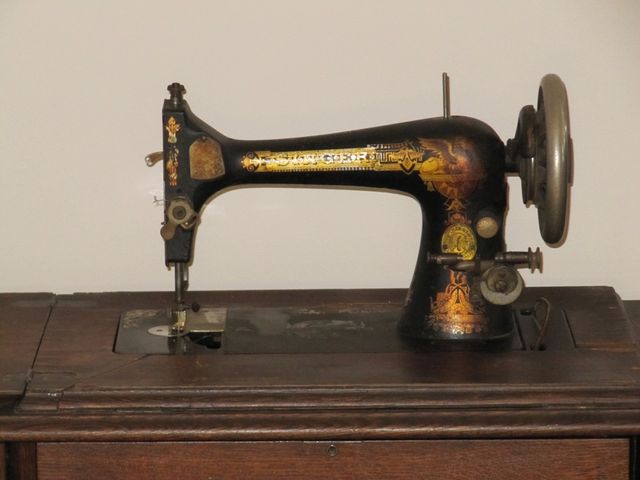
Thanks to Singer’s recent 160th anniversary celebration, I was able to pinpoint my antique machine’s model year by entering its serial number into Singer’s online database. It’s nice to know my sewing machine was manufactured in 1907. But I also wanted to find out the model number–which at first I thought would be a far more difficult proposition. Luckily, a quick search online yielded several resources that helped me narrow down my Singer’s model number.
The best and easiest to navigate is Sandman Collectibles’ online Singer identification guide. Referring back to your vintage Singer, you answer a series of yes/no questions about your machine’s features. Based on your answers, the online form jumps you to more identification questions, until eventually you arrive at one or more possible models. Using this identification form, I narrowed my Singer’s model down to 27/28 or 127/128. Based on certain factors, I think it’s most likely a model 127/128. Sandman Collectibles also offers many vintage Singer machine user manuals for sale.
Another very helpful resource is blogger Nicholas Rain Noe’s “The Vintage Singer Sewing Machine Blog”. Through several blog posts, Nicholas offers guidance through the process of analyzing a machine’s features and distinguishing very similar models from each other.
Also worth browsing is the website of the International Sewing Machine Collectors’ Society. The society archives sewing machine manuals, advertisements, and other information and offers many downloadable materials on its website. It also publishes research findings, auction results, and information on restoring vintage machines for an international membership of sewing machine collectors.
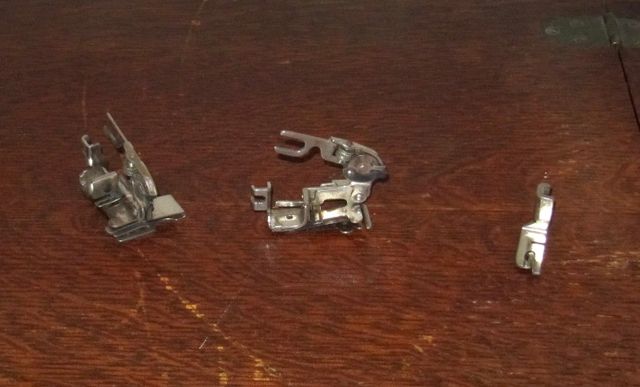
Mystery accessories from antique machines can be a little harder to identify, but you can use many of the same resources available for identifying machines. Also, there are many vendors that specialize in original or reproduction parts for antique and vintage machines, and simply comparing your machine’s mystery part-like a presser foot-to those available for sale can help you figure out its purpose. I’m fairly sure that the two identical presser feet in the photo are ruffler attachments (I know the third foot is a roll-hem attachment).
Do you own a vintage or antique sewing machine? Is your antique a family heirloom or a yard sale find? Have you identified its model and year of manufacture? Do you have any favorite resources for identifying antique machines and replacing parts?
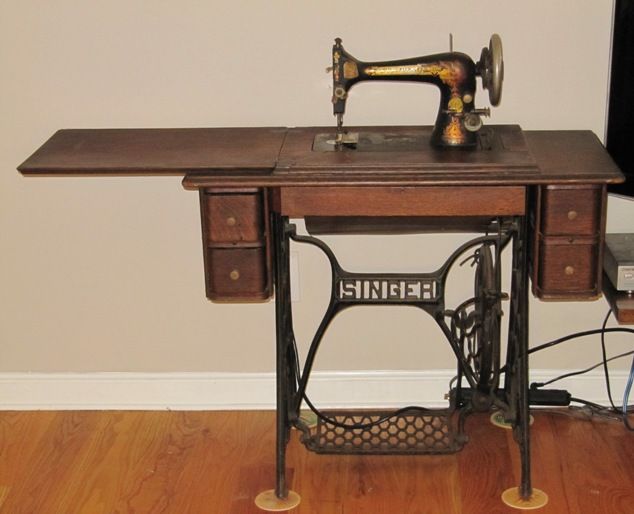









Great resources!
I have my husband's grandmother's machine and a machine left in a house we rented. A client recently gave me her older Pfaff.
I confess I prefer the non computerized machines ( i don't create decorative embroideriy ) and the lack of plastic components. I guess I am " old school".
I have a Singer from the 1920's. It has a straight stitch only, but would stitch through sheet metal. It was a tredel machine, but Grandpa had it "electrified" in 1932 for my Mother. It still works. I have an older Sears machine, Mom bought it in the mid 1950's. It is of metal construction and is as heavy as a concrete block. It has decorative cogs, they drop into the top of the machine and do the embroidery perfectly. I need to get it cleaned, checked out, but when Mom stopped using it in 1992, it was working just fine. My machine is a Viking. I bought it in 1978, all metal construction with a free arm feature. It also is as heavy as a concrete block. It is one of the best machines I have ever used and I don't think I will ever replace it. As long as it likes me, I will treasure it.
Hmmm. I have an older machine in a cabinet that was given to me. Don't recall what it is, other than you have to hand crank it! It has a lot of accessory parts and I haven't a clue what most of them are for. It works fine.
On a more prosaic note, I have my grandmother's early 1940's Pfaff with the original cabinet. My granddaughter is learning to sew on it.
I have an early or mid-1930's Singer, also in a cabinet, and my granddaughter's friend has been learning to sew on it.
I also have 2 old portable machines I found in my mother's garage after she passed away. I only opened them once and don't recall what they are nor do I know if they even work! One of these days ....
I ACQUIRED MY MOTHERS SINGER HAND MACHINE ADDING TO MY COLLECTION ! THINKING IT WOULD POSSIBLY COME INTO ITS OWN ONE DAY.
THE DAY ARRIVED...THE AWNING ON OUR BOAT NEEDED AN URGENT REPAIR AND WITH NO ELECTRICITY AT THE RIVER BANK THE ONLY OPTION WAS THE HAND MACHINE.
PICTURE A BEAUTIFUL ENGLISH SUMMERS DAY.........RIVER AVON...
ME SAT UNDER A TREE REPAIRING THE AWNING,ALL WENT VERY WELL...UNFORTUNATELY EVERY BOAT THAT PASSED WANTED TO KNOW IF I WAS IN 'THE REPAIR BUSINESS '
NEEDLESS TO SAY THE MACHINE WENT BACK INTO THE BOOT OF THE CAR AT SPEED !!!!!
The machine in the picture is exactly, precisely the machine I inherited from my grandmother! How cool to see it online. I learned to sew on it and my grandmother made my sister and me dozens of dresses on it. It is still operational though it needs to be cleaned. There are a pile of attachments that go with it but I've never used them. We also have my husband's grandmother's treadle, a New Automatic, age unknown but still operational. Most of the time we use them as tables but occasionally we still sew on one.
My mother in law used to tell a story about watching her mother sew on the New Automatic. Great granma was making a wedding veil when someone brought in a torn canvas off the tractor. She changed needles and thread, sewed up the canvas, changed back to the other needle and thread and completed the veil- not a single other adjustment was needed.
I have a 1940s Singer than belonged to my mother; it has a knee control rather than a foot control. I have my Singer from the late 1960s and my darling Janome that I splurged and bought for myself several years ago. There are at least a couple other portables around the attic and neither my husband nor I have any idea where they came from.
Is it permissible to post a link here? This page is owned by Zorba, a collector and restorer. Ever heard of "hot rodding" sewing machines?
I am such a dimwit. Here is the link:http://www.doubleveil.net/zssmp/
Yes, vintage & antique sewing machines are fun to collect. I have a modest collection of about 14. Many people have many more. For anyone wishing to learn how to refurbish their own machine, start at http://www.treadleon.net. That's a website with loads of info & also where you can sign up to an email discussion group to learn more. There are also several groups on yahoo you can join, some for any make & some specific to a single make. I have my great-grandmother's White Family Rotary treadle from 1911, my husband's grandmother's 1925 Singer 66 treadle & a friend's great grandmother's 1905 Singer 15-30 as well as my husband's mother's 1948 Singer 201-2 (electric), a couple vintage Necchi machines, a Singer 99 converted to handcrank, a vintage Singer 301a (electric), a few heads hanging around waiting for me to do something with them and my "modern" machine a 1989 Viking 948 that sees very little use now. My treadles & the 201 do most of my sewing.
When I was a child, my mother gave me her Singer. She's now 95, and learned to sew on it as a child. It's tiny, about 8" wide and clamps onto a table. It still sews a good chain stitch, and Mum remembers as a bride, sewing her first pair of drapes on it.
Yes, vintage & antique sewing machines are fun to collect. I have a modest collection of about 14. Many people have many more. For anyone wishing to learn how to refurbish their own machine, start at http://www.treadleon.net. That's a website with loads of info & also where you can sign up to an email discussion group to learn more. There are also several groups on yahoo you can join, some for any make & some specific to a single make. I have my great-grandmother's White Family Rotary treadle from 1911, my husband's grandmother's 1925 Singer 66 treadle & a friend's great grandmother's 1905 Singer 15-30 as well as my husband's mother's 1948 Singer 201-2 (electric), a couple vintage Necchi machines, a Singer 99 converted to handcrank, a vintage Singer 301a (electric), a few heads hanging around waiting for me to do something with them and my "modern" machine a 1989 Viking 948 that sees very little use now. My treadles & the 201 do most of my sewing.
I have a Singer Featherweight that I bought used in about 1964. I got it with money from a summer job while I was in college. I'm not sure how old it is, I did look up the serial number on the Singer site, but it was long enough ago that I don't remember when it was manufactured.
I still use it for quilting, it is real handy and sews beautifully.
I have a Singer treadle machine that is about 1934 that my husband bought for me for my birthday in 1999. It was one of two machines that had been in the Eaton's department store basement alterations shop in Winnipeg. It was put up for sale when the store closed after the chain went bankrupt. They had put it on the second floor where the downtown walk way passed through the store with a "For Sale" sign after the rest of the store merchandise had already been cleared out. It was missing a few parts, including the belt, but I was able to get replacements from the Singer dealer in Winnipeg at that time. It sits in my living room with some knick-knacks on top of it, but it is functional. I figure if the power ever goes out, I will still have a machine to sew on!
I have a fabulous "old lady" antique Singer 72w 119 desirable hemstitch machine that desperately needs someone to care for her since we are moving house out of state. I acquired her in the 1970's after a long, long search; she was shipped from Freemont, Nebraska, all the way to Maryland and you can't imagine my excitement when she arrived in a tractor trailer! She has a treadle and was fitted with a motor somewhere along the way - she does need a little timing work but I'd love someone to have her that appreciates her the way I did/do and would get a thrill of owning her. Let me know if you can pick her up in Maryland.
I have my grandmothers 1945 treadle sewing maching complete
with all the attachments it came with AND the instruction
book. I have used it many times on stuff like making a yert
(look it up on the internet) and a shade tent just to name 2.
I also have a nonworking 1901 machine that I bought before my grandmother died that I will have fixed next year. my granddaughter will inheret my grandmothers machine, she is 9 and has an interest in all fiber related unlike my daughter.
My mother bought a Singer Featherweight in the late 40's. She thinks she paid $90 for it, a lot of money at the time. She taught herself to sew and became a home economics teacher. She taught me to sew on it in the 1960's when I was a child. I took it to college with me and sewed in my free time. My daughter learned on it and she has it now. I recently found a slightly newer version at a sewing machine store and bought it. They are such great and reliable machines.
Featherweights are amazing little machines!
I have a sewing machine that belonged to my DH grandmother. It is a Steinway Grand - possibly a badged Damascus. It was built about 1910 - possibly earlier or later - I can't seem to find out much about it. It still works, though it is in bad need of a thorough cleaning and oiling, to put it mildly. Here's a link to the pictures of the machine.
https://picasaweb.google.com/106901717808660735440/CAMERA0102#
If anyone has any information about this machine, I'd really like to find out more. I do know that it was sold by the Homer Young Company, but the manufacturer is still somewhat of a mystery.
My mother had a Singer treadle that she used until about 1954 when she bought a new Singer 201-2, an electric that she used until her death several years ago. I currently own the machine and it is in need of new wiring, but otherwise in great condition. I have the buttonhole attachment for it, plus the bottonhole attachment and hemstitcher attachment that fit the Singer treadle. The hemstitcher also works on the 201-2. I remember my Mother sewing on that old treadle and wish I had it today.
My Singer treadle is similar to the one pictured in the article. The cabinet appears to be the same but there are slight diffences in the sewing head. The cabinet drawers have some fancy curlicues on the front. My grandmother, the sewer in the family, made many of my clothes on that machine. She taught me to sew on the treadle and I used it for all of my sewing until I was in my 20's when I purchased an electric machine.
I started sewing at age 8 and am now 79. The old treadle still works, although it is cranky sometimes (just like me).
Great resources. I bought a Davis treadle machine at auction many years ago, because that was my maiden name. Unfortunately, a key part is missing. Even though I acquired several boxes of parts at the same time, they didn't have the right part. There were several Wheeler & Wilson parts. I later sold those boxes but kept the machine. I use the extension table for my serger so I can enjoy the machine. It also had the original sale bill in the drawer with the serial number.
My grandmother (92) has a German vintage sewing machine and still sews on it. She inherited this machine from her mother in law in 1942 and this great grand mother has been sewing with it for years. The machine is in good shape, absolutely reliable and still in use. Two summers ago, we went to camp in Greece in a wonderful place in the woods where there was no electricity. Since holidays without sewing are no holidays at all for me, I borrowed this machine from my grandmother to sew a dress for a daughter who was in a summercamp nearby. I gave it to her as a present and it was her favorite dress that summer.
I was amazed how heavy and reliable the machine was. It only did a straight stitch, but it was perfect!
I own two treadle machines. One was my grandmothers, that my aunt who had kept it in her basement for years, finally gave it to me. She did not sew. The other I purchased many years ago at a Singer Store, for $1.00. I made many things on my machined. It is a Bullet Bobbin style.
I found one web site where I was able to purchase items for both. http://sewingmachine221sale.bizland.com. They carry parts for many machines. I also have my mothers Kenmore drop-in-cam electric. I still use, can get parts, and it runs like a champ. There are other websites where you might be able to compare with a picture. Good luck, and enjoy your machine.
Agapantha: Thanks so much for the link--very interesting and helpful website! I encourage you to locate the serial number on your Singer and go to the Singer anniversary website to find its date of manufacture. You'll be able to download a certificate to authenticate its age. Not that that increases its value in the least...But it's fun!
I have two vintage machines. One is a treadle that belonged to my great-grandmother. It is fully functional. I recently had it cleaned and gave the cabinet a good oiling. The machine sews like a dream. I have another Singer that belonged to my grandmother. It was originally a treadle; however my grandma bought a motor and installed it on the machine herself. It is the machine that I learned to sew with. My grandma gifted it to me in 1967, and I used it for 20 years. It is still functional.
I have a Singer 127/128 that was rescued from a fire. I restored the machine and it sews wonderfully. My husband restored the cabinet so you would never know it was ever in a fire. Fortunately, only the cabinet was damaged, mostly by water. The machine itself had no rust and had all its parts. However, the bobbin winding mechanism has broken, and I'm replacing it with found parts.
One thing I have found is that the new modern "long bobbins" they sell don't fit these old machines very well. They seem slightly too short or something. So you've got to have actual old bobbins to make them work, if you have an old machine that takes long bobbins. But you can use round bobbins in the "newer old" machines that take those -- new ones from the store work just fine!
Stephani -
That is a 27/28 you have (assuming that is a picture of your machine). You can tell the difference by looking where the bobbin winder is placed. If it is lower, near the bottom, as yours is, it is the 27/28. If it is up by the wheel, it is a 127/128.
Christine
That's my machine too! Inherited from my mother, who received it as a gift from my father (bought second-hand) shortly after they were married in 1948. I learned to sew on it as a child and teenager, and it came back to me in 2005. I checked the serial number too, and mine is from 1908. It is still in good working order, and I use it about once a year for nostalgia's sake. I have most of the original attachments too.
I wondered if you have seen the old sewing book, I think it is a Singer book which shows how to do all sorts of fancy stitches on the treadle machine? It shows how to zigzag stitch with the needle stationary and the sewer moving her hand to form the stitches. All sorts of techniques. Yes, I have several treadle machines. When I was a teenager going to take home ec. I lied to the teacher and told her I could sew on the treadle machine..then had to go home and get my mother to teach me to do it.
cloff: Thank you for clearing that up for me!
I have a tredle sewing machine in a cabinet that belonged to my grandmother. It has the manual with it, Minnesota Model"K" Sears, Roebuck and Co. Chicago. I don't think it's in working condition, needs a belt at least. Other machines I've had, 1963 Singer portable, still have but doubt it works, a 1966? Touch and Sew from a garage sale. I loved that machine until there was a problem and the repair person said couldn't get the part and the plastic part he used made it sound like a thrashing machine. :-(. My husband bought me a Bernina several years ago and I LOVE my Bernina. Also own a serger.
I have my mother in law's Singer Featherweight from 1945, a Willcox and Gibbs treadle, a Singer treadle, and another Singer that is a hand-crank machine. I am also jousting finishing restoring a treadle New Home. Love the oldies!
I bought what I assumed was an old singer sewing machine
and took it to be cleaned etc. Imagine my surprise that it was actually a Macy Sewing Machine. The guy told me it was made by Singer back in the day but was sold by Macy Dept Store
with their logo on it. Works like a champ! It too is very heavy and I use it thick material because my newer machine
has issues with heavy material sometimes.
Hope someone out there can identify this treadle machine I recently acquired. Photo: http://kitQuestions.yolasite.com
Thanks.
Hi eveyone. I have a sewing machine that was made back in the late 1800's. It was worked on back in the 1930's, I have the receipt. A friend bought it for me from a (so called antique dealer) right outside Nashville Tennessee in the early 90's and gave it to me for a birthday present. I have sewed curtains with it and made my lil girls school dresses and stuff with it then. My girls are all grown and have children of their own now. I have had this machine for 22 yrs or longer. I cked on it at one time and the Lady Margaret Snell that had the sewing machine co. in the Smithsoian Institute in Washington D.C. was very much interested in it. I wasn't ready to sell. I called her again in the early 2000's and she had moved the museum to London England. Still interested in this piece, I told her I would think about it. I have all pieces and parts and still works good and in good shape. I will send pics tomorrow. Excelsior from Wright and Mann. Anyone know anything or interested? I tried calling over to Mrs Snell awhile back but she was in not so good shape and a grandson got on phone and didn't even act like he was intested nor did he know anything about this particular maachine. So I got disscougaged once again about giving up on it unless I found someone who really knows perfection and willing to make a deal!
Hello i just aquired an old Homestead sewing machine. I really cant find much information on it. Can anyone help me out
I am very excited!!
I just purchased my first treadle Singer!!
She's a Model 66 "Red-Eye", and by her serial #, she was made in 1911. WOW. 113 years old!
I have always liked them... but the closest I have been to owning one is a table with a treadle base (minus the treadle and wheel) being used as a table at a Goodwill store.Mine for #20! We stumbled upon this Singer 66 locally at a small thrift/antique shop back before Christmas.
I don't like to purchase on impulse, so we passed on it.
We decided, if it was still there after the holidays and we had the cash, we would take that as a sign and get it!
Besides, that gave me time to do a little research and really think about it. We gave it a "once-over" the first time we saw it, but I had no idea what I should be looking for. We thought it was a really good sign that the treadle moved the fly wheel smoothly, and when you manually spun the balance wheel, the needle moved up and down smoothly too.
So today, we went back to see if it was still waiting for us... IT WAS!! I took a closer look at it, and it looks like the moving parts are still oiled (yet a bit dirty with a tad bit of surface rust) and the underside of the machine looked good too. I manually advanced the bobbin wheel (it does not have a belt... but I plan on ordering one very soon!) and the bobbin winder also moved well and smoothly!
The cabinet is in good condition, just some wear and tear, but not much that a good clean and oiling can't perk up!
It also had several foot attachments in one of the drawers and we found a Singer manual tucked up in the underside of the cabinet too!
The moment of truth came... They were asking $100 for it... I think that was a fair price from what I can tell, but I countered with $75, and they said YES!! YAY!
Now I have to wait ALL WEEKEND before they can deliver it on Monday... it doesn't fit in my car!
I think this is the start of something special-
My husband thinks he is going to put our small TV on it... HAHAHA!! I plan on learning to USE IT!!
Deborah in North Carolina
I own an antique sewingmachine and I think the brand name is Pelham. It is a treadle, and the machine came wrapped in bubble wrap. When unwrapped I found Egyptin gold leaf motifs all over and is breathtaking! Could any one tell me about this brand or the potential age of it?
i have one but i need help it has a knee control on it
Beautiful Machine you have. I have a Singer Egyptian Spinx Treadle Machine that I would love to know when it was made I really like the older machines
My husband just purchased an old White Rotary Machine in cabinet with treadle. From what we have been able to learn so far - from the serial number, 132784, the machine was made 2/26/1906 in Cleveland Ohio. I downloaded a manual for a W7 Treadle. The unit needs some parts, such as the belt, throat plate, more bobbins etc. and does need some TLC. Someone painted the cabinet, unfortunately, since it was such an ornate wood. Can someone give me some contacts as to parts etc. or does someone own a similar machine that cna tell me more about it? I also have a couple of Singer Featherweights and was wondering if the attachments will work on the White. The bobbons are definitely different so I am not sure about the rest. We would like to refurbish or get this unit operational again.
Is there a list with pictures of parts for a treadle machine? Mine looks just like the picture of the one you have here.
Monna Aaron
My mother-in-law lives in a retirement community in FL. While helping at the sale shop, she came upon a Singer Treadle sewing machine, knowing that is what I learned to sew on she snatched it up. This article is so timely as i want to learn about this particular machine. It still works as the lady that had it was still using it when she had to get rid of it. It has found a loving home and my plan it to make a small quilt for my mother-in-law.
Its Nice information..
Thanks for sharing...
I have a Kenmore model 55x15668 vintage sewing machine. I am trying to find a manual and information on the kind of needle it takes. And of course any other pertinent information I can find. Can anyone help me?
My sister has an antique treadle-type sewing machine and I can't identify it by make. It has a cast iron table frame with an anchor cast into it... It only had one bobbin so I made three more out of brass bar stock (I'm a machinist) any idea what brand it might be? Thanks.
I recently heard about an "app", for dating antique sewing machines (other than Singer). Unfortunately, when he bought a new computer, he lost the app! If any of you computer
"geeks", can find this app, you'll make all us collectors
extremely happy! Mike
i would actually like to know if anyone has ever heard of a 'wilson b' treadle sewing machine. this is not a wheeler and wilson. pretty little thing. the tensioner is in the middle on top but i can't find anything on it or like it to see how the thread goes through the tensioner.
Love quilting and making pintucks of several widths easily with the attachments on my great-grandmother's Minnesota D treadle (which she ordered for $10.45 from Sears in 1904)!
My grand mother has the same sewing machine. Happy to see this!!!
cool
Granny35658 , there are at least TWO MAJOR WEBSITES FOR SELLING ALL SEW MACHINE PARTS.GOOGLE THAT. ---(sorry i lost the link.) both of them are very good,they have parts for every sew machine made.(maybe not antiques.)--modern machines,new, pretty old, too.I have a very old Kenmore and I lost everything connected to it.those 2 websites had VIRTUALLY EVERYTHING. ---YES, AND MANUALS. almost all manuals. Go ahead and look for your manual according to model ect, no. that is how I got mine back. GOOD LUCK!!
My grandmother's Singer 66 red-eye has been with me for 60 years. I use it especially for buttonholes, since a friend of my mother's gave me the buttonholer attachment when I first got the machine. Still in its treadle base, once motorized, but I got rid of the motor stuff years ago. The treadle gives me control that I can get nowhere else. The head goes in to the local sewing machine specialist for cleaning and tune-up once every couple of years. A couple of boxes of attachments came with the machine--I'm still learning to use some of those!
I have an old treadle machine that states American Queen on the head, does anyone know who manufactured it?
Thanks
Dave
I have a Juki DDL-127, can anyone tell me how old it is and where I can find more information.
My vintage machine (I have several) is not a family heirloom. My father, a renowned engineer, grew up in his families tailor shop in Rochester, NY in the 1930's, got it humming immediately. There is a definite rhythm needed to get the needle moving! I have all the attachments which I use with an adaptor on my modern machine.
I have 17 working Singer vintage beauties, including the one pictured. They live all around my house (even in my kitchen!). I sew on my 401a and my 201. Modern machines have nothing on our vintage beauties. You can check them out over here: http://saskatoonstitcher.wordpress.com
I hope you restore yours. You will love the treadle. There is a unique click and hop sound that will carry you through your projects. It is a soothing sound.
There is something quite magical about sewing on a treadle. It is transformative. You can almost feel the energies and projects of those who had sewn with the machine before you. It is a connection to your history.
Thank you for sharing this machine.
Enjoy every stitch.
The Singer serial number database at ISMACS tells you the model number, as well as the date the serial number was issued. Your machine will have been built somewhere between that date & the date the next batch of serial numbers was issued for that model. You can approximate by how far through the range of numbers yours is. (That's why I use the table online rather than the app that also available.)