

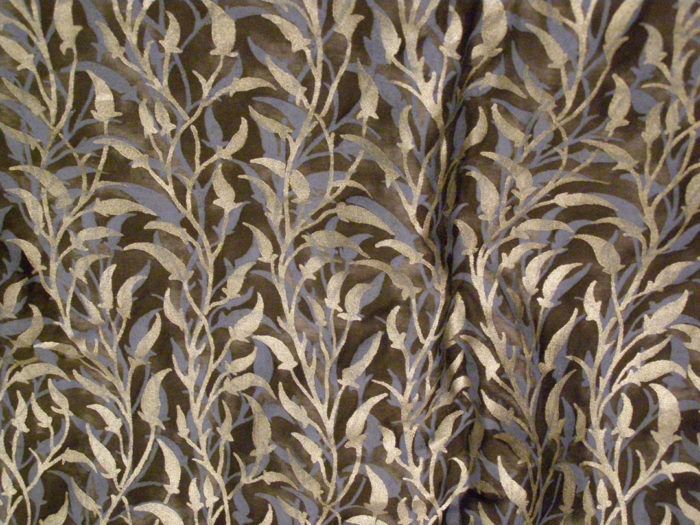
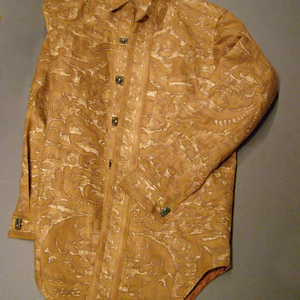
Last summer I got a call from a customer who was at the Palazzo Fortuny. She wanted to know how much fabric she should buy for a tailored jacket. So, I told her, and she bought this fabric.
Don’t miss fabric tips like this one by ordering a subscription of Threads magazine. Print subscriptions come with FREE access to our tablet editions.
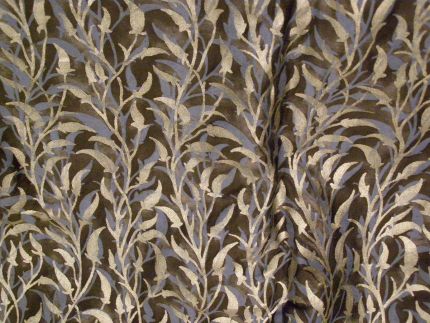
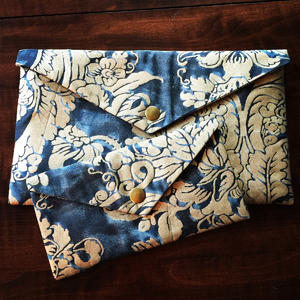
Beautiful, no?
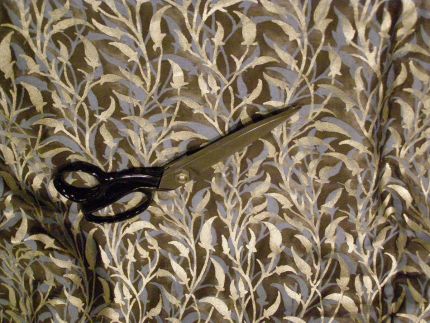
Here’s a shot of the fabric with my shears laid on, so you can judge the scale.
Generally, Fortuny prints use only one color. This print is different, being blue and silver-a new combination from their studios.
Cutting this fabric presents a small challenge, though. The fabric itself is a cotton twill, which is somewhat lightweight. I’ve decided to interline it with a blue twill of similar weight. My customer doesn’t want a jacket that is too constructed, but not like a shirt either.

As you can see in this photo, when tearing the fabric to get the grain, the printing is off grain. There is a judgment call to make here–cut on grain, or cut on pattern.
Since the paints Fortuny uses in the printing process are thick, they tend to “lock” the grain of the fabric, so I’ve decided to cut on pattern. This will mean the fabric is a little off-grain, but with the printing being an all-over pattern, this won’t present a problem.
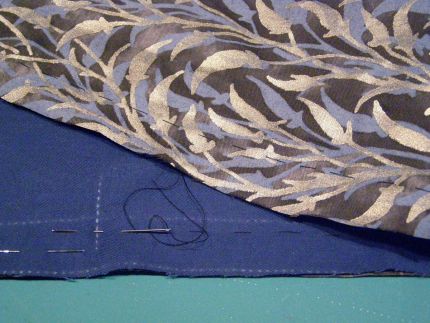
All the markings are on the interlining, and I’ve decided to baste in the seam allowances. The metallic paints tend to show pinholes slightly, so I don’t want to mar the fabric with basting outside the seam lines.
You can see stitching lines marked in tracing carbon, and thread basting to hold the layers together.
Matching:
This is an overall…
Start your 14-day FREE trial to access this story.
Start your FREE trial today and get instant access to this article plus access to all Threads Insider content.
Start Your Free TrialAlready an Insider? Log in









I have to thank you for all your posts. I always have some key question answered or problem solved. Many thanks.
Glad to be of help!
You would have to be a sewer to understand, but this felt like a cliff hanger. Was holding my breath as I went from frame to frame only to find out I would have to wait for the ending. Thanks, Kenneth, for all that you do. Your customer will appreciate such a beautiful garment so carefully assembled and all of us get to see the problem solving that goes into such a garment.
Beautiful garment. Can you tell us a bit about the sleeve shapers? I have never seen them before. Are they available on the market? Thank you.
Kenneth,
This is so fascinating. I never would have rationalized that it would be OK to cut off-grain. I have not worked with Fortuny fabric and your comment about the pin holes in the paint is something I never would have thought to consider. But your explanations have been very clear and helpful.
Also, I doubt that I would have chosen another twill with which to interline this jacket. I would have thought it would increase the bulk too much.
It was interesting that you described your customer as "asymmetrical." Over the years, sewing for others, I've not found too many people who were symmetrical. I guess I never thought about it...just made the adjustments to fit and carried on.
Thank you again for the excellent lesson. Ymana Johnson
Thank you for introducing me to Fortuny fabric. Can you tell us more about it? It is gorgeous. This type of problem solving, to go with grain or pattern, is so helpful. I would be interested also to know about the sleeve shaper.
Can you address "sleeve shapers" a bit? I have seen them before, and can guess how they work, but do you consider them an essental item or optional? If optional, how can I acheive the same effect with more common equipment? Karen Minturn Brown
Great article so far. I have never heard of a sleeve stretcher either. And if I was matching I would have gone with the design as well and not the straight of grain. I'm sure it isn't off much, considering the fabric. It is always fun to learn new ideas. Can't wait to see the finished product.
Hi Kenneth. Thank you for always sharing your expertise with us. I think you are just so smart and cute. You mention your new steam iron. I hate my iron and want a new one, and truly, for this one important tool, price is no object. What iron did you choose?
I love your problem solving and thank you for the details. Just yesterday I was working out a similar problem but on paper to decide how to make it happen. I finally figured out I'd need something to shape the sleeve. I had no idea until now that such a tool exists. Please do teach us about it. And now I also know WHY the hem is the best place to align pattern pieces and not just because it "feels" right. I really do love reading your posts. And I agree with karenc that this is a cliffhanger. I don't want to miss the continuation of this story.
In regards to the sleeve shapers (also called "sleeve formers"):
These are regarded as pressing tools--they are curved hardwood bows separated by leaf springs. You compress the two together, slip them into the sleeve, and release. They hold the sleeve taut and to shape (curved for the bend in the tailored sleeve), to enable you to steam the sleeve to shape. I regard these as a nice luxury, after you purchase the big-deal iron.
You can get them at Atlanta Thread company. The link is:
http://www.wawak.com/products/category.cfm/cid/247/Sleeve-Formers/
Regarding the iron, I bought the Reliable i500, which is dreamy. I've written another post on it that will post later, but know that this is a really sweet, capable iron. Not inexpensive, but well-worth the money!
And to Yumjo: The twill I used is the same weight as the ground fabric, really a shirt-weight twill. This gives a little body to the jacket, but not too thick or stiff, which is what she wanted. A jacket that looks nice but feels relaxed.
And for the reference to asymmetrical: Everyone has variations from right to left side, but this customer's asymmetries are very pronounced. Cutting a garment that appears balanced in this case is a bit of a challenge, but when the garment fits, with the patterned fabric, the asymmetry won't be really apparent. It's only bad fit that draws attention to these things.
And as for the next installment: I call it "Finessing the facing". Stay tuned!
And, regarding the Fortuny fabric:
You can put the word "Fortuny" in the search box here, and see other posts I've done on this exceptional fabric. Mariano Fortuny worked in the early 20th century. He produced exceptional printed textiles for interiors and clothing in Venice, and they are still being produced today, as he did them originally--block-printed by hand in Italy. This is the "Orfeo" pattern.
They cost the world. Really.
Their web site is: http://www.fortuny.com/
Initially I was given a bolt of the stuff which is the first time I used it, hence the posts already on Fortuny that I've done in the past. That pattern was called "Caravaggio".
But getting to work on some again for a customer is still thrilling. When I get done with the jacket, if there's any left over, I get to keep it to make myself a pair of jeans.
Senor King,
Can't wait for the Reliable i500 post! Sewing appliances - such an attraction!
I am amazed at the fabric. I have a question about matching the seams. How do you compensate for the seam allowance so that the pattern of the print flows from one piece to the other? When I check out the high end clothing in the local stores, this is one of the things that really impresses me.
I was told by an interior designer friend that the fortuny metallics crock badly. It would be disappointing if this were still the case, since they " cost the world". I'm thinking of stencilling my own with Lumiere paints.
Once again I am thrilled with your article and am waiting impatiently for the next installment. I, too, want to know more about the sleeve shaper. I have the iron and love it. Thanks for being such a great inspiration. I am honored to have taken some classes with you.
Thank you mr king I found an iPad app for he fabric, I am truly thankful ,
Check out this application on the App Store:
Fortuny Fabric Browser HD
Rounded Corners LLC
Category: Lifestyle
Updated: Feb 28, 2012
5 Ratings
I've seen the sleeve forms in the catalog but didn't know how they are used, so thank you. You've given out some really good information, particularly on matching prints like this, something I find difficult.
In regards to matching the pattern at the seams--that's my aim. I like the pattern to flow smoothly at certain places, such as the hem or across the front near the shoulders. So, yes--I determine where the seam line is when laying out, and make sure the pattern reads across it.
As for the crocking of the metallics on Fortuny fabrics--yes, there is some of that, but not any more than other metallic-printed fabrics I've worked with. I've even machine washed the Fortuny metallics, and don't find it a problem. But if you'd like to create your own interpretation of Fortuny, that's a good creative project! You'd be making it somewhat like they do in Venice--by hand.
I have a question about cutting the fabric off-grain. Did you also cut the underlining off-grain to match the outer fabric? I realize they're both lightweight and that the outer fabric won't shift much because of the paint, but I could see where, with wear, you might get a slight twist if there was much difference in grain and a ripple at the hems or seams. Probably depends on the specific fabrics being used - ?
Just out of curiousity what is your fee for constructing such a jacket if I may ask? The information is excellent.
Thanks for the information of the sleeve formers. I'll bet the Atlanta Thread will be puzzled by the sudden surge of orders from your readers.
I just want to add that Threads magazine issue #89 for July 2000 has a wonderful article by Jeffery Diduch called "A Tailor's Set-In Sleeve" that shows how to create the initial curve of a jacket sleeve (which allows the sleeve to follow the curve of your arm) by pressing the sleeve piece before sewing.
To CFields: I cut the interlining on-grain. The fabric itself was just a little off-grain, but cutting both off-grain would result in a real mess once the piece was dry cleaned.
In answer to how much I charge, I prefer not to state prices in blog posts. It is, in part, to honor the privacy of the client. But know that, it's not inexpensive! That much I can say.
A little aside about pricing and price for those out there who do this for their livelihood: Never compete on price. There's always someone who will work cheaper. Offer more value.
Sometimes when I'm traveling around to teach, I'll hear the odd comment, the gist of which is "I don't have to make a living on my work, my husband/wife/trust fund makes this possible." These people don't charge a lot for their work.
My response is usually a variation of, "If, God forbid, something happened to your husband/wife/trust fund, and you couldn't make a living on your work, that means your husband/wife/trust fund is subsidizing your customers."
That, and it makes it more difficult for those of us who do indeed need to support ourselves on our work. I either will charge full price, or give it away if it's friends or family. That seems to work for me.
So, do yourself and your husband/wife/trust fund a favor, and charge a fair price for your work. Fair being a price that benefits both parties equally--you get what your labor deserves, your customer gets good value. It shows respect for the years of knowledge, research, and practice that you have accumulated.
I'll step off the soap box now. Thank you.
Kenneth,
Question: Where can I find a schedule of where and when you are teaching? I would love to attend one (or more if possible) of your classes.
Comment: I wholeheartedly agree with your sentiments about how and what to charge for your sewing expertise and services. I learned a long time ago that people who want cheap don't care about quality. Those people who really care about quality are willing to pay for it.
Also, thank you for the additional info on the Fortuny fabric. I wish I could feel it.
As for where to see scheduled classes: I'm working on a re-vamp of my web site, that will have an "events" page. Check back to my site (www.kennethdking.com) in March, for that page.
Hear, hear, Kenneth! The difference between professionals and amateurs is that professionals get paid for their experience and skills. Most customers have no idea how much time and learning go into quality tailoring, but the price of well-fitted garments made with wonderful fabric should give a hint.
Another note for those wanting to buy the sleeve formers: Atlanta Threads (Wawak) is out of the sleeve formers but you can get them on Amazon from Cleaner's Supply.
Hello ladies, hi Kenneth,
Great tutorial as always, which is what I love about our craft you keep on learning, challenging yourself and growing in the process.
Kenneth I really appreciate your comments about pricing and value I specialise in one-of-a-kind garments, http://www.coralturner.co.uk, they all take time, and going that extra mile in terms of finish and technique something we all value in our work. I have found that those customers who understand the process and time involved don't question the outlay, and have a great appreciation for our craft.
Thanks for sharing your skills and helping me to be a better designer in the process.
Did you hem the sleeves before stretching them? Thanks for the great demo.
I didn't hem the sleeves yet, as I want to check fit on the customer before committing. But once the sleeves are hemmed, I'll go back ad stretch and steam them again.
I have never attempted to interline a garment but am about to try. Your photos make it easy to see.
Maybe I missed it, but how do you use the sleeve formers? I have for the first time seen this tool.
The sleeve formers, which have the curve that matches the curve of a tailored sleeve, slip into, and shape, the sleeve. You sew the sleeve, and compress the former--slip it into the sleeve where the spring pushes the two wooden bows outward. You then steam the sleeve to set the shape.