
French and Colonial Knots for Embroidery

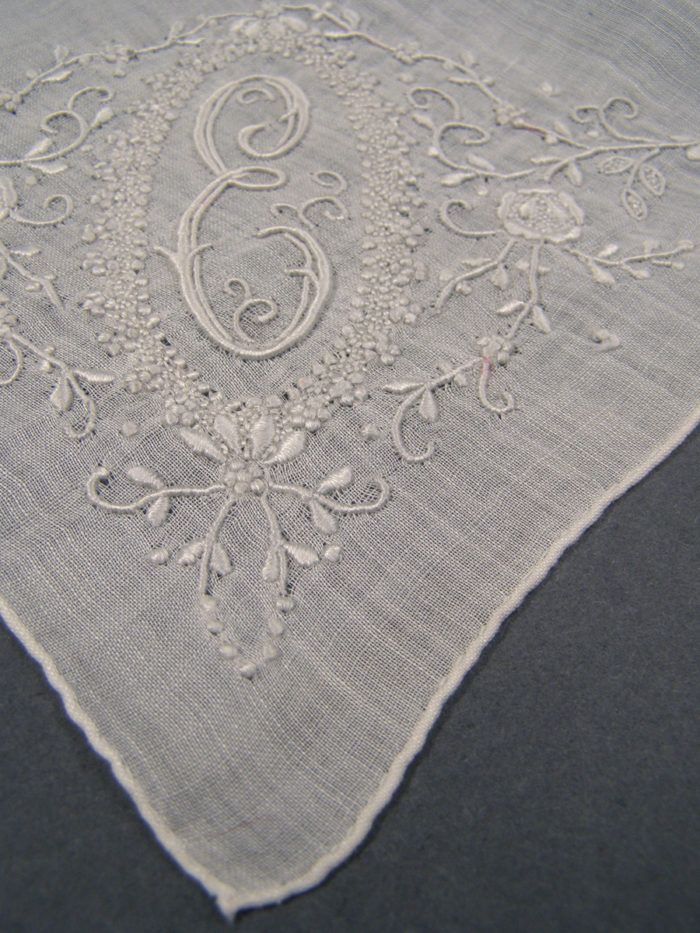
White embroidery is a lovely way to look elegant, cool, and fresh for summer. Recently, I came across an exceptional example of this type of embroidery—a sheer linen hankie that has some extraordinary work. My favorite part of this design is the texture that was achieved with French knots and colonial knots. That’s what we’ll cover in this post.
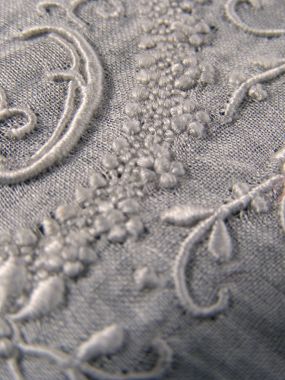
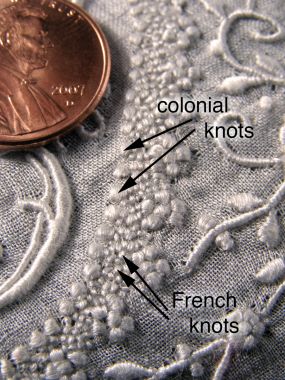
To give a sense of the fine handwork on this piece, I added a penny, so you can see the scale. I’ve also called out the French knots, and colonial knots. The French knots are finer than the colonial knots, and combining the two creates an interesting texture.
French knot
For this example, I’m using cordonnet thread on muslin, but this stitch works with different flosses or other threads.
Bring the needle up through the fabric.
Pass the working thread over and around the needle.
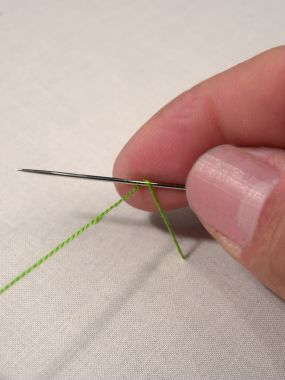
Insert the needle back into the fabric where you brought it out. Pull the thread as shown.
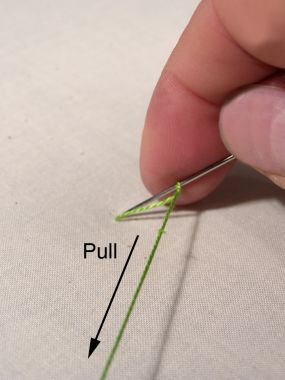
This will cause the knot to slide down the needle onto the fabric.
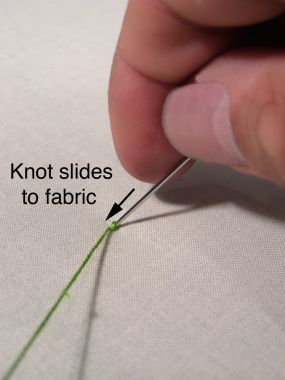
Pull the knot closed.
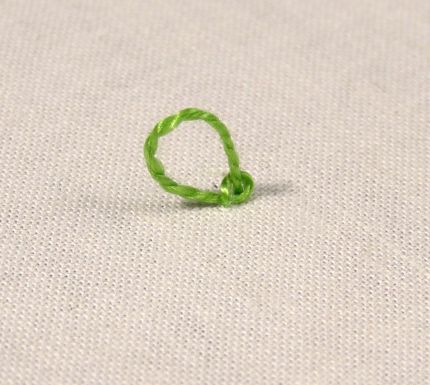
Voila! A French knot.
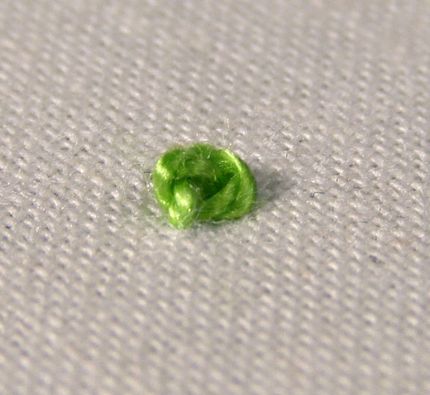
Colonial knot
The Colonial knot is larger than the French knot, due to the extra turn of thread that creates the knot.
Bring the working thread up through the fabric. Pass the needle under the working thread, and to the right.
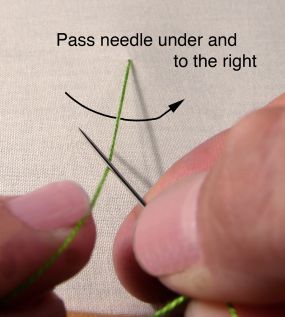
This is what it will look like after the last step.
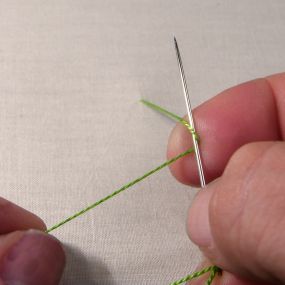
Next, pass the thread back around the needle and to the left.
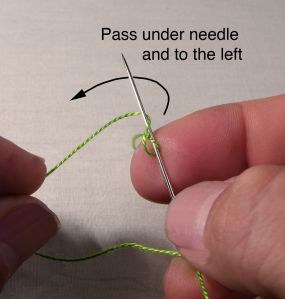
Insert the needle back into the fabric where you brought it out. Pull the working thread.
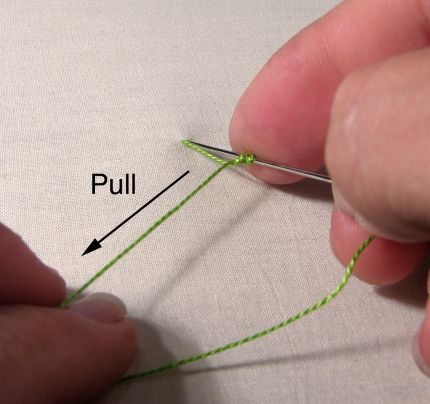
This causes…
Start your 14-day FREE trial to access this story.
Start your FREE trial today and get instant access to this article plus access to all Threads Insider content.
Start Your Free TrialAlready an Insider? Log in











Ahhh...Lightbulb moment! Thanks, Kenneth. Your work is always outstanding.
What a lovely piece of embroidery! At first glance, I thought the colonial knots were granitos. I would MUCH rather make a colonial knot than granito so thank you for opening my mind to that possibility for future projects!
Great knot instructions. Now how about the elegant letter embroidery?
I am so glad to see interest in embroidery emerging again. It, and lace-making are re-surfacing. Wonderful artistry can be created by machine, but delicate hand work shines out with simple elegance that is truly matchless. A tip about those French and colonial knots,though. When putting the needle back into the fabric, go over one thread.It helps to prevent the knot from popping to the back of the material!
I love the clear pictures! When I decided I HAD to be doing something, I picked up candlewicking and have just finished the first pillow top done in colonial knot. I found that it helps me to slip a stilletto in toward the end of the draw down to keep the threads from twisting and also to allow the pull to be tight and neat. My fingers are a bit still from not doing embroidery in so long. I have a needlework book with beautiful candlewick and applique patterns in it. I wanted to first perfect my stitch before I started on those patterns. The satin work is also beautiful. Could you tell us more about that and also the cordonnet thread? It has a beautiful sheen to it. What is a granito stitch?
I love all your work. This is great detail for two of my favorite embroidery stitches. I am trying smocking and would appreciate an article on it. One of the most frustrating things so far is that when you pleat 44" wide fabric if you want the pleats to sit neatly beside each other you can only get, at most, a 10" wide piece. So how do you get a piece wide enough for an older child? May seem like a dumb question, but everytime I try to fit the pleating to something wider, it doesn't look neat.
I vote with the lady who wants to know about doing the initialing - gorgeous! I have acquired, quite by accident, really, a linen chemise which has a yoke of eyelet which I cannot believe but which has to be entirely hand-embroidered (and you should see the under-the-magnifying-glass hand stitching with which the whole garment was fashioned!) But the eyelet thing boggles my mind: HOW LONG would it take to do something like that?? No kidding: to embark on these projects, how long a life would you have to have left to do them in??
Hello, all!
To answer some comments here:
As for the smocking, I don't do a lot of it, but if I were going to get a piece that was as wide as I needed, it would have to be done by hand. I had a smocking pleater machine once, but was frustrated by exactly this issue. It takes some time to do the hand work (running the stitches in rows after all that marking), but to my knowledge, that's the way to approach it.
I would like to clarify,that this is not my work (embroidery), but a vintage piece I found. I would love to claim it, it is so fine--really really an exquisite piece of work. The monogram is satin stitch over a padding--my guess is split stitch underneath the satin stitching.
As for the cordonnet thread, it's a garden variety cordonnet I bought at Daytona Trimmings in New York. I believe it's rayon, but could be cotton--I threw the label away long ago so don't know the fiber content.
Luv, You are correct a 44" wide pleated panel doesn't go very far. (horizontally) There are a couple things you can do: 1. Bulk the pleats of the 44" by adding a lightweight interfacing behind the area to be smocked; 2. pleat a longer width. Try 60" wide fabric or piece additional length to your 44" piece. Depending on the weight of the fabric, you may need a little or a lot more fabric. Remember in smocking the embroidery isn't stretching. It is the unused portion of the pleat that is allowing for movement and give.
Kenneth, I believe is speaking of the number of Rows or Depth from top to bottom. (vertically) It can be frustrating to be limited by the 24 or 32 Row pleater. However, with patience, you can flatten the pleated panel out flat and run an additional section through the pleater again to add more Rows.
maggieb!
That is a beautiful piece of embroidery. Thank you for letting us view it. It is similar to a handkerchief in my collection done in a very pale pink thread on a white background. I enjoy surface embroidery of all kinds and especially French knots and bullion stitches but I found them frustrating until I read somewhere that the choice of needle was extremely important. I have found this to be true by personal experience. The best needle is one (such as a "milliner's" or "straw" needle) that has a consistent circumference throughout its entire length. Although unnoticeable in ordinary use, most needles used in handsewing are not made in this way and either gradually get larger as the eye is approached or suddenly expand for the eye. Either way, this change in needle circumference means that as one tries to slip the wrapped threads off the needle, they are suddenly too tight to slide easily over the end of the needle. The alternative when using the "wrong" needle is to wind the treads too loosely in order for it to slip over the large end of the needle and this creates a sloppy knot on the surface of the fabric. If you are going to bother to take the time to make the hand embroidery, do yourself a favor and buy the right needle so that your effort will be efficient, pleasant, and result in a thing of beauty instead of disappointing sloppiness. Thanks for listening.
In that last submission, I meant "wind the THREADS", not "wind the treads". Thanks"
As always, incredibly clear and useful instructions-. Greatly appreciate the in close photos to really see how to do the knots as well as the comment about using the right needle.
And what is a "granito" stitch.
So much to learn, so exciting to think about!
I believe it is granitos stitch. It is a stitch to make small petals or rosebuds by making a few short semi-straight stitches that go into and out of the same hole in the fabric. The stitches lay next to each other, making a small rosebud-type shape. You can find many examples on the internet.
Also, typically padded satin stitch is done with satin stitch padding. From the photo, I think it is done with two layers under the final satin stitch, but I can't be entirely sure. The first layer would be done in the same direction as the final satin stitch, a bit shorter than the final outline. The second layer would be done perpendicular to the first layer.