

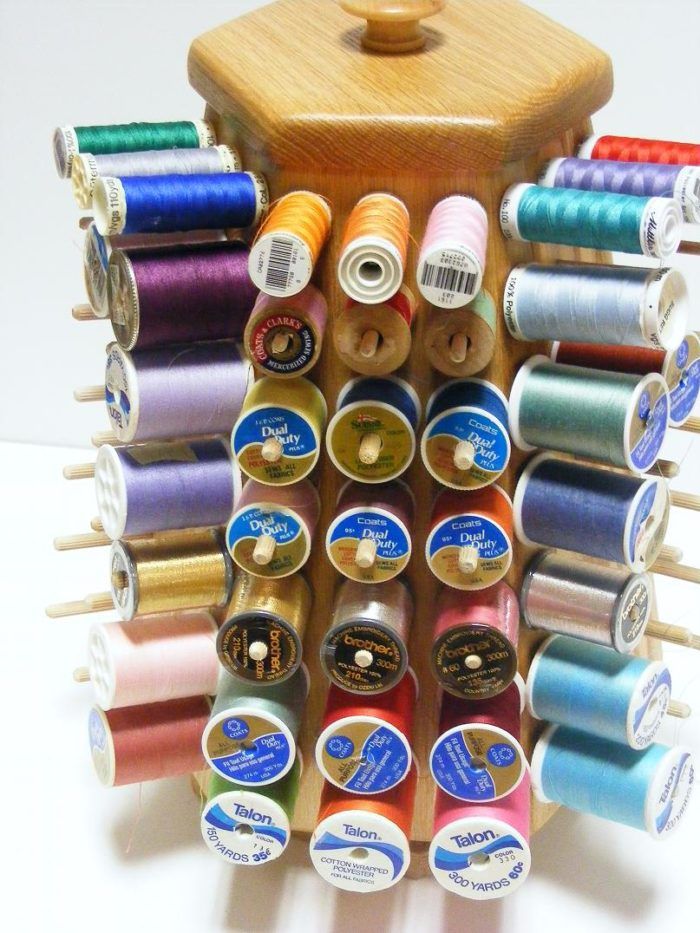
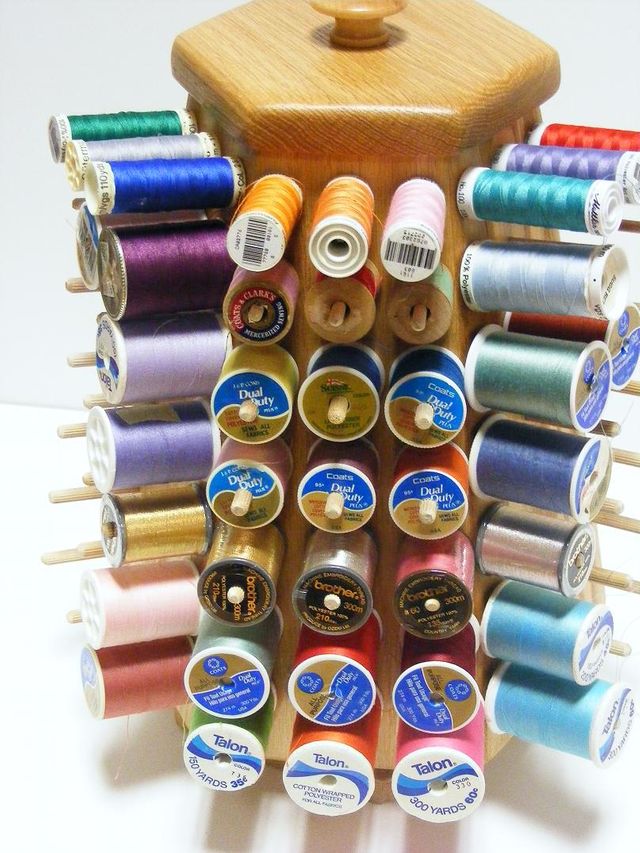
There are many products available specifically for thread and bobbins. This one is called the Easy Reach Thread Carousel which can store thread and/or bobbins and spins easily on ball bearings to help you find what you're looking for.
Our guest room doubles as my sewing room. So, whenever we have overnight guests, all of my sewing paraphernalia must be packed away in drawers and closets, or tucked under the bed. I’ve even considered buying bed risers to provide more “hiding” space!
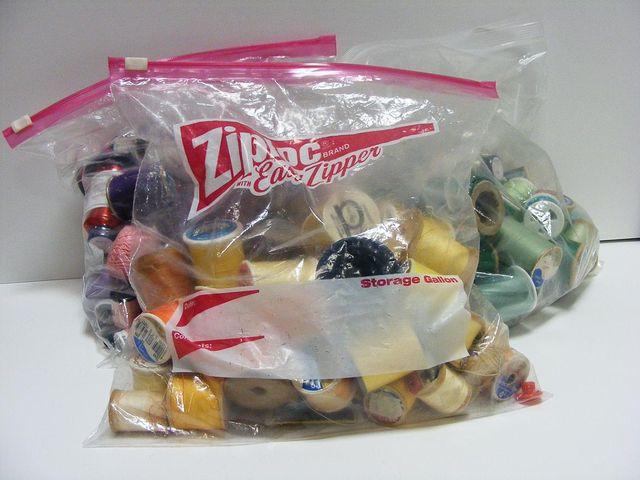
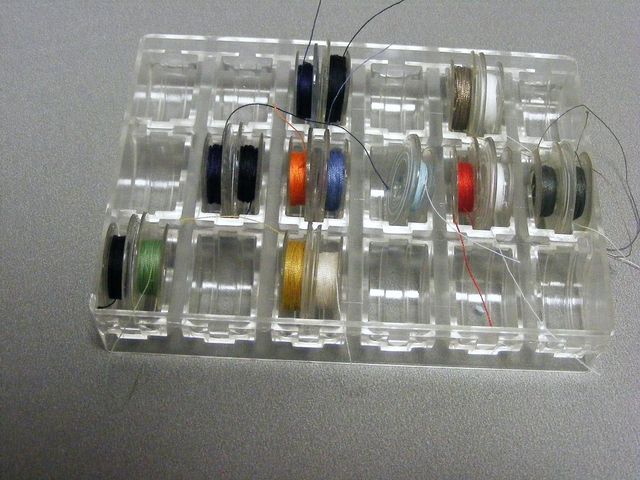
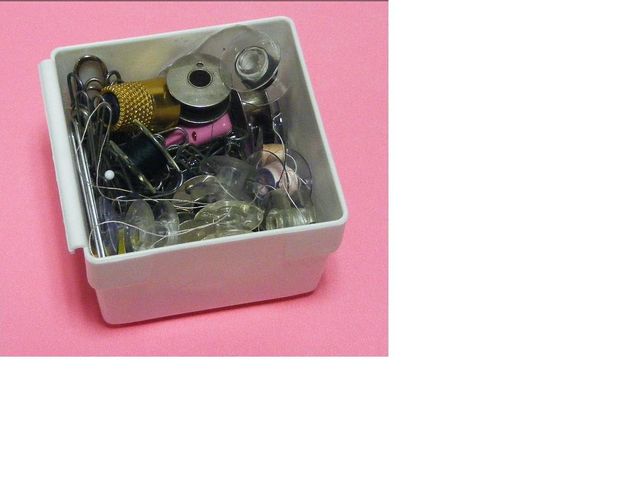
There are so many great products available for thread storage from wooden racks that hang on the wall, to revolving racks that sit on a table. There are specialty bins and drawers and containers of all types. There’s an even larger variety of products designed for bobbin storage. Yet, with all of the specialty items that are readily available, I find that zipper plastic bags are the most effective for my spools of thread and other notions, and a small, plastic bobbin container (which I’ve had since I bought my first machine over 40 years ago) is the most effective for my bobbins. When guests are expected, I cover the bobbin case and place it and the bags of thread back into my desk drawers. It’s quick and easy to remove them from sight without upsetting their organization. My thread is stored by color, and the clear bags allow me to locate the thread I want even before I unzip the bag. Each bag contains a different thread color group. My bobbins are the old Singer style that unscrew to allow you to remove the thread, so I don’t have many. If I need a new color, I simply find the bobbin containing the least amount of thread, untwist it, remove the thread, and rewind it with the new color.
Actually, I use zipper bags for almost all of my sewing gear—small bags, medium bags and large bags as appropriate. I have a bag for elastic and one for bias tape and cording. There’s a bag for zippers and one for yarns, ribbons and other trims. You get the idea. The bags all have a special place either in the desk, on a shelf in the closet, or under the bed, but I can find what I need in a jiffy, and if I’m working with the contents of the bag, it sits on the desk until I’m done. I try to organize my sewing room the way my grandmother kept her sewing space. Her mantra was: A place for everything, and everything in it’s place. The zipper bags make it easy in my dual purpose sewing room.
What is your most effective storage solution for your thread, bobbins and other notions? Is your sewing room a dedicated room? Have you used a storage product that you find indispensable? Tell us about it.














When I got my first copy of the Vogue Sewing Book in 1968 the thing that I kept looking at was the sewing room in the back. And the thing that I remember most was the see-through drawers that each held thread and notions all of one color.
I live in an apartment so I, too, must put everything away when I am finished using it and even rolling carts take too much space.
I was in the 99 cent store recently when they had the "back-to-school" items for sale and I saw clear plastic stackable pencil cases. They were about 9" by 5" and 3" deep so I bought one for each color (thread, bobbins, zippers, seam binding and ribbon) that I use and an extra couple for the odd notions. Even better, they were 2 for 99 cents so for about $5.00 I got my perfect storage. And when I'm ready to sew, I just take out one case and it has everything that I need.
I took a big thick piece of plywood and hammered measured rows of 3 inch nails with tiny heads into it, then painted it to match my sewing room. It holds about 180 spools which I arrange in colour groups. I hung it on the wall when I had my own home, and when I lived in an apartment, I just propped it against the wall on my counter. Because I have moved often, I had a cabinet maker build a set of cupboards 8 feet long. It's divided into 4 2-foot sections with 1 drawer and 2 doors with 1 shlef inside, which screw together. The "lid" or counter is one piece that fits on top and screws down onto the cupboard section. Moves like a charm and each section can be handled by one person if the shelf and the drawer are removed. My zippers are sorted into colors and styles on shower curtain hooks (the cheap ones that close) and then I hang them on a belt hanger. I hang them on a hook somewhere or in the closet depending on where I'm living at the time. Some notions, like fancy threads, sewing machine needles and things I use often are sorted into the drawers of those plastic cabinets with wheels and I roll them under my sewing table handy for use. Other notions end up in the drawers or shelves of my cupboards. I used to get the long used fabric rolls from Fabricland and rolled my laces and trims on them. I had large garage-type hooks in the walls and I had the rolls lined up the walls in the hooks. I've moved since then and couldn't put hooks in the walls but maybe again sometime. It was handy and I could see at a glance what I had.
My sewing room has a built in area with my machines. To the left of where I sit and sew is a good sized drawer. In it is are a couple of cutlery trays. They hold all of my neutral threads, black, white, navy, gray, beige, and brown. I reach in that drawer VERY often. All of my other threads are in clear plastic containers stacked in a cabinet close buy. I like to keep them from the dust and sunlight. Last year I decided to go thru my ageing thread stash and sat and yanked on every spool I own. If the thread broke easily it got tossed. It it resisted strongly, I kept it. This eliminated half of the stash as well as sewing with old thread destined for dry rot.
That Thread Carousel is one COOL way to store thread! I love it!
I have and use all the other options you've shown, but my personal favorite is pencil boxes. I sort by color and also by thread purpose, label the end of the boxes and stack on the shelf, ready to go.
I use a divided cutlery tray for my most commonly used thread colors, (black, white, cream, grey, navy) which fits into my second desk drawer perfectly. Its very handy, everything is available at a glance.
I have about 4 bobbins holders for my many brands of bobbins - my trusty old Singer Featherweight, my mother's old Singer from the 1960's which I learned to sew on and had to buy my own bobbins for (with two people sewing on one machine, you can never have enough bobbins), my grandmother's Brother from the 1950's which she loaned me for a year - so I had to buy more bobbins of course, Brother bobbins for my daughter's machine because I sometimes have to borrow it, like when my White is in for a tuneup, and of course bobbins for my White, and since I have to replace the White, I'll probably have another brand to add soon.
I think I must have about 120 to 150 bobbins in all and I still run out because they aren't a universal fit. I wish sewing machine manufacturers would get together and agree on one size fits all!
Zip lock bags are handy for so many things. I use in practically every room of the house to keep things sorted,especially small stuff. I should buy stock in the company, they must be making a fortune!
Here's a tip on what to do with old spools of thread that are so old the thread can't be used for sewing.
Make yourself a Sewing Wreath for your sewing room door, or to hand over your machine:
Dust off your old spools of thread and unwind enough thread to get down to the brighter color underneath. Find a nice vine wreath that you like. I prefer the ones with light wood, which look a bit like wicker.
Choose old spools of thread in colors to complement your decor, and wire them on in bunches of 2 and 3. Weave in some ribbon, add a bow, maybe a bit of other trims you have on hand, wire on a few special buttons in groupings of 2, 3 or 4, next add wire to the back for hanging, and voila! Your own sewing room wreath to cheer up your workspace. :)
Hi, I used to have my thread spools in a large, red, cheap plastic tool chest just thrown in there all messy and recently, I purchased 2 see-thru plastic containers made to hold spools of thread. I put all like colors together and wow, what a difference, at a glance I know what I have. I have always had my bobbins organized in a clear bobbin container and my other notions of like kind in clear plastic shoe boxes but now my thread is organized, too. Here in So. Calif. it is too dry, hot, sunny and dusty to have thread hanging on the wall exposed to all that so, I keep thread and other notions in the closet.
It's worth the time to organize your notions and supplies because you'll spend less time looking for what you need and you'll save money because you won't buy more of what you already have but couldn't find or forgot you had. Then you can spend your money on fun stuff, like the perfect fabric for your next project!
I totally agree. When I really took the time to organize all of my sewing thread spools and other supplies, it was a real eye opener. I had no idea how much I had. Just my thread alone shocked me. There were some colors that I had 6 or 7 spools of the same EXACT color, probably because I couldn't find a certain color when I needed it and just went out and bought more. I feel so much more in control of my sewing space now that it's really organized, and it actually prevents stress when I sew.
While crusing a local hardware store I spotted a double-sided plastic tool caddy approx. 10"X8" with slotted inserts to customize the interior compartments. Ah ha!! a storage container for my presser feet...I use one side to store individual feet and the other side I keep the instructions and pamphlets concerning the use of the different feet - especially those that I do not use often and forget the details of their use. Once closed the container sits on a shelf with my threads - in easy reach.
I also like the clear plastic boxes that have spool holders in them. The carousel is nice, but I need to be able to stack these. The clear ones allow you to see what's in them, and are sized for regular thread spools, as well as serger cones.
My aunt traveled overseas in WW II. I inherited her good size travel box from the Red Cross. It is a treasure to me, so have used it to store my thread. Like color families are in plastic bags, so it is easy to find the color family you wish to get.
As to my Threads issues, I copy the Table of Contents, organize them and put them in a notebook. The mags themselves are in magazine boxes for the most part.
Much of my collection of Notions, Trims, and so on is stored in 'Plastic' Boxes; some are the big ones with wheels and sit on the floor, and they decrease in size to the Shoe Box sized ones. All are labelled; thank goodness for computer printout labels.
Buttons are in Mason Jars; sorted by colour, type, even size for the most common colours.
Beads are in Pill Vials, but I recently acquirred a supply of small plastic tubes with a weird small spoon in their lid! Perfect for Beads as the lid screws on.
Some fabrics are stored flat in small cardboard boxes from the supermarket; used to ship Cucumbers, while larger pieces are in boxes that had Chicken Pieces wrapped then in a sealed Plastic Bag in them; both are perfectly clean and just a nice size for my home built shelves.
Shelves fit from one wall to the next; 8' tall X 16" pieces of MDF Board; you get 3 from a 4' X 8' sheet. I put wood blocks on the WS to compensate for the skirting board, drill a series of 1/4" holes 4" in from the long edges every 2", and cut more 8' X 16" lengths into 24" or 12" wide 'Shelves'. 1/4" Wood Dowel Pins make shelf supports. A helping hand assists as you put supports in place, put in a top and bottom shelf and continue across the wall. Sometimes you need to cut the last shelf over or under size to get an exact fit, or you can put a bottom shelf and a top rail to use the last bit as a hanging ara/ironing board storage or such.
The best is that this system can move house and/or fit in a totally different room with the minimum of trouble. So far mine has moved house/room 5 times!
Out in my sitting room I have one tall bookshelf devoted to my Sewing Books, while the bookcase hidden behind my bedroom door holds magazine holders containing my copies of THREADS and all the other magazines I have amassed over the years.
When I buy Kitty Litter in a Cardboard Box it comes in a strong plastic bag inside. Once the bag full is used I tape the box shut again then draw a line across the bottom of one 'end' 1/3rd of the way up, and across the other end 2/3rds of the way up. Then connect the corner points with a diagonal line. Cut around with a box cutter I have two slant sided Magazine Holders which I can cover with a Collage of Pictures from old magazines or Wallpaper or Sticky Backed Plastic; cheap and effective, and re-cycles something for another use. Plus they hold more than a standard Magazine Holder; great when you have thicker magazines to deal with.
I have an old Kitty Litter Bucket; square plastic, with some cut off lengths of sturdy cardboard tube in it. My rulers, 'pokers', and other long and narrow thingies are stored safely in theere, along with my "Super Stick" a length of Broom Handle with a 'Rare Earth Magnet' glued on the end; it retrieves needles, pins, bobbins and all the other small metal items that fall on the floor; mind you I have no computerised machinery around to worry about.
Liz P.
Sewer 300,
I have to store my things as carefully as I can in containers with lids because I move everything to my cottage in the spring and to my city home in the fall. In the city I have a small room but it is well fitted out with shelving. My husband put shelves in the closecloset and set up two sets of metal shelves. He also got me a steel case with little drawers , meant for a carpenter. It is wonderful for the storage of small findings and needles. A larger drawer at the bottom holds my bobbins. I have labelled each drawer so things are easy to find. Fabric is folded on the shelves in the closet and my tools are in boxes ranging in size from shoe boxes to larger boxes from other sources.Labels are the most important thing.
I store my bobbins in two bobbin cases in my top drawer of my three wooden drawer sewing cabinet (which my older brother made me years ago). I keep my threads (non-embroidery) in a fishing tool cabinet that fits on top of a three drawer plastic cabinet. This fishing case has many compartments that opens with see-thru drawers, from little to medium size down below. They are organized by color for each drawer. I keep my embroidery threads in two thread tinted see-thru boxes, sorted by number. I keep my zippers in plastic shoe boxes and my bias tape and ricrac in another plastic see-thru shoe box, both labeled on front of each. In a four drawer plastic cabinet, I keep my elastic in one drawer and other notions in the other drawers. I keep my material in plastic drawers that stack up. I can see what is in front of each drawer, so I know what material I have. I keep those drawers, two for quilting material (all 100% cotton), two for apparel material and one for fleece material, and one for muslin and interfacing. I also keep a basket with quilting fat quarters in it. It fits perfectly on a wooden shelf in my sewing room. I keep my rulers hung up on little nails on a wheeled wooden two shelves on the sides of this wooden cabinet.
After years of not having a sewing space, I finally have a room (albeit small) all to myself. It is a real joy. I've had fun being creative in my organizing without spending gobs of money. Two of my favorite ideas are for buttons and thread. I have an extensive button collection. Not an odd button here or there but whole sets, some still on cards other tied through with thread or on safety pins. I think it goes back at least to my Grandmother. As keeper of the buttons, I wanted to be able to enjoy seeing them for their own beauty as well as organizing them so that they might one day fulfill their destiny and help decorate or close something. I ended up using small silk pins to create hangers for them on a bulletin board. The other inspiration was to use lightweight chain and small dowls to create a very flexible, highly useful and decorative display for my thread. You can see pictures of these and more on my site at: http://patentingmyre-invention.blogspot.com/. I have been waiting for an opportunity to share the thread organizing idea - it's something anyone can afford to do.
I had a room divider built that houses my machine on a regal electric table that rolls into the space created for it. I have a double sided divider that has 14 cubby/cupboards that I use to store all of my sewing supplies on one side and music supplies on the other side (that side has a piano in it). When its all closed up, you wouldn't even know there was anything stored in it. Fits in beautifully with my modern decor and it is strategically placed in the brightest room in the house. Love it!
My threads are stored on a board mounted on the back wall of my sewing closet. It is 30 inches square, natural coloured fibreboard. We drew a grid horizontally and vertically at two inch intervals. At each intersection, a 3 inch nail is inserted. This will hold practically any size of sewing thread. If there are two or more of one color, put a drinking straw over the nail and add the extra threads.
Some of my storage is the familiar clear plastic storage. I have two of the clear plastic cases made specifically for thread. I visited an industrial resale place and found one of the large red tool boxes - with wheels and about 8 drawers. I lined the drawers with the bubble looking shelf liner and store the following: scissors, rotary cutters, bobbins in plastic bobbin boxes, crochet & knitting needles, straight pens, marking pencils, serger thread, machine embroider thread, specialty sewing machine feet, rulers. I store my hand embroider thread in a converted fishing tackle box - one that has 4 clear plastic cases that store on top of each other in a handled case. I store my buttons in a wall mounted draw style cabinet with clear plastic drawers.
I moved into a small 1-bedroom apt 9yrs ago. I saw a computer cupboard in an office supply sale flyer and got the idea this would make a great sewing area. Lots of shelves for storage. I put my sewing machine on the keyboard shelf, serger on the file area. See thru shoe boxes from $1 store, fit on shelves. Got 2 sets see thru plastic storage drawers from Department store; 4 large drawers, 6 small drawers fit notions, my threads stand up, color co-ordinated; all sewing needs are at hand. 3 Small containers, size of bobbin boxes, bobbin box tops fit in bottom to put feet in, that don't fit in bobbin tray. Bobbins in another, needles in another. Some books at easy access.
My swivel chair, back removed, allows me access to sewing table and ironing board. I purchased a small acrylic table which fits base of sewing machine to give me a flat surface, thru to the area where the monitor would go. The cupboard doors close and I can put my machines in the monitor area. But, I've yet to close the doors as I am usually working on another project. This cabinet is my best organizing investment.
Fabrics I store vertical in plastic containers, I recycle plastic zippered bags that blankets and linen come in. I also use plastic bags grapes come in, with zip closure, for small scraps, I can quickly find what I'm looking for. I enjoy living alone, I can leave my organized clutter out, which I call TBC - To be continued.
I had many spools of thread on fancy spindles right out in the open - in the light - with a fan blowing near many of them. For years, I have stored my thread here and there,some in plastic containers, some in sewing machine drawers. Not well organized.
Then I started teaching my four Granddaughters how to sew on their small sewing machines and the thread kept breaking. I was blaming the sewing machines, the needles, the fact that they were beginners and finally I pulled out a length of thread and pulled on it and it snapped in half. The THREAD WAS ROTTEN! Since I live 20 miles from the Atlantic Ocean, this may have something to do with it.
Then I started checking the rest of my thread stash. To my horror, almost ALL of my thread was rotten. I then Goggled the problem and read that thread should NOT be stored in the light or air. Whew! However, even my thread that was in heavy plastic cases away from the light and air was also rotten. The thread that was good and strong had been stored in double-plastic cases with one plastic case inside another plastic case.
When I went shopping for more thread (just a little at a time from now on.) I immediately tested the thread as soon as I got out the door and it was rotten (or shall we say WEAK, IT SNAPPED IN HALF. A person is supposed to pull off a six inch length and pull with both hands and if it's weak and snaps in half, it's rotten. Then I went to another Fabric Shop and purchased another spool of thread and once again, IT SNAPPED IN HALF. I returned it to the store and they said that I was the FIRST person to ever report rotten thread. I then purchased stronger thread -- for hand quilting (although they said that it was also OK for the sewing machine It was marked - Polyester 68% Glace Finish Cotton 32%. This was much more expensive, but hey, it's STRONG and I've done some sewing, and it works fine.
I suggest you check out any thread you purchase and make certain that you are getting good strong thread. I do NOT BUY Bargain thread either -- only the famous brands.
I'm still insecure about the best way to store my thread, but am open to suggestions.
I'm in love with ArtBin Super Satchel storage. I don't have a dedicated sewing room, so I have to maximize my space. The thread box keeps the spools organized and dust free. I have three more of the bins in different sizes for patterns and notions. My bobbins are in a Dritz bobin box. They sit by my sewing machine.
I have to admit I'm the most anal about my thread. It's arranged by color. I also keep a spreadsheet that lists all of the colors I own so that I don't buy duplicates. My goal is to get some index cards and make swatch cards for the stuff in my fabric stash. I need a way to keep track of the care instructions after the garment is made.
HOLA!SE MUY POCO INGLES ,PERO NO PUEDO DEJAR DE DAR MI OPINION,ES MARAVILLOSO EL PORTAHILOS ME PARECE MUY PRACTICO Y UTIL,FELICIDADES,SALUDOS DE MERIDA YUCATAN,MEXICO
I have limited space, limited income, and asthma, so if my materials get dusty, I can't use them. And all those specialized gadgets are super-neat...but I can't afford to spend my money or space on single-purpose gadgets.
I use ziplock bags and Glad Press'n Seal cling wrap for keeping my thread neat and matching colored spools and bobbins together. I tear off 3" to 4" long strips of the wrap, tuck the matching bobbin in the corner, then wrap it lengthwise around the matching spools of thread. Then I stick all the thread in a gallon-sized bag.
This keeps all matching colors together, prevents the ends from unraveling and making messy, wasteful, cuticle-snagging snarls in the bags, and I can still see what colors/how many/what kind of thread I have. It works nicely for keeping my big cones of serger thread neat too!
Best of all- as long as I'm careful when I unwrap the spools, I can reuse the wrap again and again!
The bedroom is the sewing room. Fabric stash by color on open enameled wire shelving; interfacings and fabric scraps in clear plastic tub storage; 35-year-old sewing machine on typing table -- I sit on the edge of the bed to sew; thread and bobbins in plastic drawer; several stackable, labeled Snapware containers for ribbons, zippers, vintage trims, embroidery thread and other sewing notions. Embroidery hoops and French curves are hung on the enameled wire shelving from "S" hooks. Most patterns are in standard pattern boxes, but patterns I'm working on are kept out and placed in plastic ziploc bags. I also keep as a catchall a deep tray holding scissors, rotary cutter, darning egg, needle holder; this tray I take with me if I do any hand-sewing or embroidery in another room. Pressing can be done either on the large ironing board or a small tabletop one. Garments to be copied or altered are in a separate labeled plastic tub.
My husband made me beautiful standing racks with dowels for each spool of thread. I found the thread got dirty and faded. Looking for an economical alternative to specialty plastic cases made for thread, I found boxes that are made for Hot Wheels cars. There are inserts to separate the spools which can be set at different lengths for small and large spools. I have three boxes (each has a lid) and sort my thread by color and shades.
Multiple purchases stay together and the thread stays clean. There would be room to keep the bobbins with the respective spool too.
I have a sewing business out of my home thereby giving rather limited space and a great need for being organized.
- Old dresser from garage sales double as notion drawers for everything you could think of. I make dividers in the drawers and smaller items (like trims etc) go into zip bags to keep organized and easy to find. Each drawer is labeled on the outside with its contents.
- Threads are in the smaller plastic drawers, fairly inexpensive to purchase almost everywhere. Inside each drawer I make tray dividers by cutting down Kleenex boxes both in height and width so a spool of thread can lay crosswise in the divider. Each drawer is labeled on the outside as to what colour is inside, ie:
1. black to white (includes all greys), 2. crème to beige, 3. blue to green, 4. pink, red and purple
- Another similar divided drawer holds all the machine and hand sewing needles, bobbins in cases and screwdrivers to change the needle.
- All remnants and/or uncut fabric is stored in clear plastic bins or clear leaf & lawn bags. All patterns are stored in clear bins labeled with contents: baby, children, adult, crafts, quilting etc.
I am fortunate to have both a dedicated sewing room and a husband with a dedicated shop. When it comes to thread, he made for me a cabinet which is mounted to the wall and has a door with a window, much like a china closet. Inside the box are rows of spindles perfectly spaced for my vast collection of cone threads. In addition, my mother willed to me the sewing chest of drawers that was in her sewing room for as long as I can remember. Three of those drawers have dividers that specifically fit a traditional spool of thread. Just my luck, I think Dual Duty thread spools have just been redesigned and they no longer fit!!!!
I had a clear plastic bobbin holder like pictured here. Every time I reached for 1 bobbin, I got 10 other threads and rolling, unraveling bobbins all over the place. Also, the lid had no fastening closure. It was maddening. So I invented the Bobbin Bay. (See Nancy's Notions)No spinning, no tangling, no unraveling, no falling out. But if you don't get them now, they're going to be gone. I've discontinued making them. (Manufacturing problems)But my personal list of the next best bobbin holders are this: Extra Large Bobbin Box (Clotilde), Bobbin Saver (comes in various colours which is nice) then it's all downhill from there. Bobbin Buddies are just some other small pieces to get lost and/or in the way, imho.
I am blessed to have my own sewing room. I store my many threads on the wooden dowel wracks purchased from Joann's. They are arranged by color and when exposed are beautiful to look at. I have them mounted on the wall side by side 3 abreast and 3 high and wrapping around the corner above my sewing center. I have them covered with a cloth drape which is similar to a curtain with a dowel holding the drape in place at the top. It doesn't look real pretty, but my thread stays clean and it is available at my fingertips. The bobbins are stored in the half tube shaped bobbin holders arranged neatly in the drawer under my machines. They are handy and the bobbins click right into the holders. I store my notions in various sized plastic labeled drawers, on wheels, tucked under one of the sewing tables and my cutting table. My buttons are in jars inside a small plastic tub in one of the cupboards my husband installed. He purchased them at Lowe's home center and I have 2 sets of 6 cupboards with 2 shelves each. Fabric is stored in clear plastic totes and labeled. Even though I have 2 rooms dedicated to my sewing I find I am running out of storage space. I am a quilter too and have a short arm quilting machine, which takes up one half of the room.
My thread is stored in plastic thread boxes with covers. A couple colors share a box. I keep my machine quilting thread separate, since it's all cotton. My serger thread sits on a wooden thread stand on my sewing table, which is an old dining room table. I have plastic covered storage boxes that hold elastic, seam tape, zippers,snaps, grommets, etc. Each box is labeled on the end and on the top. These are stored on shelves in the closet. My smaller notions that aren't in use, are stored in a dresser drawer in small boxes. My quilting fabric is stored in plastic storage boxes with covers, each labeled on the box ends and covers. Generally one color per box. These are stacked around the edges of the room and under my sewing table. I also have a four drawer plastic storage tower on wheels that holds more quilting fabric. This also serves as my portable ironing surface with a Quilter's Square 'n Press on top. It's just the right height for me to use and stay sitting at my machine, so I can press as I piece my quilt blocks. I try to be organized, but my sewing room is a multi - purpose room for me. It also holds a light stand to start seedlings in late winter, my computer desk, my ironing board is always set up and sometimes used more as a table than to iron on. There's also a dresser which holds some notions, fabric and one drawer for my gardening notebooks. My son made me a ruler rack to store my rotary rulers in, which works wonderfully. There are more slots than I have rulers for, but other items have snuck their way in to be stored upright. Lastly there's a bookcase filled with quilting books and Threads magazines.
My thread is stored in stackable, locking plastic containers, the kind that snap together. All my sewing supplies are stored in these. My bobbins are in Altoids tins which are then put in the plastic boxes. Large spools of specialty threads and serger threads are stored in a shoe box. No fuss, no muss.
Like the author, I find that the clear zipper bags work best for most of my sewing supplies, including thread. I've stored thread for years in quart size bags and sort by color. Finding my thread is quick and easy, and the thread is protected from dust and light. I've never had a problem with thread breakage. I also do not buy "bargain" thread because it usually isn't such a good bargain in the long run.
Recently I started using plastic bobbin attachments that allow me to attach the bobbin to the correct color of thread. If I have a bobbin that has a useable amount of thread on it, I put it with the thread so that I don't have to search for it. If I finish a project and there isn't much thread left on the bobbin, I take it off and put away the empty bobbin. That way I am not left with bobbins that really don't have a useable amount of thread on them.
I try to store things like zippers, buttons, bias tape, etc. in clear containers - either zipper bags or stacking plastic boxes. I prefer the plastic boxes that (1) have a tight-fitting or locking lid and (2) are offered in a variety of sizes.
I purchased a sheet of pegboard from the hardware store and cut it into 4 pieces, and spray-painted them white. Now all of my scissors are hanging from pegboards that are mounted on the wall. I keep my embroidery scissors near my embroidery machine, my pattern cutting scissors near my cutting table (which is a small dining table purchased at a yard sale, raised on bed risers so that I can stand straight as I cut things out - and it provides a good space for storage underneath), scissors I use while sewing and serging are on a pegboard above those machines, and my craft scissors are on a pegboard above the craft table. I even made labels that indicate what each pair of scissors is to be used for - keeps the rest of the family from using my good dressmaker shears to cut paper!
There are some great ideas in every post - you will have to decide what works best for you. Whatever storage method you decide to use, you should label each and every container. You'll be glad you did when you are looking for a specific item.
I forgot my most important sewing storage idea! I have a notebook (8.5 x 11) with fabric inventory pages (1 page per fabric). In addition to a swatch of the fabric, each page has the fabric content, yardage, date of purchase, where purchased, cost, care instructions, and the number of the box where the fabric is stored. If I know what I plan to make from that fabric, I list the pattern number and brand, which view on the pattern, yardage needed and any notions needed. Sometimes I include a sketch of the project. When I make the garment I put the completed date on the page. I carry this notebook with me when I go to the fabric store. I can match threads, buttons, trims, and know exactly what notions I need to purchase for each project.
In the back of the notebook I also keep a printout of an Excel spreadsheet of every pattern I own. I list the pattern number, brand, and a brief description of what the pattern is - i.e. dress, pants, tops, valances, duvets, etc. If I am looking for a dress pattern, I can sort the computer file so that all dress patterns are grouped together. I reference the spreadsheet especially when shopping pattern sales. Keeps me from buying patterns I already own!! This spreadsheet also has comments about the pattern if I have used it - any alterations, what I liked or disliked about the pattern. This spreadsheet comes in handy when I purge my pattern stash every couple of years.
This notebook keeps me focused on my sewing projects. It also comes in handy when I purge my fabric stash. I can attach a small tag with the yardage, fabric content and care instructions onto each fabric piece that I donate.
I have the luxury of having a dedicated room, I actually took over the master bedroom for my studio, and have two great closets (we have 4 bedrooms and my husband suggested that I have the largest room for my sewing business)
I store my threads in plastic containers that were originally for the Matchbox cars for children. they were about $6 a container and have compartments on both sides, So I can store color ranges on both sides... I can keep emboridery thread seperate from sewing thread. they are easy to store in a cupboard under my sewing desk, which is actually a computer desk.
I store my bobbins in those cute plastic round bobbin holders and they stay in there without a struggle and no more of the threads being tangled.
On the slide out on the desk, which would be where the keyboard for a computer would have been I keep a drawer oragniser and store empty bobbins, tools scissors etc.
I do have a spindle thread holder on the top shelf of the computer desk, where I store the regular black, white, cream and brown threads. My fabric is stored on the cardboard like they are in the store. So at a glance I can see what I have and use it. The cardboard in most fabric stores ends up being thrown away, they dont always get to recycle it. So I do my part to recycle. They are free. My patterns are kept in pattern boxes and stored in the closet.
All notions are stored in pattern boxes on a shelving system you find in a pantry or closet.
I love my Studio. I love my husband for making the suggestion to change rooms!
I'm blessed to have a handy husband and every house we've lived in he has made it a priority to remodel a room for my sewing and crafts. As our children flew the coop that meant I had much larger and better spaces to use.
My current space is about 32 x 10 plus a storage closet. I love to collect sewing antiques and collectibles and use many of them for storage, but my most often used storage is a large plastic case with about 32 tiny plastic drawers that is intended for storing screws, washers and the like. I sew buttons, tape measures, hooks & eyes, thimbles, tiny screw drivers, chalk, needles, pins, etc. in these drawers. I can see at a glance what's in there, and because the drawers are small, i don't bury items in there, never to be found again. And the device was very inexpensive.
I love threads of all kinds, and own many that I haven't yet figured out where I'll use them. I keep them in shallow drawers out of sun and dust to help preserve them until I finally use them.
Sew Happy today! Annie
Most of my notions, threads and bobbins fit inside
a plastic roll-around cart with 6 drawers found at any office
supply store. My best hint is I store my bobbins in "Applets and Cotlets" candy inserts set inside the original boxes, 3 bobbins fit per candy slot. These intern sit inside the cart. Fishing tackle plastic boxes hold presser feet and buttons. All these inserts are open, no tops, so are easy to access. I also use 2 large set of multi-drawers used
in a garage for all the little stuff like snaps, labels, various needles, etc., each item has it own drawer. Ribbons,
strings, bias tapes are wrapped around a 3 x 5 card and are stored in stacking plastic drawers with zippers.
All sewing supplies are stored in a 6 ft. closet with permanent shelves installed. I separate my fabric in open apple boxes used on the selves as drawers as silkies, wool, cottons, decorator, knits, interfacings, tracing papers, outwear, special projects.
Patterns are stored in a basic cardboard bankers box. I cull old fabrics, patterns often. I keep a record of what I make on a simple piece of card stock (about 3 garments per card) with pattern number, a piece of the fabric and a comment on what I did special on that garment, any changes I made to the pattern and what I would do different next time to make the garment fit better or ideas to try. A 3 ring notebook holds the cards plus ideas for future projects
I have a small sewing room that has to double as a bedroom so storage is very limited. I use --beautiful stack boxes-- to hold items I don't use everyday, and my favorite is an --over the door clear shoe storage bag.-- The bag is clear so you can see what is contains. I store things like my favorite and most used sewing notions, presser feet, and large spools of serger threads, snaps, zippers, and embellishments for my sewing projects. The shoe bag hides behind the door is out of site but so easy to access. I had seen something similar at my cousin's, she had a Barbie Doll storage bag similar hanging on her wall, and it gave me the idea for the shoe bag. Another storage solution I have is using my --local fabric store’s reusable "green" bags. I place my “projects” in plastic bags, write on the outside what it is, then stash them into the reusable bags throw them into the closet and can find everything I need for that project in a flash.
I have a small sewing room that has to double as a bedroom so storage is very limited. I use --beautiful stack boxes-- to hold items I don't use everyday, and my favorite is an --over the door clear shoe storage bag.-- The bag is clear so you can see what is contains. I store things like my favorite and most used sewing notions, presser feet, and large spools of serger threads, snaps, zippers, and embellishments for my sewing projects. The shoe bag hides behind the door is out of site but so easy to access. I had seen something similar at my cousin's, she had a Barbie Doll storage bag similar hanging on her wall, and it gave me the idea for the shoe bag. Another storage solution I have is using my --local fabric store’s reusable "green" bags. I place my “projects” in plastic bags, write on the outside what it is, then stash them into the reusable bags throw them into the closet and can find everything I need for that project in a flash.
I am not lucky enough to have a sewing room right now. I am using my living room which thankfully is very large. My sewing machine and serger is right next to my desk and P.C. along with my embroidery machine.
I keep all my sewing thread, quilting thread, embroidery thread and all my bobbins in an old card catalog; that the libraries used before they cataloged all the books on computers.
We got this when our library switched over around 15 years ago, but I have also seen one at a rummage sale. They’re great for sewing thread and work great for bobbins too because my husband made dividers for my bobbins. He even took out several drawers and made larger drawers for my embroidery thread. I also have extra drawers for misc. items that aren’t used all the time.
Before I got the card catalog I used a plastic cart with 4 drawers that I got from Kmart. We just put in dividers in it and it worked well for all my sewing equipment
Wow, such great and wonderful ideas for sewing room storage. We have just moved into our retirement home which we designed and built and it has my dream craft studio. I can spend hours in there happily working on all those projects I had envisioned while working that 9-5 job. Next to my favorite sewing machine, I have my computer which I have found to be quite invaluable for cataloging my inventory of fabrics, threads, patterns, etc. I had never thought of using my scanner for my patterns until one day I was feeling so overwhelmed with boxes of patterns and no space to sensibly store. Then, I thought of using the computer to work for me. I take the the patterns out of the envelope and scan the front of the envelope into the computer. The pattern image is categorized according to type, size, pattern co., storage location, etc. Once cataloged, the patterns are placed in labeled, numbered boxes and stored out of sight. When I need a particular kind of pattern, I just go to the computer and do a search for the particulars desired and quickly find it. This method could be used for a number of other items as well.
I have two small hard to access cubby holes underneath the eaves which I use to store things which are seldom used.
This is really cool. Take a storage crate and fold your material and stack it vertialy in the crate as in a filing cabinet. You can sort according to color or type and see at a glance what you have. For fat quarters you could use plastic shoe boxes.
For large bulky fabric storage I buy those cheap cheap plaid plastic zippered large storage bags for about $1.50-$2.00 each usually sold at Dollar stores. They hold tons of fabric and are quite strong but the zippers can be flimsy. I take a rectangular paper tag and write the contents on each tag. I try to keep one type of fabric in each bags such as: fleece, quilted etc.
We have a cape cod house with eaves on the front so it makes a nice storage space to line up the bags. A quick glance at the tag and I know immediately what is inside.
I also bought a cheap four drawer filing cabinet for my patterns. I have way too many patterns...... In each drawer I made paper dividers for each catagory. The bottom drawer is for "Misc. Patterns"
You can also take strong straws and insert them over the wall hanging thread pegs to extend each peg. Also cut
a plastic water container and place it over hanging spools.
It has been very interesting reading all of the above ideas.
Thanks!
Great ideas for storage. My room serves as my bedroom, study (I'm an online college student), sewing and craft room and a library along with my quilting fabric. I have a 6'wide, 7'high closet that has shelving and is filled with my fabric. To store my supplies I at first had those old fashioned tins and the predominte color held that color of supplies. However, the room began to look TOOOOOOO cluttered so I bought white photo storage boxes. I marked each one with a color and store everything (except bobbins) - thread, buttons, zippers, tape, ribbon, of the same color in the same box. It makes a much neater looking shelf space above my sewing machines. I have found that plastic bags seal in moisture and can be a problem. Cotton, especially, has to breath.
I have a dedicated sewing space, however it is an open area in the back of our family room.
I recently had my husband install hooks on the wall so I could hang my wood spool racks.... I have 2 racks for serger cones & 2 for regular sewing thread. My next plan is to make plastic dust covers for the racks.Most of my other notions are in plastic shoe boxes or in plastic stackable bins
I have a large and varied collection of sewing thread. I purchased two large fishing tackle containers that open on both sides. Normally, fishermen use these to store their flys, weights, hooks, etc., but I found that the compartments in these containers are just the right size to put spools of thread. I separate my threads by functionality, decorative embroidery and metallic threads go into one container and everyday thread goes into another container. The sides are clear so I can see exactly what color I am looking for. These cases are also very portable and can be easily moved from one room to another.
I used to have two rooms dedicated to my sewing and crafts, but then the grandchildren arrived and now I am using only one small room for all my sewing and craft projects so everything has to have a place.
I have a large variety of sewing threads and a very small room to use for my sewing and crafting. My threads were packed away out-of-sight until I saw these fishing tackle boxes (with handles) at Walmart. These boxes were already divided into small compartments and had storage on both sides. I purchased two of these box. I place all my specialty embroidery thread in one box and all my general sewing thread in another box. Now I have all my thread in one place and because the cases are see through, I can find the color that I need. If you wanted, you could also store the bobbins in these boxes.
Now I don't end up buying more thread because I couldn't find it in my stash. I know exactly what colors I have.
I hang a Clear, Plastic Over-the-Door Shoe Rack on the wall next to my sewing machine. I can see all regular notions I need, and grab it without getting up from my chair.
Old zippered comforter cases, the kind bed sets come in, store fabric by type (knits, fleece, etc).
I take cardboard greeting card trays and use those as storage for notions, patterns, etc. These have cut out handles on each side. I only know about these because I work at a popular card shop. Since they regularly throw them out, they're free :)
My work table is an old retail table that displayed folded t-shirts,from a going-out-of-business sale. Because it's meant for display, it's low and good for short persons. And it has two full-length storage shelves beneath it, which is where I place my card trays of notions and comforter cases of fabric.
A flat cork bulletin board is used for pattern manipulations and stored in the closet.
Also, at my school, people use tackle boxes, old train cases, or small suitcases to hold all their sewing notions. Some use a small basket for things needed at the machine.
I have all of my thread on a picture frame that took the glass out of and backed with a thin sheet of plywood. I nailed nails into the backing that were long enough to hang the thread and the corresponding bobbin on. I used the tutorial found here:
http://www.u-createcrafts.com/search/label/craft%20room
I store all of my buttons, small embellishments and closures (hook and eyes, skirt bars etc) in a bead box that has little compartments. All of my buttons are organized by shape, size and color.
For common tools like my rotary cutter, pinking shears and scissors, I bought a small bar that screws to the wall and hooks to go with it from Ikea and i hang them right by my sewing table so they are always in reach.
I can probably use this storage design for all the wire and piping I've got in storage in my garage back in Sydney! My wife will be so happy I cleaned up…
I know my wife just chucks all her spools into a box somewhere for storage. Hardly as organized as this, but they're all in one place at the very least!