

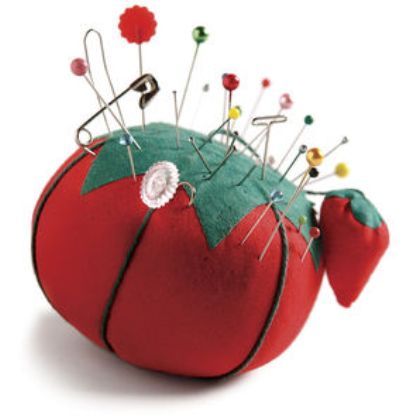
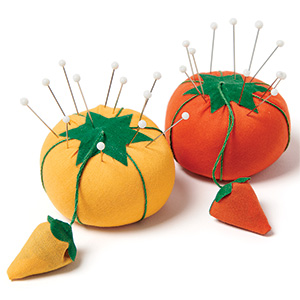
The tomato pincushion has become an icon representing sewing today.
TOMATO PINCUSHIONS HAVE BEEN POPULAR FOR YEARS
The “Best Tip” in Threads #160 (April/May 2012) features the use of a standard tomato pincushion (and a permanent marker) to organize your machine-needles. Knowing which needle is in which sewing machine or serger is just an added benefit to trying out this technique. The tomato pincushion lends itself beautifully to this tip, but as I read the tip, I couldn’t help wondering how the tomato pincushion came to be. My grandmother and mother both had tomato pincushions, and I have several. I did plenty of research on this subject and found some interesting information.
 More on working with pins:
• A Pin for Every Purpose
• Create Intricate Fabric With Pin Weaving
• How to make a dust pan that attracts pin
A LITTLE BIT OF PINCUSHION HISTORY
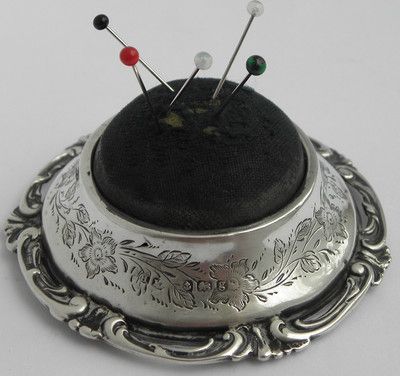
In the years 1300 through 1400 metal pins were costly, and as you would imagine, not as readily available as they are today. They were usually stored in special needle/pin cases made from ivory, bone, silver or other metals. In the early 1700’s pin-pillows came into use–the predecessor of the pincushion of today. They were beautifully made from fine fabrics and often delicately embroidered. Soon the pin pillows became mounted on a silver, china, or wooden stand or base. In many cases the pincushion was actually used more as a home décor item than a sewing tool. During the early 1900’s pincushions became more common as a useful, functional sewing aid.
THE TOMATO EVOLVES
I also learned that during the Victorian Era, folklore suggests that when a family moved into a new home, a fresh tomato was placed on the mantle to ward off evil spirits and thus bring prosperity to the new homeowners. Since tomatoes were only available in certain seasons and didn’t stay fresh forever, the good-luck symbol was frequently fashioned from fabric instead–stuffed with sand or sawdust and made to look like the real thing with embellishments such as leaves and veins. I can imagine how easily the tomato graduated from a “tchotchke” to something more useful. Whenever I find straight pins or needles lying around my home, I poke them into my quilted toaster cover until I’m able to bring them upstairs to my sewing room. If I had a stuffed tomato on my mantle, I’m sure I’d use that instead! Perhaps even the “voodoo” nature of the tomato encouraged people to poke pins into it.
Do you have a tomato pincushion? Does your mother? Your grandmother? Have you heard other “folklore” stories about the origins of the tomato? If so, share them with us in the comments.








Thank you so much for this nicely researched bit of info- I always wondered about that! I'm going to email Dad & ask him to print one out for my mother, too, since she gave me mine for Christmas years ago!
When my daughter in law started sewing, I knew she needed a tomato pincushion. I didn't know why, I just knew it was something we all started with. Now I know and she will have a new one for her new home!
My grandmothers, mother and I all have used tomato pincushions abundantly with our sewing. Granny taught me that they were filled with steel filings and this helped keep our needles and pins sharp! I've noticed that recently marketed tomatoes are sometimes stuffed with poly....totally missing the point! No pun intended.
I've been sewing for 51 years and was just given my first pincushion. I've just always kept my pins in a box. Since I bought my Embroidery machine, I had to move my sewing machine and my box won't fix on the right side of the machine any more, so I put the pin cushion (a small brightly colored brimmed hat) on top of the machine. Also about 6 months ago I found out what the little strawberry is for. It's to hold your thimble. I like having a pin cushion so much now that I bought a vintage half doll to make one to go with my vintage sterling needle case, awl and thimble.
My mother's tomatoes were filled with sawdust. The little dangling thing was for sharpening and filled with something grey and gritty. When a tomato cover got hopelessly worn out and the sawdust started leaking, we would cut the tomato before throwing it away to retrieve all the needles that had gone completely inside over the years.
Her tomatoes always seemed bigger than my current tomato, but maybe that was my child's perspective.
Moirnet, if your thimble will stay on your strawberry, more power to you. I don't think I've ever had one that would stay on it.
The strawberry traditionally is filled with steel filings so that you can stick your pins and needles in them from time to time to sharpen them, or to smooth off rough or rusty spots if they develop. To sharpen points, you stick them in and pull them out five or six times. To smooth a rough spot, stick the needle in the strawberry until the rough spot is firmly inside, then hold the berry tightly around the needle while you move the needle back and forth inside. It works like a champ!
Filled with sawdust, a pincushion has enough heft to stay in one place. It doesn't seem to me that one filled with polyester would have enough weight to stay put. I know that my cats would be playing with it on the floor in no time.
I am running a sewing school for kids and they always ask me why we use a tomato as pincushion. I never knew why to answer. Now, I have a story to tell. I will post it on the wall of my school for everyone to see. It is also on my the school Facebook page. Great story!
Hey! Great timing with the tomato lore! We are building a new house, which will have a fireplace in the familyroom next to my new sewing room. I'll be certain to place a tomato on the new mantel! My sewing projects need all the luck they can get! heh heh Thanks for the tip!
Love this story and I love my old tomato pin cushion! Thanks for sharing the history.
This is a little off subject but the Amish Ladies do not use saftey pins but they straight pin everything. But they use zippers?!
Thank You! That explains the old heart-shaped pin cushion I remember my own mother using as a child. It was large, heart-shaped, probably 8-10 inches across and made of a beautiful soft ivory satin, with a intricately crocheted overlay, and a surrounding ruffle.
My Mother always told me that pincushions were red, called Tomatoes, because that way they were easy to see. Mom said that fabric was not always available in the nice bright colours we have today. So that red tomatoe stood out. Also, when Mom was sewing and asked for the Tomatoe, we knew exactly what she was asking for. I like the pretty handmade cushions very much and enjoy the small antique cushion I have from my Grandmother. But, I have at least 3 of the trusty old tomatoes.
Dear little tomato pincushions! Yes, I have had tomato pincushions from the time I began making my own clothes, at age twelve. Now, I will get a new one to organize my machine needles. Thanks for the idea!
My only pin cushion is a red tomato because it is large and colorful to see. I tried the wrist pin cushion but its smaller. I am not getting an award for beauty so I will continue using my red tomato.
I took my love of sewing, starting at age 8 and turned it into a collection of Pincushion Dolls. I have now collected over 350 porcelain half dolls. Each doll represents a period in History and I am happy to say they are now very collectible. All this started from the little red tomato.
I have taught sewing in the public school system for over 50 years and am now teaching in my retirement. Each student comes with their red tomato each session, reminding me of my childhood sewing with Mother and Grandmother alike. Now you have given me a piece of History to share with my students, thank you so much.
The little dangling "Strawberry" on a Tomatoe Pin cushion is filled with Emery Powder. It is an abrhsive and will shrpen the points, polish blemishes and even rust off pins and needles. The seamstresses sewing the lace onto Kate Middleton's wedding gown had to use a new needle every so often so that it was never blunt. http://thestar.blogs.com/royals/2012/02/index.html
Pins and needles were handmade until fairly recently, and were costly. a woman would be allowed to sell some farm and garden produce and keep the money for her own needs; hence "Pin Money".
http://www.forgemill.org.uk/
Liz.
LorWin
I am very impressed with the idea of the Tomatoe Pin Cushion
used for our Machine Needles. I am one person who changes my
sewing needle between starting and finishing my garment especially if I am embelishing with the sewing machine. I also
found the history of the Tomatoe Pin Cushion very interesting as it was something I didn't know or had heard of, looking forward to more hints or tips and history anedotes.
As a milliner, I have to ask you all to remember the chatelaine, the ladies' "tool belt" broach, usually worn at the belt but sometimes as a necklace, from which the seamstress or milliner (hat maker) hung her tools from fine chains of silver or nickel-silver. These tools, often made of silver, nickel-silver, or carved ivory, might include a needle case, a scissors, a thimble case, an automatic pencil (!), a tiny notebook (the iPhone of the day), a button hook, an awl,...
The greater the wealth and skill of the milliner, the more opulent the toolkit, and as she sat in the great plate window of her shop working on an amazing piece of couture millinery, people might gather to watch her work as her chatelaine, her badge of office, lay gracefully draped down the side of her skirts as she worked.
A common ornament among the bone or metal tools was -- more commonly than a tomato -- a small emery-filled strawberry to sharpen her pins and needles. Emery is usually the same corundum used to sharpen and hone knives and scissors, as a grit. It's mostly aluminum oxide crystal fragments.
Oddly, we get children's books about people watching steam shovels from the fine ages of millinery coming down to us, because a steam shovel was amazing at that time -- a milliner was, you should pardon the phrase, "old hat."
But millinery was the breakthrough trade for independent women in New England and many other places, and was the way a woman alone could make a respectable living as a businesswoman, an artisan, and managing others, well before that was acceptable in any other trade. Tailors all men, and dressmakers were rarely working for them at any design level, when fine millinery was acceptable women's work from every level including supply chain, business details and the lot.
I'm working on reviving and updating millinery craft/technology, which has been pretty sadly neglected. Maybe we can bring back the chatelaine too. It's a wonderful tradition, and some of the old chatelaines are stunning works of art, as well as the most amazing toolkits for sewing!
Thanks, Shava23, for sharing another bit of sewing history with all of us!
SewcietyMaven wrote: "Thank You! That explains the old heart-shaped pin cushion I remember my own mother using as a child."
It may have been a keepsake from her wedding dress. My aunt made one for each of daughter from remnants of the wedding dress she also made for each of them. I made my own wedding dress, and plan to use the (now 40 year old) remnants to make the ring pillow for each of my daughters - you have given me the idea to make them a little smaller so it might become pin cushions instead of being hidden away in a chest or trunk!
Farmers wifes in England traditionally sold their home produce; Butter, Eggs, Cheese, and so on, at the local market. The money they earned was THEIRS; and when expenses were taken into account the little left over was always referred to as "Pin Money". A woman could spend this money on whatever she wanted; pins, buttons, ribbons, thread, yarn, needles; those small 'notions' that are always needed.
My one grandmother; a child in Shropshire, England, in the 1880's, used to, like many of her school friends, make a "Peep Show". You took a small box such as a pair of children's shoes might come in, and cut a playing card sized hole in one end, covering it with white tissue paper At the other end you pierced a small hole with a largish nail, an awl, or a skewer; the Peep Hole. Then inside the box you arranged small flowers on a bed of moss, or other miniature items to make a pleasing scene. You then charged your friends ONE PIN to take a peek at the amazing scene that you had created. By holding the small hole to your eye and the tissue covered end towards a bright light you had a wonderful view of a dainty arrangement. Of course the girl who's scene was most beautiful ended up with many Pins which she was happy to take home to her mother for household use.
As well, while many European Medieval women wore head coverings which needed pinning in place to keep them secured, Traditional Habits worn by Nuns are based very much upon these same garments. Nuns used to literally use straight pins to hold their Wimples in place around their faces, And not so long ago Nurses wore, on a day to day basis, a simple cap made in the shape of a "T". Laundered and starched to perfection these were folded so the two side 'corners' were pinned to form the cap; no buttons, instead small straight pins, then later on, 'Safety Pins'. Buttons just did not stand up to the laundering process well enough.
Superior Liz: Shropshire is my ancestral home. I'm a Pitchford. I was able to visit there several years back.
My great-grandmother told me once that she would stuff pincushions with the hair from her hairbrush. She told me this when I was very young and it made an impression on me- that wow, back in the day people never wasted anything, things that today we just discard like it’s nothing, was repurposed any way how.