


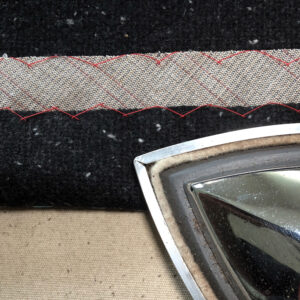
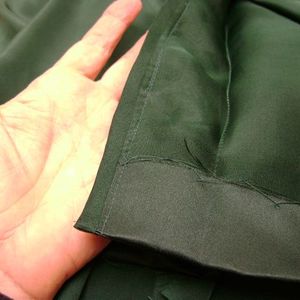
Pleats can fool you. Just when you think you know them you learn you didn’t at all. Here, for example you think you see pleats but you’re seeing wedge shaped fins stitched into tucks.
What could be easier than pleats? As it turns out, these little devils aren’t as straightforward as we thought.
I was surprised by the various definitions that surfaced during a pleat conversation this week. It caused me to spend a few moments revisiting what I know about pleats and then double-checking other respected sources. Because there are so many contradictory opinions, I’ve listed a few definitions to help settle the confusion. What I didn’t expect to find was how loose the definitions are. Many of these pleats and tucks are really the same thing. The definitions used here are from either Fairchild’s Dictionary of Textiles, Sixth Edition, or the Fairchild Dictionary of Fashion. The comments below each are my own.
Pleat—a crease
I have never thought of the edge running down the front of a standard pant leg as a pleat, but of all the various definitions, this is the most basic. From this simple definition all of the others grow. Depending on how a series of creases are arranged as pleats, they may be called knife pleats, box pleats, inverted pleats, sunburst pleats, and more. These various pleats are pressed and stitched in assorted ways, too. They can be stitched across one end, down an edge partially and released, stitched on the right side, and stitched from the wrong side. There is no limit to how they can be stitched.
Tuck—a narrow pleat in fabric of even width, usually stitched in place
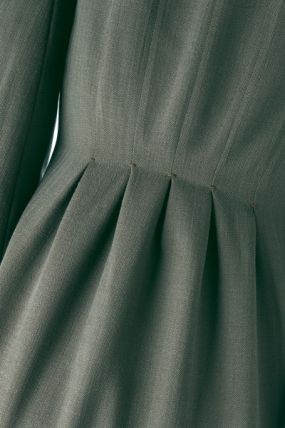
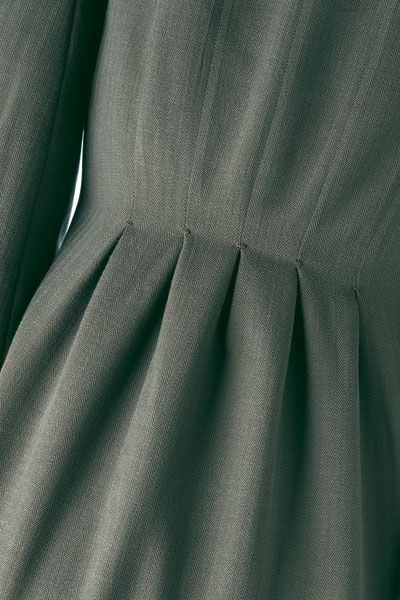
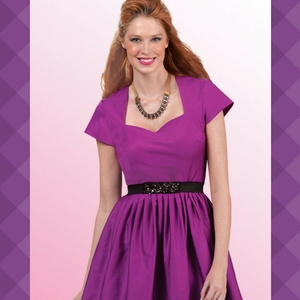
In this Richard Tyler-inspired suit (adapted from Neue Mode 21952) a center-sleeve tuck echoes the jacket’s softly tucked back peplum, whose folds are each finished with a hand-sewn detail.
Did you know that not all tucks are stitched? They can simply be a pleated section in a blouse or garment. The flap of a stitched tuck can also be on the right or wrong side of a garment. A tuck is also a fabric with woven pleats running from selvage to selvage and formed with a separate warp and filling. If I were writing the definitions, I would distinguish tucks from pleats by where the stitching line occurs—on a pleat it would be on the fold, and for the tuck it would be a distance from the fold, but this is not a textbook definition. That leaves us understanding that a tuck is a stitched-down pleat, but it isn’t always stitched. Is that clear?
Cartridge pleat—small, rounded pleats used for trim
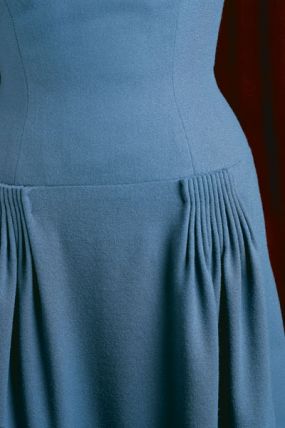
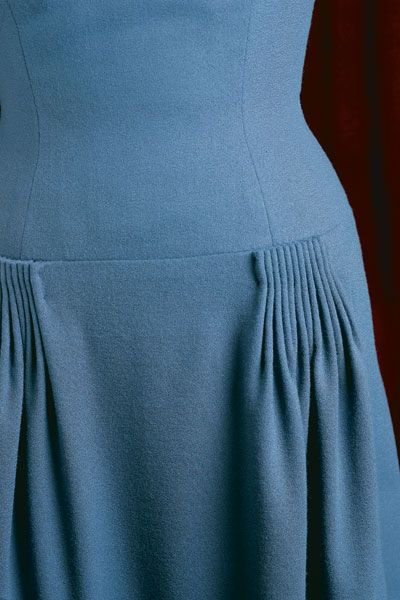
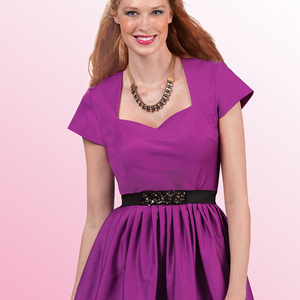
A cluster of 1/2-in. deep cartridge pleats adds fullness where needed on a wool-crepe dress. The unpressed pleats remain standing for a softly draped texture (designs by Conover Mayer; similar to Burda 2897).
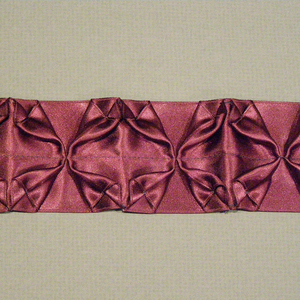
These guys show up on everything from graduation gowns to draperies. I was in Old Saybrook, Connecticut, last week at the Katharine Hepburn Cultural Arts Center and saw a delicious dress she wore on stage with delicate cartridge pleats molding the shape of a silk georgette dress. These would be stunning used with the technique Louise Cutting describes. However, in some instances, this pleating technique doesn’t follow any of the pleating definitions we’ve just explored. Sometimes it’s more of a smocking process, while in other situations it’s more like pleating but can involve padding, too.
I guess in the end, a rose by another name is still a rose and a pleat is a tuck is a pleat.









Great explanation, Judy. I'm glad you responded to all the conversation taking place here last week. I guess the most important thing is to make sure that if designing for someone else, you both know what exactly you're both describing.
I always had a feeling that there were several variations and definitions of pleats. Thanks for defining the terms.
Thanks Judy for the great info.
I am working on a wedding gown with sunburst accordion pleats as a chiffon overlay. The challenge has been to get the waist small enough and yet have a circumference of 6 yards for the train. I was surprised to learn that it can have no seams only one down the back.
Yikes! Does any body have any experience with this?
Here's another fun technique in line with the cartridge pleat above. I've found it on nearly all dresses of the 1825-1840 time period. It's the way in which a gown's skirt is gathered and joined to the bodice. The top of the skirt is folded over 2-4 inches. a row of 1/4" running stitches is made about 1/8" from the folded edge. Next, another row is run 1/4" below the first with the stitches following the same spacing. As the two threads are drawn up the cartridge pleats are formed, but here's the difference: The pleats are attached to the inside of the bodice! When the gown is worn, the skirt is hinged on these stitches and it is pushed out and over the hips adding great fullness to the skirt. Very cool.
Everytime that I access this site I find something else that I never have seen done. I'm 83 now and I don't know how I am going to try everything that I see. I am just going to have to start sewing again and let everything else go. Someone will clean it up when I am gone. My Mother always had a "hell room" and in her diary she said that same thing. Guess it was who cleaned it up? Someone owes me one.
Dear Judy,
Could you please help me to identify the sewing technique on the Sophia Kokosalaki Spring 2007 Ready To Wear runway Collection? The photos are 3 of 33, 4 of 33 and 17 of 33 .
The garments are pleated? tucked? tops of soft sheer material.
Is that possible to master that beautiful work?
Thank you very much,
varrono
I am trying to find out if you can purchase accordion pleat fabric or if I have to buy fabric and do it myself. If so, is there anywherer on the website that gives direction?
Thanks
I am trying to make angel wings for a liturgical dance.
How are the accordian style pleats that Hiroaki Ohya does to make a sphere?
EvangelistCastillo, i purchased my accordion chiffon fabric in LA at a fabric store in the fabric district of downtown LA. The name of the store is Mikeys. Hope this helps.
How do I sew pieces of accordion chiffon together?
Judith,I always find your teachings and comments so useful ,how I wish I knew so much in sewing.Thank you.
Ghis
amazing work mate
I like your effort
Its great efforts thanks for share it