

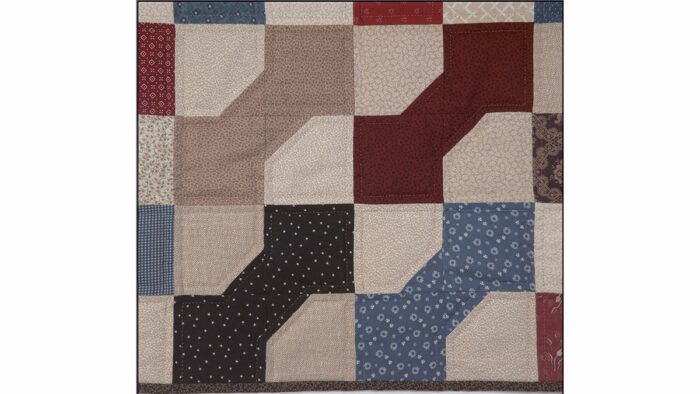
A perfectly-rendered hand-quilting stitch has been admired and envied since the beginning of quilt making. Quilters view beautifully hand-stitched quilts with reverence, and often whisper, “Look at those stitches!” Yet, many quilters avoid hand-quilting because they’re unhappy with their results. Skipped or uneven stitches, visible knots, and puckered fabrics are just a few of the potential pitfalls. Others include uneven, “pin-prick” stitches, which catch only a few threads on the back of the quilt and can easily pull out, and large stitches that can snag and break. Consistent hand-quilting stitches will enhance a quilt’s beauty and help it last a lifetime.
When executed correctly, hand-sewn quilt stitches are the same length on both the front and back of the quilt, and the spaces between them are all identical. Ideally, the smaller the stitch, the better; however, evenness and consistency of the stitches are more important than stitch size. And once this method becomes familiar, you will automatically sew smaller stitches.
If you’re dissatisfied with your hand-stitching, follow along for an in-depth look at a hand-quilting method I call the hybrid rocking-stitch. With lots of practice, it produces consistently excellent results.
Stitch toward yourself rather than right to left.
Fabric, batting, and thread
The right fabric contributes to a well-made stitch. Loosely woven fabrics don’t quilt or wear well, while densely woven fabrics (such as bed sheets) and polyester and cotton/polyester blends are difficult to stitch. For uniform stitches, easy quilting, and durability, choose medium-weave, mid-weight, 100% cotton fabrics.
Batting forms the center of the quilt “sandwich,” and there are many types, from cotton, polyester, silk, and wool to blends. Experiment to find the type that works best for you (see Choosing the right batting).
The best thread to use is one made for quilting; it’s slightly thicker, stronger and longer-wearing than regular sewing thread. Of course, if you’re making a purely decorative quilt, choose any thread you like.
Needles and thimbles
I use a “between” needle for hand-quilting. Its short, thin shaft is easier to direct in and out of the quilt layers than a larger needle. Betweens come in sizes 5 through 12 (larger numbers designate finer needles). Be aware that needle-sizing isn’t standard from company to company. I prefer the size 10 or 11 between quilting needles made by Jean S. Lyle.
A thimble is vital for my hybrid rocking-stitch, because the eye end of the needle is maneuvered with the tip or side of your middle finger. Many different thimbles are available, but only your finger knows which fits you.
A metal thimble provides the best protection. Look for one with deep indentations to hold the needle in place. An open-ended thimble, such as those available from Roxanne Products (see Quilting supplies by mail), accommodates long fingernails, and reduces perspiration, which is often a problem with traditional thimbles. The thimble I prefer, however, is a leather one. A leather thimble grabs the needle better, giving me more control. It’s also a good choice for beginners.
Marking tools and quilt hoops
The most important quality of a marking tool is its removability. To be sure that what you put on comes off, test your marking method every time you use it.
I favor soap slivers, whose marks are completely removable. Be aware, however, that soap-sliver marks aren’t the most precise, they’re difficult to see on light-colored fabrics, and they rub off easily. Use a brand that doesn’t contain cold cream, which makes the soap too crumbly. Store the soap in your freezer to keep it hard, and use an emery board to sharpen its edges.
A hoop or frame maintains proper tension and keeps the quilt layers from shifting and bunching. I prefer a handheld, 11-in. by 17-in. PVC frame for its portability and comfort. It accommodates any size quilt, even king size. I just reposition it as I work.
Quilt patterns
The quilt motif you select can help determine how smoothly the quilting process goes. Patterns that involve long, straight lines are easy and quick to quilt, but crooked or uneven stitches are more apparent. Except for overly long stitches, such flaws can be camouflaged if you are using designs with short, curved lines.
Balanced stitches are easier to achieve by stitching along the cross-grain or on the bias, because there’s more flexibility in the fabric. Start with a simple pattern, and soon you can tackle more intricate designs.
Basting
Basting is essential to keep the grain of the quilt top and backing aligned. If the grain of the two fabrics does not match, quilting will be more difficult, and the fabric is likely to pucker. I use a thin, curved upholstery needle and authentic white basting thread, which is quite thin, breaks easily, and is easy to remove. Using colored thread for basting can cause permanent damage if the dye transfers to the fabric. While some quilters baste with safety pins and quilt basting guns, both leave too much play between quilt layers. Also, safety pins can discolor the fabric, and basting guns may leave holes in the fabric. Baste generously and work in a grid, with stitches no less than 3 in. to 4 in. apart.
The hybrid rocking-stitch
My hybrid version of the traditional rocking stitch is unique and allows you to see what you’re doing all the time. You always stitch toward yourself, rather than sewing from right to left most of the time as in the normal rocking stitch. Securing the quilt quite loosely in the frame allows you to manipulate the fabric into tiny “pleats” as you pick up stitches on the needle. To produce this stitch, follow these steps:
|
|
|


1. Wearing a thimble on your middle finger, lightly place the tip of the needle on the quilt top in a vertical position (photo A). Balance the eye-end of the needle on the thimble. Your thumb should be resting on the quilt in front, but slightly off to one side of the needle, and your hand should look like a relaxed, backward C. Place the middle finger of your other hand underneath the quilt to feel for the needle’s point, and manipulate the fabric. This hand may also help hold your hoop. Gently pierce the quilt until you barely feel the tip of the needle on your middle finger. The moment you feel the needle, stop pushing (photo B).
|
|
|


2. Use the thimble to lay the needle parallel with the quilt surface. Do not push forward. The eye should face away from your body (photo C). At the same time, push the thumb of your thimble hand down and slightly forward on the fabric, away from you; and push the middle finger of the hand under the quilt up and slightly back, toward you, working together to pinch the fabric into a tiny pleat (photo D). This procedure sets the tip of the needle into the reverse side of the pleat. The bottom finger doesn’t actually push the needle, only the fabric. The length of the needle that travels beneath the quilt back determines stitch length on the back and the space between stitches on the front.
|
|
|


The hybrid rocking stitch involves, in essence, picking up a series of tiny pleats (consisting of all three layers of the quilt) on the sewing needle by guiding the needle through the quilt’s surface fabrics and batting, and rocking it back and forth repeatedly from a vertical to a horizontal position. The author positions the needle vertically on the quilt top (photo A), then pierces the fabrics and batting until she just feels the needle’s point touch the finger of her other hand beneath the quilt (B). She lays the needle parallel to the quilt top (C), and stitches toward herself, working the fingers together as explained in the text, while simultaneously pinching the fabric into a tiny pleat. Pushing the needle through the pleat just until she sees its tip (D), she returns the needle to its vertical position (E), before repeating the process to load several stitches on the needle (F).
Keep in mind that only your thimble finger guides the needle, and that the thumb of your thimble hand and middle finger of your bottom hand maneuver the fabric. The needle should always be either vertical (when entering the quilt top) or horizontal (when pushing through the fabric pleat). Proficiency comes with lots of practice. The secret is to understand your materials and perfect the correct hand movements, which, once conquered, will reward you with small, even, beautiful stitches.
| Threads Online: Author Mary Stori compares batting and demystifies the hidden knot at www.threadsmagazine.com. |
—Mary Stori is a nationally recognized quiltmaker, fashion designer, instructor, and author.
To contact her via e-mail: [email protected]. Or visit her Web site: www.quilt.com/marys.
Photos, except where noted; Mary Ray.
From Threads #93, pp. 49-51
More on quilting:
• Quilt it Freehand
• Symmetry for Quilters
• Video: How to Make a Quilters Knot
Quilting tools by mail
Coats and Clark
PO Box 12229
Greenville, SC 29612
800-648-1479
www.coatsandclark.com
Quilting thread
Fairfield Processing Corporation
Department W
PO Box 1157
Danbury, CT 06813
800-243-0989
www.fairfieldprocessing.com
Batting
Hobbs Bonded Fibers
PO Box 2521
Waco, TX 76702
254-741-0040
Batting
Jean S. Lyle
PO Box 289
Quincy, IL 62306
217-222-8910
Quilting betweens
Mary Stori
W. 811 Taylor Trail
Brodhead, Wl 53520
PVC quilt hoops
Roxanne Products Company
742 Granite Ave.
Lathrop, CA 95330
800-993-4445
www.thatperfectstitch.com
Open-ended thimble










This is a wonderful explanation of hand quilting. I have benn trying to find a good explanation for months and was so excited to find this one. Very well illustrated and explaned. I am thrilled.
Anita
That IS a good explanation. I've been quilting for about 2 years now and love it. I've done lots of crafts over the years and find quilting far more relaxing for me. I haven't really had anyone to teach me, just jumped in and did it. I was explaining recently to my mother-in-law how I quilt (which is actually the same way that you do). She thought it was very strange. She goes from right to left. I can do it that way, but find that it puts my hand in a weird position, this way is much more comfortable for me. Thanks for the information.
I may try your method, but am not sure if I really want to, as I seem to me set in my ways with a size 8 needle (no thimble), punch stitch, and 18-inch hoop. How long does it take you to complete a queen size quilt?
I've just started hand-quilting, and loved this article. The pictures certainly helped. Keep up the good work.
This is a fantastic explanation and photo demonstration of handquilting. My grandmother would be proud.(She taught me to quilt.) Thanks again!
How do you finish your stitch when you are ready to cut the thread after making the stitiches?
I just uploaded our new quilts on Bellwether Dry Goods.com. All are expertly hand quilted by our Amish and Mennonite ladies. If you have questions about hand quilting, just let give me a call (410) 867-0665.
I am also a self taught quilter. I quilt straight "north," meaning I use my thimble on my thumb and push the needle straight away from me (north). Jenny Beyers does it opposite, "north to south" straight towards her. But, to answer Persistant's question, you make a knot, and insert the needle in exactly where you made the knot, "travel" inbetween the layers (where the batting is) and come out about a needle's lenght, pull taut and cut the thread near the fabric. This way, the "tail" disappears and cannot be seen. Leaves a lovely quilt finish.
I am new to quilting. What is punch stitch? Thank you in advance. cjstitches
This is a great illustration. I have just started quilting. I have never been very good at sewing, but I think it is because I did not have any intrest in it at the time. I am so in to this and am very excited about finishing my first quilt. I have been getting frustrated, because I do not have anyone that can show me how to do this. I will start practicing this technique right away so that by the time I get ready to put my quilt top together I will be better at the technique. Thanks again and look for more techniques to come.
its easy and good explanation.i have juz started quilting.Thank u for this site.it's so challenge me forward beside our home http://be4rt.com.
I've been hand quilting with a hoop since I was about 40 or so...mainly to use up all the scrap pieces leftover from dresses made by for myself, my family and shirts for my hubby. I also inherited all my Mother's sewing scraps when she passed on many years ago. I'm now 65 and came down with Rheumatoid Arthritis nearly overnight when I was age 59. At one time, my hands were totally useless, and I couldn't even walk...let alone hold a glass. Thanks to the MIRACLE DRUG..HUMIRA, I have my life back, but do have to be careful about heavy outside work. I had SO many quilt tops to quilt..plus began making more. I'm still using my hoop, but am finding it very hard compared to years ago. :-(( It's a round hoop, and I now find it heavy to turn and manuever. I CANNOT afford to have my tops professionally quilted nor can I afford a quilting machine. EEEK...WHO CAN, but a millionaire? Also I make king size quilts as well as twin and queen. I've looked at the Grace Handquilting Frames as they are about all I could afford. But they will not hold a king size quilt or odd-sized. I've always used a sheet for my backing as they wear so well, but do use good heavy batting. I use a huge table to cut my backing and batting and lay out my quilt and use safety pins...A LOT as I have huge CANS of them. I've never had any problems with puckering, etc. My problem now is mainly with the WEIGHT of the quilt in the round frame as my wrists were severely damaged by the RA and don't have too much strength. My stitches aren't quite as nice as they once were, but then I also lost my right eye and half of my face in an accident when I was 31 and my remaining eye (even though I've always worn glasses as I'm near-sighted) is now "aging"...macular degeneration and such. BUT...I NEVER GIVE UP and do ALL my own housework, have a large garden, can and freeze all our food and mow a 20 acre lawn. Sadly, I cannot pull weeds anymore, so my hubby does that. lol I wondered if anyone out there also has RA with wrist and hand damage but STILL quilt and just what they are using. I LOVE hand sewing even though I do have two sewing machines. One can make baby-size quilts, but that's it. Plus I ADMIRE hand quilting. Any help or advice would be deeply appreciated. Remember, I am poor and cannot afford to have my tops quilted, nor can I afford and expensive machine. Thanks so much for any help. Have a wonderful day!
Hello. My name is Annie and I'm from Australia and stumbled on this website. I've been knitting, crocheting, embroidering and tatting since I've been 5 years old. I was taught by my mother and grandmother who are (Mum) and were (Nanny) fantastic seamstresses. My Mum retired a few years ago and took up patchworking and is so good at it that she has taken out a few show championships. Her work is just simply exquisite. Which led me to wonder if I could do patchworking but without the machine as I don't like sewing machines. I thought "well they used to do it hundreds of years ago and didn't have machines" so thought I'd give it a go. I found a lovely lady at a sewing shop who is mentoring me and I've found a wonderful new craft hobby. I started doing a backstitch for my design (which is just a simple dresden design) but then found out that a running stitch is better so have been doing that. I'm up to appliqueing my dresdens onto a backing by a blanket stitch. It's going very well. To be honest you wouldn't be able to tell that it wasn't machined sewed. Anyway just thought I'd share my thoughts. I loved reading everyone elses thoughts. Take care patchworkers.