

This blog post is excerpted from a section I wrote for the book: 1000 Clever Sewing Shortcuts & Tips, by Deepika Prakash from PatternReview.com.
Just so you know, 100% of the royalties generated from this book go to breast cancer research.
Working with lamé fabrics:
Lamé fabrics are regarded by some as too difficult for any but the most experienced. This isn’t true-with a little information, and a little practice on the scraps of the fabric you are working with, you will get polished results.
Lamé is the French word for “blade”, which refers to the appearance of the yarn under magnification-imagine a very tiny strip of tape. This is what the lamé yarn looks like.
So, I refer to these fabrics as lamé fabrics, instead of “metallic” fabrics, because of the varying appearance of the yarns. For the look of metal, the yarns can be made from actual metal, or man-made materials. Metal yarns have a richer luster than man-made, but they are difficult to work with, and may tarnish or darken over time.
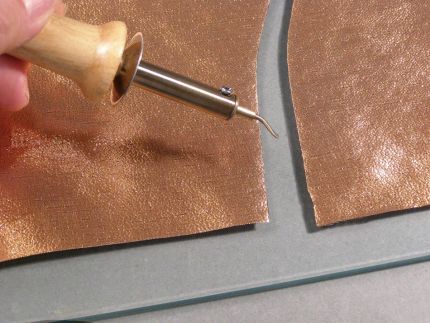
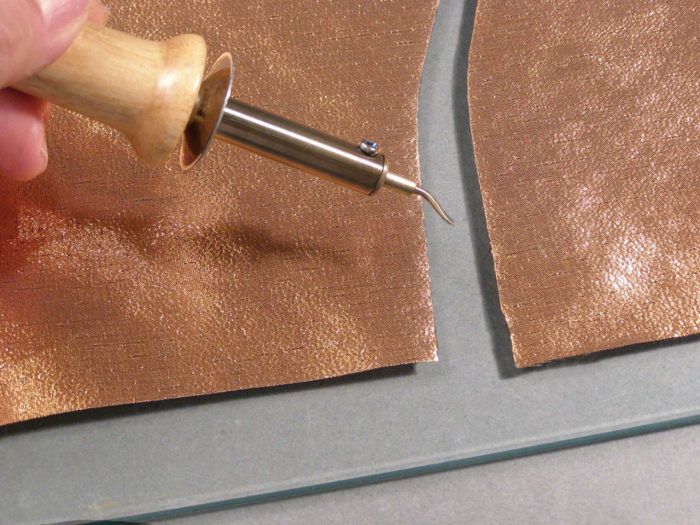
These examples are made from man-made fibers and present fewer challenges. Consequently, you can cut it with a hot knife against a sheet of glass and the seam allowances won’t fray.
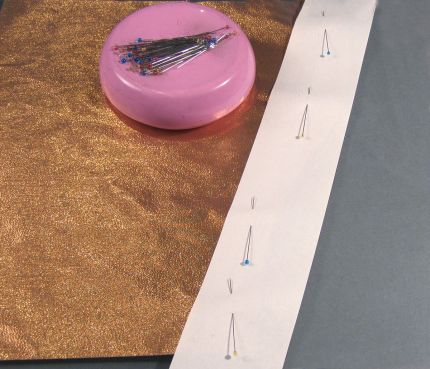
When sewing lamé fabrics, it’s helpful to sew with paper. I’ve found that a roll of cash register (or adding machine) tape is good for this purpose. It is thin enough to tear easily, but heavy enough to control the fabric.
Pin the cash register tape to the front side of the fabric.
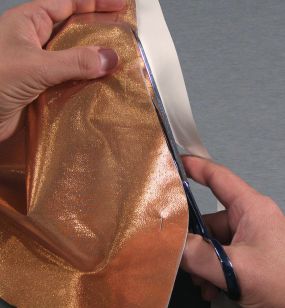
Turn the work over, and cut the paper to match the cut edge of the fabric.
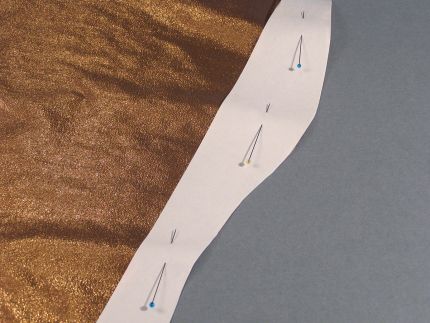
Turn the work back over, so the paper is on top before sewing. Re-pin so the pins are on the top.
Start your 14-day FREE trial to access this story.
Start your FREE trial today and get instant access to this article plus access to all Threads Insider content.
Start Your Free TrialAlready an Insider? Log in











This technique would have been so helpful when I made veils for my belly dance costumes! I'm saving this! Who makes the hot knife shown?
Great, clear article. I could really use this tutorial. Thanks for making rolled hems less scary.
Another helpful, well written tip. Thanks for sharing!
Where was this advise when I was rolling a hem on a linen ruffle. Great tip.
What a great idea! Glad you thought of it. I will be trying this method very soon. The tutorial made it look so easy. Where can we purchase that hot knife? Thank you.
The hot knife shown is from a place called Air Nouveau Marketing, in New Jersey. Their number is 732)223-7878. I bought this one through the web site: http://www.pjstencils.com
The tool mentioned appears to me to be an electric stencil cutter. There are various models. Some have that curved tip, some do not. They are available at the usual on line markets.
I haven't worked with lame but thought this article was very interesting. Thanks for sharing!
Great article... I can think of some other things this might work well with. maybe hard to control slinky's and such?There are some wonderful tear away and wash away stabilizers available today, I think i'd go for those instead of the register tape - but that's certainly resourceful!
Interesting! The foot shown during the edge stitching looks like a special kind. Is it the general foot or a special one? and where can I get that?
In regards to the stencil cutter--any kind will do, but I have worked with several models and prefer the one by Air nouveau. Just my preference. But it is indeed electric.
As for the foot, this is just the transparent sewing foot on my Bernina--nothing special. I find I use that as my standard foot on the machine now, because one can see through it.
And yes, it can control other fabrics--I use this sometimes on chiffons and other slippery fabrics.
Thank you so much for a great article! I had never considered sewing on these fabrics. Now I am no longer afraid.
I just finished a beautiful top with a shirt tail hem in a silky fabric. The whole garment was beautiful but my hem was a disappointment. Think I will go rework it using this technique. Oh, the places I will go!
Kenneth, you make everything so clear and are a constant source of inspiration! I have trouble keeping the edge of the tape even with the fabric as I sew, especially when I can't see the fabric with the tape side up. Pins don't help. Any suggestions? Thanks!
To Divaweava:
You want to trim the paper to match the curve of the fabric, instead of trying to keep the edge of the fabric even with the edge of the tape. This way, you know that both edges are lined up exactly and correctly, and you can sew an even distance from the edge all the way.
Also, Divaweava, lots of pins.
Thanks for this!! Very helpful! After making yards and yards of prarie points for my son' Native American dance regalia, I swore NEVER to sew with lame again. I will once again use lame! Thank you
Awesome. Being a court reporter, I have cases of steno paper left over from the days we used paper in our machines, now that we are computerized. So luckily I kept the paper, and that is what I use as backing on buttonholes or making a thread scallop on the edge of a garment. What a great idea to use it like you just did. Thanks. Jenny
The problem that I found with lame, when sewing a Halloween costume, was that after only a few hours of wearing, the lame started to fall apart at the seams which had a little pressure on them from just minimal pulling. The costume would not have been able to be worn again, and I made it for a friend! I felt bad that I'd made it for her, and it was now in shreads. Any advice??
kershawgirl, there are a few things you could to to help alleviate this next time, depending on what would make sense for your project:
1) If it needs to be close-fitting, consider an underlining that can be cut slightly smaller and seamed with the lame; this puts the stress on the underlining fabric instead of the lame, and also supports the lame.
2) If the fabric is heat-safe, apply a flexible fusible interfacing such as French Fuse to the underside.
3) If an underlining or interfacing isn't appropriate, reinforce just at the seams with a fusible seam tape.
4) Use a longer stitch length.
5) Use a ball-point needle, such as what is used for knits.
I'm sure others will have more ideas, but those are my initial thoughts...
Thanks for the super-clear instructions. You mention that the hot knife will result in non-fraying seam allowances. Do you also get that benefit on fabrics other than lame, such as chiffon or organza?
Your techniques make my sewing more fun!
This Headline did not match the article. The one and only error I have ever seen Threads make!
Excellent, Can't wait to get home and try this. You have the most worthwhile tutorials.
As usual, brilliant.
As usual, brilliant.
To torilynn,
Really the method for hemming the curve works on any fabric, not just lame. This excerpt happened to be from a longer piece on working with lame' fabrics, so the bonus information here was using the stencil cutter to cut the lame' so it doesn't fray. So the headline is really the point of the post, but sorry for any confusion I may have caused by not mentioning the lame' fabric in the headline!
To NinaLBoston: Yes, you can use the stencil cutter on any man-made fiber that is thermoplastic (nylon, acetate, polyester) but not on the cellulose-based fibers (rayon). It doesn't work on natural fibers, however.
I have used waxpaper on silk with great success. I also like the idea of tear-away interfacing. What do you use to avoid pin holes when they might be noticeable?
Genius! And just in time for summer sheers and bridal garments. I plan to use this right away. Thanks for making your tutorials so clear! I have your "Cool Tricks" dvd, and I keep print-outs of every "KK" tip I come across.
To answer about avoiding pinholes:
Try paper clips. binder clips, or any other clamping-type device, similar to what you'd use for sewing leather. Also, if you buy the really good silk pins that Susan Khalje sells, you'll also avoid this problem.
Thank you so very much for providing another excellent tutorial that so many of us will benefit from as we sew. I am saving this one too! You never cease to amaze me!!!
I tried your technique on a ruffle for a summer blouse. The ruffle pattern piece was rather circular so it covers both bias edges and on grain edges. While your technique is superb along the bias cut edges, the grain edges were significantly more difficult. I have also tried using a rolled hem presser foot, but in either case getting the fine edge to turn at the grain edge is still impossible. Any advice?
To Linda74sews: I find that when I encounter a straight grain portion of a curve, stretching the fabric slightly while pressing, before doing this technique, will help make the hem roll well. The object of the game in navigating this section, is to make the folded edge of the hem allowance a little longer, which helps it to roll.
Thanks so much for the response. There are so many items I would like to make this season that have either ruffles or edges that require a narrow rolled hem. I am determined to master the technique before I tackle any of them and will definitely try your suggested remedy.
I have a related question on curved hems. I just purchased a linen blouse with curves at bottom. Almost immediately after putting on the freshly ironed shirt, the hems - both front and back - curl up. What can I do to stop this?
Any advice is appreciated.
Thanks. Kate in B-ton.
In answer to the question of hems on a finished garment (I assume this is ready to wear) curling: Aside from taking the hems out and re-doing them, there's nothing else you can do. Ready to wear clothing is constructed to different standards, and they press the heck out of a hem once they've sewn it, so it will lie flat on the hanger in the store. But once you wash it and press it, the incorrect stitching will make it curl.
I wish there were another solution.
Please can somebody help me to find a hot knife as mentioned in the article above? I would love to buy one.
The knife is by a company called "Air Nouveau", and if you google it there are some suppliers on the internet who have it.
If the pattern for a full skirted dress says "shorten here" and the line is a semi-circle, how do I shorten the length?
would I first cut off all the extra length under the "Shorten Here" line?
There is no shorten here line pat way up the skirt. The skirt of the dress pattern is 35"., I want it to be 25"