

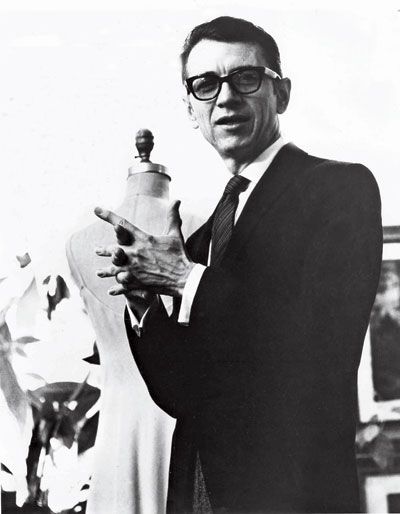
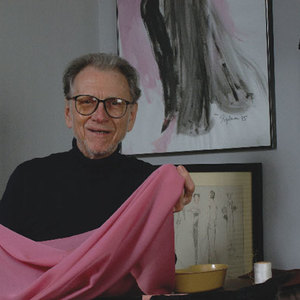
Charles Kleibacker in his New York studio circa 1965.
I am saddened today to learn of designer Charles Kleibacker’s death. According to the Columbus Dispatch, Charles died yesterday, Sunday, January 3, 2010. Just slightly over a year ago he and I shared dinner in Chicago with Sandra Ericson, founder of the Center for Pattern Design, after judging the Association of Sewing and Design Professionals’ annual Threads challenge. Charles was honored by this same organization some years earlier for his lifetime contribution to the sewing and design communities. How can I adequately express the charm, style, and graciousness this man exuded? He was a delight to be around and generous with his knowledge. I envy every one of his students. Perhaps you’ve met him on the pages of Threads where he first appeared in issue #6 and has been with us ever since—always a willing contributor with proper solutions and helpful suggestions. He will long live in our hearts. Here is some of Charles’ life from the pages of Threads:
Kleibacker, who was literally brought up in women’s ready-to-wear at his family’s department store in Cullman, AL, began his career as a reporter for the Birmingham News. Next he wrote copy for Bernice Fitz-Gibbon at Gimbels, NY, where he extolled automobile tires and garden accessories. When a fashion copywriting job opened, Fitz-Gibbon chose him. “He was horrified. We talked him into it,” Fitz-Gibbon recalled. (As a designer, Kleibacker is “right up there next to Norman Norell, maybe alongside Norell,” wrote Fitz-Gibbon in her book. Macy’s Gimbes and Me.)
After many visits to the house of Dior in Paris (where singer Hildegarde, his promotion-writing charge, was a client), Kleibacker realized that women’s fashion had always been his first love. Returning to New York, he and two partners opened a women’s custom and limited-edition ready-to-wear business. He eventually sold designs through Hattie Carnegie, Bergdorf Goodman, Bonwit Teller, and Neiman-Marcus to celebrities such as the late Gertrude Lawrence and Lady Iris Mountbatten.
In 1953 he closed up and went to Paris to work as a designer for Antonio Castillo in the house of Lanvin. He admired Paris designer Alix Gres, who did “beautiful, lyrical, lilting, soft body clothes.” But of his own designs he said, “I feel what keeps me in business is what I have to offer as an entity. . .not something taken from here, there, and everywhere and not a garment watered down for production purposes.” Kleibacker also worked in Italy. He did two small collections on his own in Rome before returning to this country in 1957.
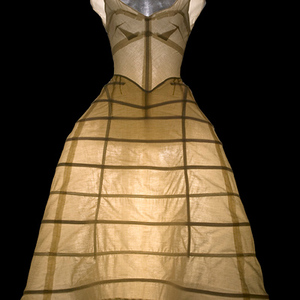
After three years of designing for Seventh Avenue’s Nettie Rosenstein, he opened his own business in 1960. His designs were usually on-the-bias, soft body shapes, in silk. The clothes were painstakingly made, individually cut, and supervised by Kleibacker in his studio in the Hotel Park Royal on New York’s West 73rd St. and sold for $950 to $2,500. Kleibacker believed in simplicity, fit, and comfort, His designs may have been dramatic, but they were never flamboyant in silhouette or color.
In 1983, Kleibacker began a collaboration with Ohio State University, which grew to include a position as Designer-in-Residence, as well as Director and Curator of the world-class Historic Costume and Textiles Collection at the College of Human Ecology.
This impressive designer and “Master of the Bias” will most certainly be missed. Share your stories of how this great designer has inspired you, as we celebrate the life and work of Charles Kleibacker.
For more information on the designer, read the following articles from the pages of Threads:
“Close Up with Charles Kleibacker: An interview with the “Master of the Bias” on fabric, design, and being original.”
“Hands on with Kleibacker: Lessons for Working with a Bias”










Judy,
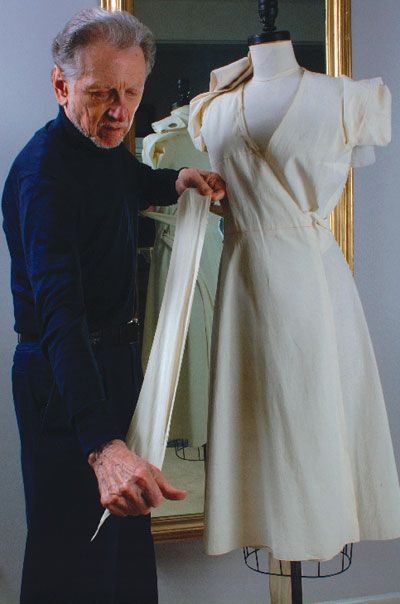
Thank you for letting us know. Yes, he was a delight; so appreciative of everyone's work and so generous about sharing his knowledge. I met him for the first time when I was in his studio in NYC in the mid-1970's, learning how he worked on the bias -- he cut and sewed a black silk crepe dress with a center front seam and a very deep V-neck. His particular magic that day was how he prevented the neck from opening even when the model was seated. I was so amazed and have followed his career for all of mine. He was a treasure who enriched us all.
Sandy Ericson
I have always admired his use of bias and the fluidity pf his designs. I was fortunate to be at Iowa State University in Ames, Iowa as a graduate student in the 60's when Charles was there as a visiting professor. We worked in muslin to drape a costume and his sharing of information to let the student discover what the bias of the fabric could do was endless. The things I learned have been invaluable to me all these years. Bias sleeves and what I still call the "Kleibackler hem" as two things I learned and use to this day. His gentle approach to design is what I admired most. He will be missed. Leonore V. Mangold
I was honored to have one of my clients bring him to my dressmaking shop here in Columbus 4 years ago and I since talked with him at The Columbus Museum of Art where he had been curating.
I meant to look him up again not long ago and now am sorry I hadn't.
The sewing world is a lesser place without him and his positive attitude. 'Good things' he would say to me on the phone at the end of our conversation.
As a matter of fact, I had been thinking about Charles the two days I spent building my 'Scintillating' gown. I was hoping he might see it.
Although I never had the pleasure to meet him, I was sorry to read of Mr. Kleibacker’s passing. After reading a Threads article about "The Master of the Bias" was fortunate enough to see an exhibit of his work at the Kent State University fashion museum. I stood and marveled as the museum docent pointed out the craftsmanship of his stitches and garment construction. He was truely an artist and genius at bias construction. He will be sadly missed.
I met Mr. Kleibacker while studying Fashion Design at Drexel University in Philadelphia where he was a visiting professor in the early 1980's. As an older student sewing nearly 20 years, I was well familiar with sewing techniques but not couture work. What an opportunity to learn from such a talented man. I enrolled seeking tailoring techniques and graduated with a wealth of knowledge that I continue to use today as a couturier.
Barbara
Charles was a visiting professor at Virginia Commonwealth University in Richmond in the mid-70s. I was one of his students in the tailoring and draping classes in the Department of Fashion Design. We got along because we were both quirky. Other students adddressed him reverently as Mr. Kleibacher. I called him "Chuck," and teased him for wearing a monkey fur coat - a hairy, long, black glossy thing of wonder. He'd fly back to New York on the weekends and I'd sometimes drive him to the Richmond airport in my Mustang convertible. So unchic! I'd have the top down and drive like a maniac. Chuck loved it.
There was one fitting session where we argued whether I had put my design on backwards or not. I have a small bust. The debate went on for a few minutes until I proved my shoulder blades protruded slightly more than my breasts. He was mortified, but we laughed about it for years after.
A few days later, my younger sister was standing in front of him for a fit review - we had very similar bodies. While other students presented him with staid, safe designs, I had gone overboard with my senior project. The "rules" said the project garment had to be designed for "someone" other than the designer. Chuck and I cooked up a way to "bend" those rules. That's why my sister was the official fit model. Not content with one draped dress and one coat, I had to have two 2-piece dresses with interchangeable parts, and a cape with a capelet that removed and could be tossed over a coat. The big cape, of course, was reversible. He spent hours with me, perfecting the design and inspecting my handiwork. Then my sister and I modeled the results in the department's big fashion show.
In the middle of the fitting, Chuck accidentally stuck a pin deep into my sister's armpit. He looked up at her, held his breath and s-l-o-w-l-y pulled it out. "Owwwwwwww," she said loudly, glaring at him. Like a good fit model, she had not moved. Chuck and I fell on the floor laughing. "I thought I killed her," he said.
After graduation, I went to a school in NYC on a Fellowship and he was thrilled. I visited his salon at the Hotel on Central Park West and met his assistant, who doubled as his fit model.
Though he moved permanently to Ohio ages ago, we exchanged Christmas cards every year. My holiday newsletters was always lengthy - and his summation in his cheery reply was succinct, less than 50 words.
This year, I did not get a response from Chuck. Now I know why. He will be missed, but the memories of our fun times remain.
Charles was a visiting professor at Virginia Commonwealth University in Richmond in the mid-70s. I was one of his students in the tailoring and draping classes in the Department of Fashion Design. We got along because we were both quirky. Other students adddressed him reverently as Mr. Kleibacher. I called him "Chuck," and teased him for wearing a monkey fur coat - a hairy, long, black glossy thing of wonder. He'd fly back to New York on the weekends and I'd sometimes drive him to the Richmond airport in my Mustang convertible. So unchic! I'd have the top down and drive like a maniac. Chuck loved it.
There was one fitting session where we argued whether I had put my design on backwards or not. I have a small bust. The debate went on for a few minutes until I proved my shoulder blades protruded slightly more than my breasts. He was mortified, but we laughed about it for years after.
A few days later, my younger sister was standing in front of him for a fit review - we had very similar bodies. While other students presented him with staid, safe designs, I had gone overboard with my senior project. The "rules" said the project garment had to be designed for "someone" other than the designer. Chuck and I cooked up a way to "bend" those rules. That's why my sister was the official fit model. Not content with one draped dress and one coat, I had to have two 2-piece dresses with interchangeable parts, and a cape with a capelet that removed and could be tossed over a coat. The big cape, of course, was reversible. He spent hours with me, perfecting the design and inspecting my handiwork. Then my sister and I modeled the results in the department's big fashion show.
In the middle of the fitting, Chuck accidentally stuck a pin deep into my sister's armpit. He looked up at her, held his breath and s-l-o-w-l-y pulled it out. "Owwwwwwww," she said loudly, glaring at him. Like a good fit model, she had not moved. Chuck and I fell on the floor laughing. "I thought I killed her," he said.
After graduation, I went to a school in NYC on a Fellowship and he was thrilled. I visited his salon at the Hotel on Central Park West and met his assistant, who doubled as his fit model.
Though he moved permanently to Ohio ages ago, we exchanged Christmas cards every year. My holiday newsletters was always lengthy - and his summation in his cheery reply was succinct, less than 50 words.
This year, I did not get a response from Chuck. Now I know why. He will be missed, but the memories of our fun times remain.
While I was earning my BFA in Fashion Design from Virginia Commonwealth University in the early 1970's, we were fortunate to have Mr. Kleibacker as a visiting professor. A group of us also visited his atelier in NYC on a field trip. What a magical place that was! From reading the other posts, it sounds as if he was very generous with his time at various fashion design schools.
At the time I did not realize the value of my exposure to his techniques, but over the years I have often heard his advice to "stretch the guts out of the bias"(not necessarily a direct quote) as I have worked on things for my own design and dressmaking clients here in Los Angeles. I endeavor to bring the kind of quality to my work that he brought to his. The world will miss his generosity and talent.
What I remember and cherish most are Charles' incredible grace, charm, ingenuity, and generosity. I first saw his presentation on the bias featuring his amazing gowns at a seminar for 4-H members at The Ohio State University in the late 1980’s. I was a 4-H advisor at the time, and was attending with some of my club members. I was enthralled! His gentle voice, his generosity with his knowledge, his showmanship, and his beautifully constructed garments combined to mesmerize me and made a lasting impression.
In the years following, I had opportunities to attend several of his seminars; his extensive handouts are a valued part of my resource collection. He generously allowed a group of us from the Greater Cincinnati Professional Sewing Association to tour the Costume and Textile collection at Ohio State when he was the curator. He was a generous guide, telling wonderful stories and pointing out intricate details on garments. He allowed us to not just see the garments, but to turn them inside out! The inspiration and knowledge we gained that day was immeasurable.
Charles always had words of encouragement and support and never from a position of superiority—always as a friend and colleague. He didn’t just talk to us about his experiences, techniques, and designs, he shared them. He was a true gentleman, artist, and technician, and he will be missed.
Karen Howland
I had a chance to speak with Charles when he called to thank us for a retrospective we ran on him. What an extraordinary designer, and a gentleman to the core. Amber
Twenty five or so years ago I took a class on mastering bias at Wayne State University. I didn't know anything about Mr. Kleibacker - I had read about him in a magazine and found that he was to teach this two week summer class in
Detroit that I just had to take. He showed us how to create muslins and then stitched us into them to fit them perfectly. When it came time to remove mine he discovered that he had stitched it to my body. He was amazed I hadn't complained at all. He was so generous with his time & expertise - what an honor to have studied with him.
Ten years ago I met Charles while taking a week-long sewing machine embroidery class in Milledgeville, Ga at the University there. Allowed to meander through his class on bias construction during our break, feeling cheated, I wished the scheduling conflict hadn't occurred allowing me to stay longer.
Dressed in natty black and white (tweed jacket, silk tie and pocket square) which I was told was his trademark, he impressed me with his appreciation of his young students slender figures just perfect for his garments which on me, although comfortable for sure would have revealed every lump and distortion of a Pillsbury dough boy figure--oh, well, I will never forget his name, his creations or his elan and am sorry that he like other talents will take his artistry with him to heaven. I can see the angels in his diaphanous bias garments already!
Ten years ago I met Charles while taking a week-long sewing machine embroidery class in Milledgeville, Ga at the University there. Allowed to meander through his class on bias construction during our break, feeling cheated, I wished the scheduling conflict hadn't occurred allowing me to stay longer.
Dressed in natty black and white (tweed jacket, silk tie and pocket square) which I was told was his trademark, he impressed me with his appreciation of his young students slender figures just perfect for his garments which on me, although comfortable for sure would have revealed every lump and distortion of a Pillsbury dough boy figure--oh, well, I will never forget his name, his creations or his elan and am sorry that he like other talents will take his artistry with him to heaven. I can see the angels in his diaphanous bias garments already!
Though I am from the same small Alabama town (Cullman) I never had the pleasure of meeting Mr. Kleibacker. My mother and her sisters knew him and the town was very proud of the local boy who made it in the fashion world.
In another parallel reality, Sir Charles is continuing to master a new aspect of beauty! His whole being exuded precision and devotion to mastery. I worked with Charles four sequential summers at GA College, Milledgeville, GA. He was patient and exacting. He asked me to model some of his own designs - it was no less than wearing a second skin -- draped and sewn to PERFECTION; therefore, he allowed no underclothing beneath his magnificent garments!!! True Mastery of the Bias. My son, Harrison Morgan who is also a designer, drove me to see Charles when he was curator of the Design Museum at Kent State - Charles was so impressed with my sons beaded gowns, that he asked us to donate a couple to the museum -- we were greatly honored. In that magical way that people meet and "connect" - Charles' gentle, yet firm encouragement and high standards for fashion will always be a part of me. Yes, indeed he was, is and always will be a Treasure! Love to Charles
Camille Morgan
I remember going to Frederick & Nelson's in Seattle for a special fashion show of Vogue patterns, with models and everything. It was very exciting--this was probably in the late 60's-early 70's. And Mr. Kleibacker was the MC. Each garment was discussed and his techniques were explained--I remember he talked about gathered skirts and pressing each little fold. Some of the garments were made from polyester jersey (Qiana, maybe?) He made a lasting impression on me when I was really just learning to sew. The garments were so beautifully made and his excitement was contagious. Somewhere, I still have the program from that show. It has been so much fun to read about him in the years since. He truly was a treasure.
Chris Wohlstetter
I knew Charles when he was Designer-in Residence at Ohio State University. I learned to love bias from him. His technique for making a pants or skirt waistband on the bias was wonderful and the fit was terrific. At the time I was the Home Economics Librarian and was taking advanced construction classes on the side. He was so willing to share his knowledge with all of us and was so kind and helpful to all. I am still a librarian and am in the process of reviewing a new book "American Beauty" in which he and his work on bias are described. I still sew and am never afraid to use the bias. Yes, a sad day for all of us.
As T & C Specialist at U of Wyoming in the early 80's, I attended a Charles Kleibacker draping workshop at Colorado State and was so impressed that I brought him to UW the following summer (1985) for a draping workshop. His expertise was so inspiring for everyone in that class. He brought a trunk full of his designs and we were all free to try them on. I particularly remember a long grey silk knit (2 layers of knit) that looked gorgeous on the tall body of one student. A black silk gown with tiny spaghetti straps and a very, very low back fascinated me. Being older than most of the students, I asked Charles (after class) if I could wear something like that. He said, "Sure, try it on". And with a few pinned in tucks here and there, it was flattering and lovely.
We draped in muslin - I still have mine, signed, of course, by Charles. We learned to incorporate so many "little things" that even the muslins looked great on our bodies. His generosity in sharing so many techniques was, indeed, a treasure for all of us. His charm and warmth in a workshop situation made everyone relaxed and wanting to learn more and more.
At the end of our week, we took Charles out for dinner and he wore his black and white tweed jacket. The young waitress at the restaurant accidentally spilled a glass of red wine on him - we all nearly died of embarrassment - but Charles was so gracious that dinner continued on with him sporting a now red stained black and white tweed jacket.
I still continue to use his techniques and always think of him when doing so. Bias designs have become a favorite for me and I use it often, remembering the fluidity of Charles' designs. He will, indeed be missed - such a gentleman - living on in our memories.
Carol Zahn
A wonderful designer, but also a wonderful human. We will miss him.
I didn't have the opportunity to know Mr. Kleibacker as well as others who have posted here, but I have vivid memories of his Master Class at my first PACC conference. His gentle humor, skill, vision, and "of course you can" attitude come to the forefront of my mind every time I work on the bias. He is part of my "designer trinity" that inspires and encourages me. I wish him peace...and lots of fabric.
Marilyn Johnson
It's a sad time though this energetic and most kind man still makes so many of us smile remembering time with him.
I first met Charles about 15 years ago at Ohio--Marlene Ingraham who heads the Original Sewing and Quilt Expos introduced us. She knew how delighted I'd be and our friendship continued since we had several fashion industry friends in common, most notably Steven Stipelman from FIT who illustrated my pattern envelopes for me. Steven and I would ask each other, "Have you heard from Charles? How's he doing?" Last time was during NY fashion week a couple years ago. I had just seen Steven and then as all karma happens, I ran into Charles backstage at Ralph Rucci's show just a few hours later. We had our picture taken together and then I later included it in a newsletter and sent copies to Charles. He sent me the nicest letter back about how much he enjoyed my newsletters and work. Really a thoughtful letter.
You didn't mention one of the things I remember about him the most in his biography--his work with Qiana in the seventies! At the Rucci show, when we had a brief time to chat, I was with a woman who had sung the Qiana jingle that they had used all those years before and when I put them together for her to sing it to him, he just howled with laughter--and Charles was so soft spoken, it was fun to get him chuckling like that.
He traveled the country on behalf of that business and had several articles he authored in Vogue magazine back in the day when the issues came out twice a month, were about double in dimension and always included a home sewing with Vogue patterns article in the back of every issue. Early on, shortly after I had first met him, we were at an expo together and I asked him to autograph one of those issues. We had such a wonderful laugh and giggle about it--he couldn't believe I had those old magazines let alone bring one to Ohio for him to sign. His delight was so apparent that he passed it along to me as I'm always delighted now when a woman wants me to sign something I've written.
My happiest for him was when he was able to sell his extensive couture collection through Doyle. He gave away so much time and energy to non-profit educational institutions and his love of brilliant fashion design was able to sustain him later. He had many, many friends in fashion that were very much like him--hard working, thoughtful, bright and not as famous as they deserved since they didn't seek the spotlight but rather shared it or directed it to others.
He was generous beyond belief with his thoughtfulness. He was an example to me time and again that success has nothing to do with being famous. It's the people you touch and help that's become so inspirational to me through the course of my business. In that way I hope to always honor him. He will be missed in our community.
I am so saddened to hear of Charles' passing. I had the pleasure of escorting him around the Association of Sewing and Design Professionals October 2008 conference. Charles and I dined and visited during the two days of his visit. He was with us to judge our design contest. I reminded him of our first meeting, years ago, when he gave a master class, to those of us lucky enough to attend, on draping the bias. I proceeded to return to my studio to create a bias dress for my daughter's wedding with his directions securely at hand. The dress was spectacular and this I give credit to Charles for. I treasure the notes from that class and will always remember Charles as a master and a true gentleman. The thank you 'Kleibacker' scarf he sent to me will be even more treasured now. I am surprised at the saddness that fills my heart. We have lost a wonderful person but will be blessed by his teachings. Mary Beth
The world has lost a wonderfully talented,caring,gentle, and thoughtful man. I met Charles in the early 1970's while a student at Mt Mary College. It was a privilege and honor to have him review my work and to be his student. Years later I saw him at ASDP conferences and at Mt Mary College events, and he was always so warm and kind to visit with me. His talents in design are inspiring. He will be sorely missed.Sincerely,
Christine Kazmerzak
What a wonderful life he led and how he enriched those of others through his love of fabric and clothing. I will always remember his gracious nature and how he took a moment to talk to me and encourage me. I know his spirit will live on with those he has worked with.
Tammy O'Connell
I took a week-long master class from Charles at the University of Texas in the early 1980's. I found my niche for design from his class (draping, bias), and like WendyW, I was the quirky one, and we had fun.
At the time, I had a dressmaking shop with employees, and he and I shared stories about production problems.
One of his most colorful was how they cleaned garments in the shop: filled a sink with dry-cleaning fluid, immersed the garment, and then ran with it outside onto the street and flapped it dry. Talk about lack of regulations and safety!
He also told me about the ladies that came in for their final fitting, and would say, oh-so-charmingly, "Oh Charles, I think it should be a teensy bit longer, don't you? Maybe a quarter of an inch?" He would charmingly agree, and she would leave.
Then he would hang the dress up on the rack, and wait for her return appointment. (didn't do a thing to the hem). When she came, she would rave, and say, "Oh, that quarter inch just makes it divine, don't you agree?"
He was also very supportive, and wrote me a letter of commendation to frame on my shop wall. I would say he had a fabulous sense of humor, a wicked one at times, and was an utter gentleman.
His gifts of his talent and methods and skills were given over and over. Just look at these posts: classes and teaching in many, many venues over the years, always associated with places of learning. Not many successful designers do that. And what gifts--the attention to detail, always for a reason of the beauty of the product--I can't add to the already wonderful expressions of appreciation above.
He is a National Treasure, and it is our loss that he is gone.
Thank you, Charles, for so much.
Anna
In the '70s when I was Corporate Home Economist for Meier & Frank Department store, Charles came to Portland twice to commentate an all silk fashion show sponsored by American Silk Mills. It was held in our downtown store auditorium and it always drew over 500 people. As a sewing notions buyer as well as events planner for the store, I traveled to New York City and when he still had a studio there, he let me wear one of his designs to a special event. What a memory. We had great times and he respected all sewers, not just designers.
I first met Charles at the PACC (now Association of Sewing and Design Professionals) conference in Chicago where I was blessed to be able to present him with our very first Lifetime Achievement Award. There is no one who deserved it more. He was so charming, funny and certainly approachable. The draping class was simply amazing and like another comment made previously, I learned to stretch the "heck" out of that bias! Charles was the type person who made you feel special. Although we met only a couple of times, we had amazing conversations and he was so encouraging. Elizabeth Rhodes told me that Charles said he knew he had "made it" when he had someone to hold is pins for a fitting. I'm sure the angels are holding pins and delighted to have someone who knows how to fit. He sure made a lot of women look like angels. Linda Stewart
I was lucky to have studied with Charles in two different week long seminars at Fort Collins CO in the 1980s He was the most giving and demanding instructor. One weeklong class we all made a bias skirt and I choose rag silk fabric that frayed terribly with his OK. Charles just said underline and hand overcast. And when overcasting didn't work going one direction he just said now do it again going the opposite direction. He was doubtful of my doing welt pockets which the skirt called for but I did using my way (Threads #92 Softly Tailored One Seam Pants) and they worked just fine. I still wear the skirt with his autograph on the muslin underling. His comment was "Now that is a skirt and it deserves a jacket". I learned SO MUCH from him about BIAS and teaching sewing and fashion and shared my knowledge with my students. He will be missed.
Shirley L. Smith
As a member of the Fashion Group Internatinal and an adjunct faculty member of the University of Cincinnati, School of Fashion Design, I met Charles in the late 1990's when he visited the University to inspire the students with his intriguing presentations and fashion analyses. Such a gifted and talented person, he inspired all of us. I especially remember his connection with Qiana since I and many of us at the time welcomed Quiana's advent for its sewability and easy care characteristics. Charles, however, saw much more. He saw the opportunity for garment innovation and engineering, which, of course, was his forte and marked his entire career.