

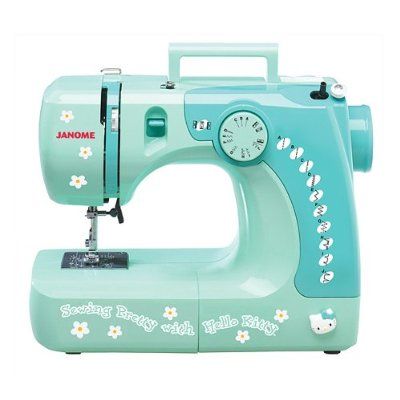
Online reviewers said a reason to enjoy the Janome Hello Kitty sewing machine is its portability. What do you think of smaller, themed sewing machines for teaching children to sew?
I have very fond memories of my first sewing projects, but not of lugging the heavy, metal Singer I sewed with at home. At school we started out with letter-shaped pillows, but once I’d spelled S-A-R-A-H, I wanted to make CLOTHES!
My mom was great about letting me use her sewing machine and supplies. There was one important rule, however. I had to put everything away before bedtime. Oh, how I came to hate the weight of that olive-green monster. It had a cover that clamped on to the base with two clasp locks. I think I still have dents in my shinbones from swing-walking it in front of me – both hands on the handle – back to the closet.
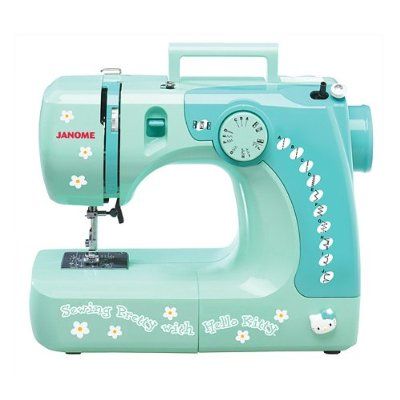
What brought back thoughts of that first machine was something I came across online at Target.com – the Janome 3/4-size Hello Kitty-themed sewing machine. It’s green, but that’s where the similarity ends to my original sewing machine. The shipping weight is less than 14 pounds and the machine measures 10″ high by 5.62″ wide by 12.75″ long. It offers six stitch variations (but you cannot adjust stitch length).
I grew up with Hello Kitty, and I want one almost for the cute factor alone. Who can resist “Sewing Pretty with Hello Kitty,” as is written across the side of the machine?
I wanted to ask the members of the Threads community how they felt about starter machines. What type of sewing machine did you begin sewing on?
Because as cute and as light as they are, 3/4-size machines seem almost like toys. I have heard of many children who took to full-size, full-function machines right away. Is it better to encourage kids with a machine they can easily handle, or will it hamper their creativity to work on a machine with perhaps limited options?
I know I had a healthy respect for my mother’s sewing machine. It was sacred and important, not another toy, but a serious tool. It may have been heavy, but it worked like a charm. And I learned to take care of things and keep them neat for other people.
One last note about starter machines – I read some of the online reviews for the Hello Kitty machine and it was interesting how many sewers said they bought one for a child, but ended up using it themselves because of its portability. How many of you use 3/4-size machines? I wonder if it is enough reason to justify getting one…







That is way too cute, and I probably would use it. I learned to sew on my mom's Singer, which was a cabinet model so it weighed about 400 pounds and had one type of stitch. (Yes, i'm that old!)
when I was in college I bought a Singer Featherweight, also metal but small and portable -- the best sewing machine ever!! I still have it and use it for upholstery and heavy fabrics. My newer one is plastic -- with lots of stitches, embroidery, etc., most of which I find too intimidating to use. So yes, the little Hello Kitty version would be great and I'd probably actually use it.
Several years ago my granddaughter got a "Barbie" one like those advertised on TV to pull out of a desk drawer to sew something at work. It was a nightmare--would hardly sew a stitch & "clattered". My 5 y/o said "it didn't sound right". She preferred sewing on my machine set on her little table to fit her. I will admit they are adorable machines but will they be more frustration than fun? Will they turn them away from sewing because the machine does not work well?
Don't discount this particular machine. I bought a couple of toy type machines for my granddaughter (who sewed her first skirt when she was three) but none compare to this one. The final machine I bought is this Hello Kitty machine. It really is a terrific machine and cute too. My main machines are Bernina's and my granddaughter (9) uses them too, but this her own machine that she can use whenever she wants without bothering her mom. Her mom even uses it sometimes too rather than pull out her big sewing machine!
This Janome machine is really cute, and I'm glad to hear that it works well. Like alotofstitches, I bought my daughter a little Barbie machine when she was turning 5, I think, and between us we managed to sew about 9 inches before it stopped stitching properly. It was so loud and jumpy that it scared her--we never used it again! And while that purchase was a bust, it did get her interested in using my machine, a low-end computerized Brother, which is much easier to handle--all push-buttons with pictures, easy-to-load bobbin, etc. Now we fight over who gets to sew! I wonder if it's time for Hello Kitty to save the day.
I purchased this machine when I found it on clearance at Target. I paid less than $40. and honestly purchased it as a complete impulse. I use it primarily for experimental free motion work as I continually knocked my Pfaff out of time with my rather 'passionate' sewing. :) I have been surprisingly pleased with little Hello Kitty. It sews well, produces an even stitch and threads easily. The accessory box is a bit of a pill to remove and you have to remove it to access the bobbin.
As far as a 'toy' or starter machine for children or beginning sewing enthusiasts....when I purchased my Pfaff, my daughter was 7 years old. I kept my old Kenmore for her to learn to sew on. Once she sewed on the Pfaff though, she preferred the walking foot, the built in needle threader and the capability to have the needle always return to the position that doesn't unthread it. (Sorry, can't the proper name) It was also wonderful to have the ability to slow down the speed of the machine. She doesn't sew much, but once she got the feel of the Pfaff, she didn't want to touch the Kenmore at all! I finally sold the old dear (the machine, not my daughter) to a family with four daughters.
The moral of this tale is that everyone should try out multiple machines and know which features they consider important. Buying a good, steady, even stitching basic machine is fine but do get quality for your money!
By the way, Hello Kitty is quite the conversation starter. She certainly brings a smile to my sewing room.
My tiny machine is an Elan Lotus, purchased on ebay. Actually I have two, the Sp and TSP. It is a very efficient little machine for its size. Unlike the Singer Featherweight, which I also have, the Lotus can zig zag and make buttonholes. I can carry this machine in a carry on suitcase and still have room for my clothes. I don't know if the airlines allow sewing machines as carry-on but I have packed for classes I am driving too.
I learned to sew sometime before kindergarden on an old Singer machine (I don't remember the model). It was electrified, made of heavy metal, operated with a knee lever, and could make only straight stitches without attachments. It had a zipper attachment, and maybe a zig-zag attachment. It belonged to my step-mother, and it was fabulous! It NEVER misbehaved. It's probably STILL working flawlessly. At first I had to sit on some thick books to reach the controls properly.
After a while, a new Singer Touch 'n' Sew came to live at our house. I never liked it. All the sounds it made sounded like plastic! Every machine I've had since then sounds like plastic, too -- not like smoothly whirring metal parts. I was very spoiled by the sounds made by that old machine, and I still long for them...
Singer used to make tiny little machines for children, and I know I had one, but I don't think I ever really used it. I liked the big Singer too much! The Hello Kitty machine sounds bigger and more useful. If it intrigues you, go for it!
I learned to sew on an old metal singer that only had a straight stitch. When my mom upgraded to a Kenmore with decroative stitches on cams I was in high school and making a lot of my own clothes. My step father wouldn't let me come near the Kenmore until I had read the entire instruction book. I think I would have loved to have had my own machine when I was young, I certainly have enough machines now!
I'm happy to hear that the Janome Hello Kitty machine works well as I am a Janome fan. whenever I saw advertisements for those 'toy' type sewing machines, I assumed that they were junk that wouldn't work. I doubt I could use a smaller machine now as I have gotten spoiled by the large throat in my machine, and with large hands and long fingers, I wouldn't want my hands feeling 'squished' when I sew.
My first machine was from J C Penney and was called a 'Swing and Sew". It cost $77 in 1970 It had drop down sides, very light weight, all the tools in the top and it had bright "hippy" flowers all over it. It came with a sturdy folding table for an extra $15. I sold it when I got a Singer Golden Touch & Sew. But, in 1980 I found an Elna "Stella" TSP air electronic which looked just like the Swing and Sew, and it works like a charm. A real workhorse even though it is only about 14 lbs. I have 3 full size machines too (Elna, Viking, Bernina)and someone just offered me a Pfaff from about 1974. I'm eager to see it.
I bought the 1st Janome Gem for my then-teenaged daughter, thinking she could take it to college, but she still doesn't sew. I love it, though it does shift around. The many attachments that go w/ it are great!
I thought I'd take it to quilting classes--so light weight--but my Singer Featherweight is tops!
I don't believe in introducing a beginner to a 'toy' sewing machine. There are parts on the machine that must be understood and respected, and if a beginner looks at it as a toy, what can be learned? I learned on my mom's machine and it was good for me, I was happy she trusted me, and I felt proud.
What I have observed after teaching regularly for four years, is that ages eight to ten is just a bit young for the machine. It's all about hand, eye, foot and brain coordination, far too many things for someone so young to control at once. Better to teach them hand stitching and embroidery as a solid foundation and ease them into the machine later. On the other hand, I have noticed that ages 12 and up who have NOT done hand sewing, and while they take to the machine very well, are not very adept at sewing on a button and are not interested in the calming and joyful skill of hand stitching. This age group wants to rush their projects and get them done too quickly. Just an observation over the years.
I believe a vintage Singer featherweight, would be a great
light weight beginner machine (11 lbs) I take one with me
when we travel by car. Its a great machine and not a toy.
Having already found a Bernina (OLD Style) 830 for my daughter, and having given her a Hello Kitty Waffle Maker for Christmas, I may start looking for this "Toy" for her for her Birthday. A 30 somethings gal can never have enough toys!
As for using a 3/4 machine, I have, and use, an electrified 99 K Singer, in a cabinet. Works great and is just that bit smaller than my full sized others.
I also have a couple of Treadles, a couple of Handcranks, and some more Electrics. I am NOT a Collector; each machine serves a different function. ;-)
Liz
Before I would purchase a toy machine I'd want to sit down and sew on it a bit. My daughter purchased a Brother at JoAnns and I found it very difficult to sew on. She experienced a number of problems with the machine. I think that too many cheap machines have turned off many potential sewers. They struggle with the problems of beginner sewing and also with a balky machine. I don't know what is available from the main sewing machine companies or what their price range is for those machines but before I would invest in Kitty, I would check those out. I did see one episode of Eleanor Burns, Quilt In A Day, and she was teaching one little girl to sew. She was using (I think) a Baby Lock machine. It looked very easy to use and you could adjust the speed of the machine to sew slow or at a normal speed. Instead of a presser foot, the little girl used a stop and start button. I was very impressed with the set up of the machine. It seemed one that you could teach a child how to operate it and then leave them to do their own designing. There was not that much difference between this machine and a machine a few steps up so the learning curve on a more advanced machine would be very different.
I spent a lifetime teaching young children to sew. The thing you always want to remember is that you should NEVER start a young sewer on a machine that does not work properly. Far to many people are afraid to let the youngster try their own machine and give them one that you would not use daily. If taught properly they will not "ruin" a nice machine. It is frustrating enough to learn a new skill without adding a machine that does not work. Somehow I thought that the machine you were featuring was not a toy machine. I guess I missed the description. My experience with toy machines is that they are a plaything and do not sew well. All my beginning students (300 a year) learned on a Bernina. Some were pretty rough on them, but none of them broke a single one.
A beginner must have a machine in good working order, or will be turned off to sewing before (s)he even begins. Adults cannot sew successfully on toy chainstitch battery machines; neither can a child be successful. I love the little Hello Kitty machine I picked up for my 4 year old granddaughter--she will get it eventually. Her first machine will be a 3/4 size vintage Singer 99 that I plan to convert to hand crank. It is very hard to sew over your finger while turning a crank. There are several vintage machines, such as the Singer 99, that can be purchased or converted to handcranks.
honestly, I don't remember which machine my mom was sewing with or what age I was when I started sewing. Mom was a professional seamstress and I grew up under a cutting table!
I was maybe 17 when I bought my 1st machine - used! - a Morse portable that has maybe 5 built in stitches and weighs a TON.
My other machine was also purchased used in 1974 - an Elna Super with a bunch of cams in place of computerized stitches (and weighs a TON). The only part that has broken is the ONLY plastic part. Whenever I get either one tuned up, I'm always told to never get rid of them because they're all metal & will outlast any new machine.
I sure wish I had a featherwieght, too. But I think I might need to get a new computerized machine soon as its getting really difficult to see well enough to thread the needle!
Right now, I find that most of my sewing doesn't need anything too fancy, so have been using my trusty 50 yr old portable. Hello Kitty is sure tempting, though...
There is nothing worse than trying to interest someone (child/adult) in sewing with a machine that is finicky or doesn't work properly. My advice - before buying try it out yourself. If you don't like the way it operates do not attempt to try to teach someone how to sew with it. There are lots of well built nice sewing machines that do not look like toys or behave like them. They don't have to be top of the line, they just need to sew reliably and be easy to use.
I agree cheap toy machines are not worth it. In fact cheap machines are not worth it.
my first sewing machine was a Christmas gift it was, IS an old singer hand crank. Was a child's version of my mothers singer. it was a heavy metal and sewed a chain stitch.
LOVED it. When I first married and needed a sewing machine I dug it out of my mother's attic and set it on my ironing board... too funny when my DH walked in and I was cranking away at a pair of curtians I needed to shorten.. and he thought I had lost my mind.. but it still works today...and was my daughter's intro to sewing too.
my son however.. took it upon himself to learn to sew.. and messed up my mom's good singer.. but he is pretty good and can make what he wants to make... as long as it doesn't have a pattern... LOL
and I agree with the sound of a metal sewing machine. these new plastic ones ... seriously don't seem to sew as long and as well as a good old metal sewing machine.
I learned to sew on my Mothers' old Singer Sewing Machine, it was big, black and heavy and I was 7 years old. Straight stitch only. That was in 1953!
Today I have a Bernina 830 which I am still learning to use but I love it, BUT I go to patchwork group and workshops frequently and then i use my little ELNA Stella Free Arm, very basic, straight stitch, zig zag, and buttonhole, and probably blind hem, not sure, and it is fabulous, easy to transport, very compact, tool in case on top of machine, and I wouldn't be without it.
I would advise anyone who wants to do workshops to hunt for a small machine, Janome Jem Gold or Platinum comes to mind in more modern ones, because of the portability factor.
Just my 2 cents worth.
The machine is cute and sews well - but - for beginners I prefer a larger machine - doesn't move around - and one with a speed control.
My classmate Lu made her Vogue Designer prom dress in her dorm room using a solidly built straight stitch sewing machine the size of a child's toy. This was the early 60's and Lu had a Holly Golightly look already. The dress was gorgeous, showcasing lace with the scalloped border at the bottom edge of an empire bodice and at the knee-length hem. And Lu was the most glamorous young lady at the prom that year. None of us will ever forget the transformation of several pieces of cloth & thread put together on a toy machine in a dorm room by a talented visionary who resembled Audrey Hepburn. Yes, you can sew something extraordinary on a "toy" machine.
My first machine was a tiny Singer hand machine from my mothers childhood.I still have it & it still does a great chain stitch. I then graduated to a large heavy Dutch hand machine creating so many Cindy dolls clothes. At school hated sewing as I could only get the treadle machine to go backwards no matter how hard I tried . More than half way through the year I was allowed the electric machine.Bliss. I now have a Bernina 1130 & Janome plus a cover stitch & serger but the most important thing is i am still sewing & enjoying it .
As cute as these machines are - they are not worth your time nor money. My sister and I purchased a couple of these "child-sized" machines in preparation to teach young children to sew, but once we had them and started to play around with them, we took them back. The machines clunk, stitching tension is almost impossible to correct. Others may find more success.
I have found that the greatest frustration in learning to sew is using a machine that constantly needs fixing. The individual finds no joy, and is discouraged to try again. So it is far better to have a simple machine that works well - such as the Singer Featherweight, or an older "metal" machine that is steady and true.
I teach beginning sewing, and owners classes at a local machine shop. I've heard many stories of dissappointment using this very sub-standard machines. The aggravation of using a cheap (cute does NOT mean that it works well!) machine is often enough to turn off today's short-attention span youngster from every trying sewing again. The BEST machine is mom's, used with mom's guidance. The next best thing is a structured teaching environment, where machines are provided and the class is taught by someone experienced in teaching youngsters - in a fairly small (under 6 kids) class... a hard thing to find. When your child is ready to sew - visit your LOCAL sewing dealer, ask them what machines they recommend for youngsters, get a demo, use the machine yourself, and buy a machine that has at least a 1 year warranty on parts and labor - anything else will not be worth the money or time spent. Expect to spend $140-150.00. $200 is better. Don't buy a machine with an old style bobbin and bobbin case - a drop in bobbin is easiest to learn. Start with easy projects - for example a pillowcase, or a small drawstring bag... and MOST important..HAVE FUN!
I am a firm believer in learning to sew on a full size machine. I learned to sew at about 6 by hand and about the same time on my grandmother's treadle machine. My nex machine was an old Montgomery Ward's machine. It was a work horse but only did a straight stitch. My grandparents got me a Singer Touch and Sew that I used through junior and senior high school and college. When I started working I bought a Pfaff 1222, still have it and it works great. I have kept all my Pfaffs (3) and now have a Babylock Ellisimo. I wouldn't hesitate to start a youngster on any of the Pfaffs or the Babylock. My best friend from high school hates to sew, but she is working on machines from the late 40's, early 50's (not a Featherweight) that cause her problems all the time. No wonder she hates sewing. Just can't convince her to get a new machine.
As far as a small machine for class, I use my Pfaff 7570. I have a great hard sided rolling case that makes travel easy. Just have to lift it in and out of my Wrangler and lots of times, there's a guy at the quilt store to do that for me, if I ask. (and I have one at work, too, so that I can sew at lunch - the jooys of being a pack rat)
There is NOTHING like good tools to make sewing enjoyable! I have taught hundreds of children and adults to sew, and like many of you I started on my mom's full size machine. I remember "back in the day" that kids machines were really just frustrating toys. Today the new smaller machines which work well, but do very basic stitches, are a way to teach how to care for a machine and do the basic length and width stitches without a huge investment. My favorite "little" machine in the Janome Mini ( http://twowildflowers.typepad.com/two_wildflowers/my-sewing-room/ ) you can see it for size against a standard size sewing machine. I use it when I sew crafts with my grandkids! While it does not have lots of options (Janome saved money by no light and is meant to use just one basic foot), it is not too confusing for a little one. I paid less than $50, which is much less than one trip to a sewing machine repair shop in most cases!
Sometimes when I only need to make a seam of two with a standard machine, while using my serger, I often pull out this little light weight (5lbs) jewel for use.
I don't think this machine should be considered a toy machine as it sews quite well and is light and easy to use. Don't be fooled just because it is "cute" doesn't mean it is a dinky toy. I found a Miss Kitty machine like the one shown at a Goodwill Store, ordered the pedal and electric cord on eBay and had a nice machine for $59. I was planning to give it to my grandaughter but I like it and decided to keep it. Her mother does not have time to teach her and I live in another city so I can't. Eventually I will give it to her but for now I like to use it for quick tasks. I have a Bernina 830 which is my main machine, an old Kenmore with the embroidery cams (it is so heavy!!) a Singer that I bought at Goodwill, a White which I bought for $7.99 when I worked out of town and needed to alter some scrubs and three sergers. I am a sewing machine junky!
I started sewing with my mother's old Singer (heavy black and gold, before they sold their name), but it was in a cabinet and we didn't have to put it away. I have never resorted to keeping a sewing machine in the closet - it's an important part of my decor! *laugh*
I teach sewing at a store. When the kids want to learn how to sew, and all they have are the beginner machines it is more discouraging than helpful. These machines sew only light cotton fabric successfully. Only one (I don't remember the make) was able to sew actual clothes. Most of the time the machines jam or are not strong enough to pull the heavier fabric through. I advise my students to use a full size machine. I would like the experience to be a positive one rather than a frustrating one.
My mom bought me a 3/4 Singer when I was 7 years old and expressed an interest in sewing (everyone in my family sews, knits, crochets, does needlepoint) so I really had no choice! My mom assumed that I would start with doll clothes, but I got ambitious and wanted to make myself a dress. She bought me the pattern and the fabric and told me that I should try to do it myself. Well, I did, and it came out well enough that I wore it to school! She was so impressed that she let me use her big Singer (yes, another 400 lb monster) - it was beige and made entirely of metal. I used the little one for years for doll clothes until I outgrew it, but never lost my love of sewing!I now have 2 Berninas and a BabyLok Quilter's Pro Choice, but I would consider this machine for quick mending projects. Besides, it is just TOOOOOO cute!
I had a toy sewing machine which made a chain stitch, but did not find it very useful. At about 7 or 8 I did learn to do hand stitching and embroidery with my sisters and friends. However, when I was 12 I went to a Home Show with my dad and I took a chance on a sewing machine with my 50 cents. Amazingly, I won it! My mom was very busy with 7 other children (I am #2) so she bought me a pattern and some fabric and said, "You can read, see what you can do". The machine was a basic straight stitch Pfaff, but I made shorts and shirts for myself, my sisters and all my friends. I learned to make bound buttonholes, and all sorts of other tricks from a book in the library. Fifty years later, I have a much better machine, plus 2 old ones and 2 sergers and an embroidery machine. I cannot imagine not being able to sew. One of my favorite things, is to "save" something from the rag bin, or give old clothing new life. Nothing seems to phase me - I have made beautiful wedding dresses and re-vamped old kilts. All my siblings know that they can count on me to repair "anything" they have. My most important advice to a new sewer - take the chance! If you are afraid you will make a mistake - don't worry; ANYTHING is salvagable. And you never know, you might even like it better!
actually, I am not an advocate of the smaller machines. Or am I an advocate of the very cheap machines. You really do get what you pay for in a sewing machine. I'm also not an advocate of buy sewing machines and any place other that a sewing machine distributor unless you have sewn for many years and can figure out on your own what to do with the machine. You can buy some very good, lower priced name brand machines, you don't have to have top of the line, but good quality is IMPERATIVE.
You also need a buttonhole application and a zig zag stitch.
The help that comes with buying a machine from a good distributor is priceless.
I have taught kids classes and adults where I would p/u older machines at garage sales and my husband would do maintanence on them, but if you want you own machine, do definitely buy a quality name. The stress it will save you is WELL worth it.
I have been sewing for money for over 45 yrs and have tried all kinds of machine. I always my friends when they ask, buy the best you can!
The Hello Kitty machine is very cute, but I'm not sure that
it will sew as well as a full size machine. I learned to sew
with an old black Singer model 66 in junior high school. At home there was my Mom's Singer Golden Touch & Sew. Oh my I
hated that machine! It was loud and just a cranky machine.
I didn't love sewing until I bought a used Singer 717 school
machine, it sewed wonderfully. I traded the 717 for a new
Singer 6212 that was trouble from day one, after 2 years of frustration; I taught it to fly and the next day I bought a wonderful Bernina 1031 that was heavenly to sew with.
Nothing worse than using a machine that is problematic and oh
so frustrating to use.
I have been sewing for over 40 years and taught my daughter to sew with my Bernina 1031, she fell in love with it and has had 2 older Berninas of her own, she sews wonderful garments. She just turned 23.
I started sewing in the 7th grade on a Singer Industrial machine. The table that held the motor was large enough that I needed a "booster seat" to reach the sewing machine bed to use it. :)! I am a very petite adult (technically not quite a "little person") and when I was 19, I moved into my first apartment. It was quite small and the only room I had for a sewing machine was a corner of the bedroom. My mother was not about to give up her Singer 401A to me so I purchased a Singer 717 with a cabinet that doubled as a table and a Greist button making attachment. It was just the right size for me to use and gave me a good 10 years of wonderful sewing. I traded it in for my Bernina 930 and as wonderful as that machine is, I missed the ease of using a smaller machine. In 2007 I purchased a Janome Jem 720. It only weighs 11 lbs and can be brought out of the case in a flash when all I need to do is something quick. I know that learning on a "toy" machine probably would not have given me the satisfaction that a smaller "real" machine always has.
I learned sewing at school with an electrical sewing machine, made the required skirt and that was it - simply no fun - but at home I learned it on my grandma's sewing machine - think 1800 and no electricity.
This machine had a great wheel that got turned by working the metal plate with your feet up and down - which in turn moved the needle up and down - but the machine was really "modern" it even had a zig-zag-stitch. And the machine went as fast as you worked with your feet - from very slow to quite fast.
35 years later I got tempted to sew again but the modern machines were way too complicated for me - I bought one and got really frustrated. So I started sewing by hand.
And then I saw a Janome Mini Sew Deluxe and bought it - I thought "if it is for kids even I should be able to work with it". That machine was slow enough for me - not too complicated with the stitches (and for such a small machine there are quite a few) and very sturdy (worked through 4 layers of lightweight cotton fabric) but you could lift the machine with one hand.
I sew clothing for dolls so as a starter machine it was perfect. Now I own a Janome 415 because the little one wasn't enough any longer. Still a mechanical sewing machine but that works best for me. Maybe in a few years I'll buy a computerized one.
But for just sewing an open seam closed or hemming something I still use the little Janome - it's faster than taking the "real" one out. And I can use the same bobbin for both of them.
I learned sewing at school with an electrical sewing machine, made the required skirt and that was it - simply no fun - but at home I learned it on my grandma's sewing machine - think 1800 and no electricity.
This machine had a great wheel that got turned by working the metal plate with your feet up and down - which in turn moved the needle up and down - but the machine was really "modern" it even had a zig-zag-stitch. And the machine went as fast as you worked with your feet - from very slow to quite fast.
35 years later I got tempted to sew again but the modern machines were way too complicated for me - I bought one and got really frustrated. So I started sewing by hand.
And then I saw a Janome Mini Sew Deluxe and bought it - I thought "if it is for kids even I should be able to work with it". That machine was slow enough for me - not too complicated with the stitches (and for such a small machine there are quite a few) and very sturdy (worked through 4 layers of lightweight cotton fabric) but you could lift the machine with one hand.
I sew clothing for dolls so as a starter machine it was perfect. Now I own a Janome 415 because the little one wasn't enough any longer. Still a mechanical sewing machine but that works best for me. Maybe in a few years I'll buy a computerized one.
But for just closing an open seam or hemming something I still use the little Janome - it's faster than taking the "real" one out. And I can use the same bobbin for both of them.
I learned sewing at school with an electrical sewing machine, made the required skirt and that was it - simply no fun - but at home I learned it on my grandma's sewing machine - think 1800 and no electricity.
You worked a metal plate with your feet up and down - which turned the great wheel at the side of the machine and in turn moved the needle up and down - machine even had a zig-zag-stitch. It went as fast as you worked with your feet - from very slow to quite fast.
35 years later I got tempted to sew again but the modern machines were way too complicated for me - I bought one and got really frustrated. So I started sewing by hand.
And then I saw a Janome Mini Sew Deluxe and bought it - I thought "if it is for kids even I should be able to work with it". That machine was slow enough for me - not too complicated with the stitches (and for such a small machine there are quite a few) and very sturdy (worked through 4 layers of lightweight cotton fabric) but you could lift it with one hand.
I sew clothing for dolls so as a starter machine it was perfect. Now I own a Janome 415 because the little one wasn't enough any longer. Still a mechanical sewing machine but that works best for me. Maybe in a few years I'll buy a computerized one.
The Hello Kitty machine is awsome!! I first encountered it a few years ago when one of my adult students brought it to class. I have since purchased it for our daughter who is now 8 and she loves it. It has all of the features that a beginning sewist would ever need and is easy to operate and relatively maintenance free. I would definitely recommend it for any beginner. As far as beginning machines go, (3/4 size vs full size) I don't think that it is the size that is important but rather the features that the machine includes.
As far as the "olive green monster", I have several of these in my studio and use them when I teach a group of students. I had never before seen this machine until a few years ago and when I purchased my first one ( I absolutely love the colour green!!) It also uses the same low shank attachments as the singer featherweight. Yes it is heavy but if you don't have to move it around too much it is a great basic machine.
My Mum doesn't sew at all but she did have an old brother sewing machine that she had bought in the 70's when she was in college and when I was about 12 she said that I could use it so I gave it my best shot- no instruction manual, no help from Mum... even after having the machine serviced I could never get a decent result- I didn't know how to change the bobbin thread tension and couldn't understand why I had such a mess on the back of my sewing. No one in my extended family sewed either so there was no one to help me out. I struggled on with the machine anyway until I was about 16 when my parents gave my sister and I a Janome Jem Gold for Christmas as a joint present. Initially my sister preferred to sew by hand anyway (period costume in her own size for the most part) so I had the machine to myself and it really was a wonderful beginner's sewing machine. When I was about 19 I bought my own machine- the Toyota Quilt50 because I wanted a machine with quilting capabilities... and I really don't like it. It sews well enough and hasn't needed much servicing but it is unbelievably loud and clunky and it walks while you sew. Also I quickly found that I far prefer hand quilting anyway so I never use it to quilt- it really makes me wish I'd spent the money on a different machine. Perhaps one day when I find I have enough money to spare I'll look into a new machine and I'll research it better.
The only thing I dislike about the Kitty as a learner machine is the inability to vary the stitch length- I think it would be good for some applications but it wouldn't really take long to get to a point as a sewer where you needed more flexibility.
I'm about to open a sewing studio and give classes for tweens up to adult. As a former costume designer & current college adjunct in fashion, I've worked on a lot of different machines. My old Bernina, record 830 is tops. But I can't afford Berninas for my school. What do any of you who've run classes suggest for a very durable, yet inexpensive machine? I've been offered to rep for Brother. What is the general opinion of their models? Someone else in town sells Janome, so I'd rather not be in competition with them. Thanks!
I have my very first machine to this day. It is a Singer treadle machine my mother bought at a tag sale. I used it for probably 5 years and then graduated to an electric machine (very exciting). Also a Singer, also still with me, it was a Singer 201. I sewed with that machine for another 15 years. Neither of them did anything but sew forwards and backwards, but I learned to do everything that way. I made all bound buttonholes, french seams to finish seams (even cuordoroy if you can believe that). I have a weird buttonhole attachment that worked on both machines by moving the fabric back and forth instead of the needle.
Since then, I have had the pleasure of working with my beloved Bernina 1130 and Janome 10000 (50th birthday present). They both sew like a dream and can do remarkable things. But the skills I developed making everything from silk lingerie to winter coats with those old basic machines have never left me. And I use the straight stitch 80% of the time to this day. So don't worry too much about the bells and whistles.
I have a similar 3/4 15-yr-old Jaguar Mate and it is still going strong. It's adorable, portable and was the perfect machine to learn on. It has features that I don't see on more expensive full-size machines: adjustable needle position and presser foot pressure.
Don't let the cuteness fool you!
I teach kids sewing classes (40 kids a week)and know from experience that cheaper machines frustrate the kids. Last year I purchased better quality machines with speed control and what a difference it made in my classes. My students stay within 5/8" and even 1/4" seams and they are straight. I have seen many students struggle with controlling the speed and accuracy with machines that don't have speed control. They become very frustrated and want to use my machines instead of their own.
With cheaper machines (which some of my students bring in the ones they got as a gift)the students hear the difference in quality right away. "I can tell my machine is not as nice as yours by the way it sounds" Cheaper machines often can't handle thicknesses in fabric and can't sew many of the stretch and micro fabrics without skipping stitches.
Sewing Mechanic don't repair cheaper machines bought in box stores. They consider them "throw away" "disposable" machines that are only good till the tensions go out or something breaks.
Besides being a garment sewer I am a quilter. This light weight machine is great to take to quilting classes and you can put on the generic 1/4" presser foot with guide for perfect seams. It beats purchasing the expensive Singer (the black antique model) if it is not in your budget.
I bought $100 Walmart Brother machine for $10 at a yard sale when pregnant with my daughter. She'll be 21 in June and I've never had any problems with my cheapo find!!! It's helped me make baby clothes, curtains, pillows, blankets, pageant clothes, dance costumes, cheerleading uniforms, basic hems, repairs, etc...from the finest chiffon to the thickest denim! I've considered getting a new machine, but I'm a simple person and if it's still working, I see no need in replacing. (btw I'm still using my 23yo whirlpool washer and dryer too lol)
thnks for sharing
That is way too cute,